
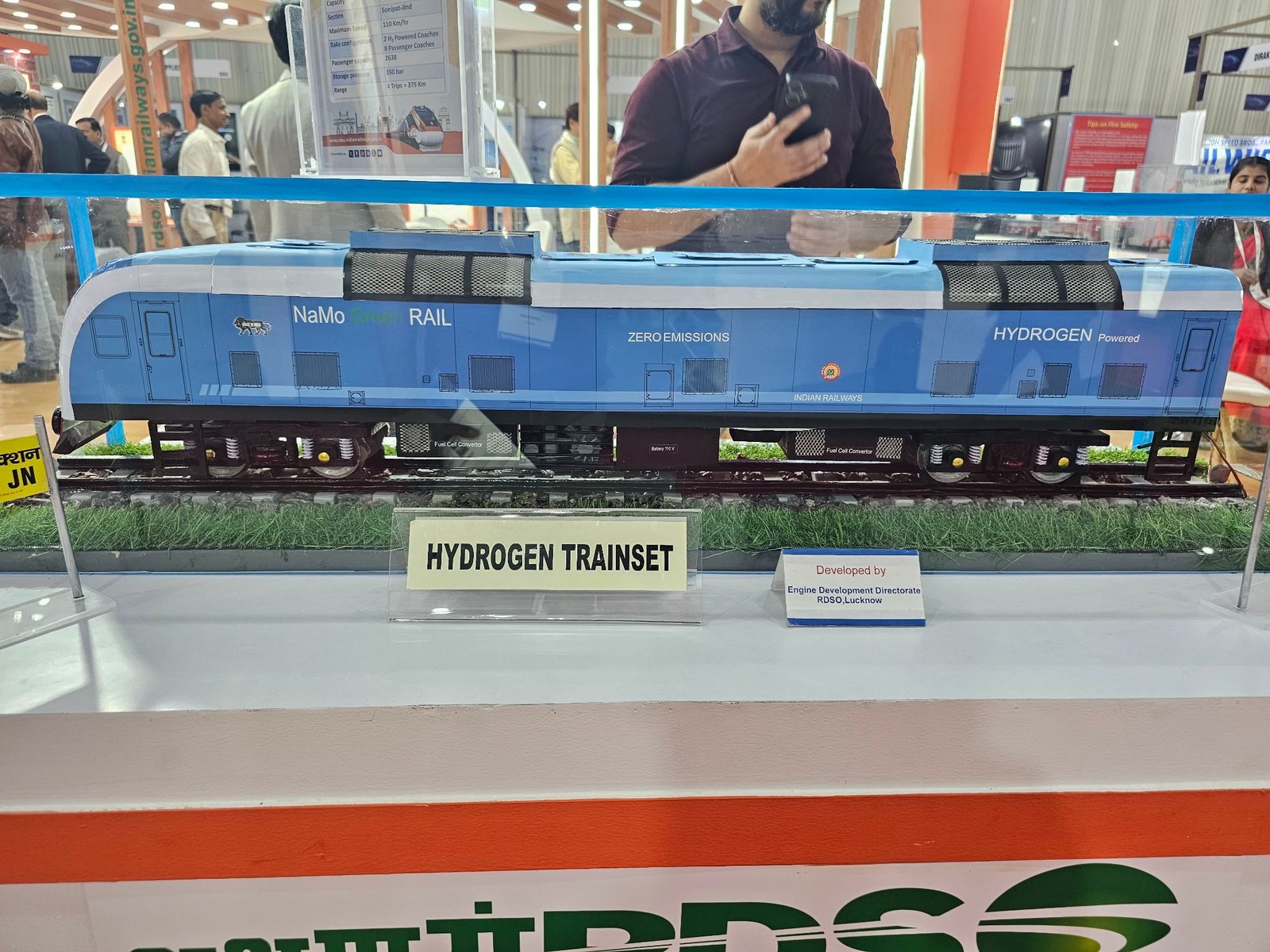
India’s clean-energy experiments are rolling – and driving – into new territory. The Indian Railways recently tested its first hydrogen-powered train, promising a future of “zero-emission” travel on tracks that crisscross the subcontinent. Meanwhile, high up in Leh, Ladakh, public buses are running on hydrogen fuel, part of a pilot project by NTPC that’s being lauded as a glimpse of green transport in one of the world’s most difficult altitudes and terrains.
It sounds like a clean, futuristic vision – locomotives and buses puffing only water vapour instead of diesel fumes. But how green is hydrogen, really? As India dives into the hydrogen race, experts say not all hydrogen is created equal, and the environmental math behind these shiny new projects may not add up.
This fact-check looks beyond the hype to examine whether India’s hydrogen-powered trains and buses are genuine climate solutions – or just well-meaning but misguided detours on the road to sustainability.
To find out, we dug into what hydrogen really is, how it’s made and where it makes sense to use it. The short answer: while hydrogen can play a role in cleaning up some hard-to-decarbonize sectors, running trains and buses on it may not be the climate win it is made out to be. Here’s why.
What hydrogen really is, and isn’t
Hydrogen is the lightest, most abundant element in the universe – and also one of the most misunderstood. On its own, it’s a colourless gas, but in the world of clean energy, it’s often assigned colours that describe how it’s produced.
Most of the hydrogen used today is grey hydrogen, made by splitting natural gas in a process called steam methane reforming. It’s cheap but dirty, releasing large amounts of carbon dioxide – one of the main global heating culprits. There’s also blue hydrogen, which uses the same process but captures and stores those emissions underground (as “carbon capture and storage”, an expensive proposition so far). The cleanest form is green hydrogen, produced by splitting water into hydrogen and oxygen using electricity from renewable sources like solar or wind.
In theory, only green hydrogen delivers on the “zero-emission” promise. But in practice, most of the world’s hydrogen – and nearly all of India’s – is still made using fossil fuels.
The energy equation
Even when (green) hydrogen is made cleanly, it’s not exactly efficient. Producing green hydrogen takes electricity – a lot of it. Then, converting that hydrogen back into energy (as electricity in a fuel cell or engine) loses even more energy along the way.
By some estimates, hydrogen vehicles use up to three times more electricity per kilometre than battery electric vehicles. That’s because every step – from electrolysis to compression, transport and reconversion – eats away at the original energy input.
In other words, if you can power a train or bus directly with electricity (given the fact that more than 90% of our railway network is already electrified), it’s usually far more efficient than making hydrogen just to turn it back into electricity later.
Why hydrogen still has a role
That doesn’t mean hydrogen is useless – far from it. It can be a game-changer in places where batteries simply don’t work well: think steelmaking, shipping or long-haul aviation, where the energy density and weight of batteries become major hurdles. Hydrogen can also help store renewable energy for later use, smoothing out the peaks and troughs of solar and wind power.
But for everyday transport – like trains running on fixed routes or city buses – hydrogen’s advantages aren’t impressive, given the fact that battery prices are dropping rapidly and much of India’s rail network is already electrified. Against that backdrop, hydrogen starts to look like an expensive detour rather than a leap forward.
So yes, if you can directly use that renewable electricity – say, to power an EV or heat a building – that’s usually much more efficient than turning it into hydrogen first.
| When Green Hydrogen Makes Sense — And When It Doesn’t | |
|---|---|
| When it doesn’t make sense | When it does make sense |
| In most everyday energy uses, hydrogen is a bad idea compared to direct electrification:
Cars, buses, homes and power grids are better off electrified directly. Every step of converting renewable energy -> hydrogen -> back to electricity or motion loses energy. Hydrogen also has storage, leakage and transport challenges, since it’s the smallest molecule and can escape through pipelines or storage units. |
Green hydrogen is crucial for the hard-to-decarbonize sectors where direct electrification isn’t practical. Think of it as a niche but vital solution:
Fertilizers and chemicals Long-haul transport Heavy industry Energy storage |
The sensible view
Think of green hydrogen as:
A specialty tool, not a universal solution.
Worth investing in for specific sectors, but not for general energy use.
Still expensive, but costs are falling as electrolyzers and renewables scale up.
Many experts compare it to early solar or wind: inefficient and costly at first, but improving fast.
In India’s case
India’s National Green Hydrogen Mission aims to produce 5 million tonnes per year by 2030, mainly for:
Green ammonia exports
Cleaner steel production
Reducing LNG imports
That’s sensible – if the hydrogen goes to industries that can’t electrify otherwise.
Grey vs blue vs green hydrogen
| Type of Hydrogen | How It’s Made | Emissions Profile | Typical Use |
| Grey Hydrogen | From natural gas (methane) using steam reforming | ⌠High CO₂ emissions | Fertilizers, refineries, chemicals |
| Blue Hydrogen | Same as grey, but with carbon capture and storage (CCS) | ⚪ Moderate (partial CO₂ captured) | Transition fuel for industry |
| Green Hydrogen | From water electrolysis using renewable power | ✅ Zero direct emissions | Green steel, ammonia, clean fuels |