
India’s solar manufacturing story is entering a new phase. After a decade of relying heavily on imported equipment, the country has spent the past few years trying to build its own solar manufacturing ecosystem through policies such as the Production-Linked Incentive (PLI) scheme and the Approved List of Models and Manufacturers (ALMM). The strategy has transformed India into one of the world’s fastest-growing solar module manufacturers, with domestic capacity rising to around 193 GW. But a critical gap remains: India can manufacture only about 30 GW of solar cells, the semiconductor devices at the heart of every solar panel.
This mismatch is now being tested. Since 1 June, many new solar projects covered under the government’s ALMM List-II rules can no longer use imported solar cells, marking the country’s boldest push yet to localise a more technologically demanding part of the solar supply chain. Unlike earlier policies that encouraged domestic assembly of modules, List-II requires the cells inside them to be made in India.
The objective is to strengthen India’s energy security, reduce dependence on China and build a globally competitive manufacturing base. But the transition comes with immediate trade-offs. Domestic cell production remains limited, newer technologies are still being scaled up, and industry players warn that higher prices and supply constraints could temporarily slow solar deployment, particularly in the commercial and industrial sector.
India’s solar success still depends on China
India’s installed solar capacity has grown from almost nothing around 2010, when the national solar mission was launched, to 162 GW as of 30 June 2026 making the country the world’s third-largest renewable energy producer. Solar is also central to India’s goal of installing 500 GW of non-fossil fuel capacity by 2030.
Yet much of that success rests on an uncomfortable reality. India remains heavily dependent on imported solar components, particularly from China, which accounted for over 60% of the country’s solar imports in the last quarter of 2025. Across all imports during that period, solar cells made up 79.2% while finished modules accounted for the remaining 20.8%.
For a country that sees solar power as both a climate imperative and a pillar of its energy security, this dependence has become a strategic concern. If supply chains are disrupted or geopolitical tensions escalate, India’s energy transition could become vulnerable to events beyond its control.
India is not unique in facing this challenge. The United States, Germany and Japan also rely heavily on imported solar equipment. Even China, which manufactures more than 80% of the world’s solar products, imports critical upstream raw materials such as high-purity quartz and silver.
To understand the government’s latest policy push, it helps to see how a solar panel is made.
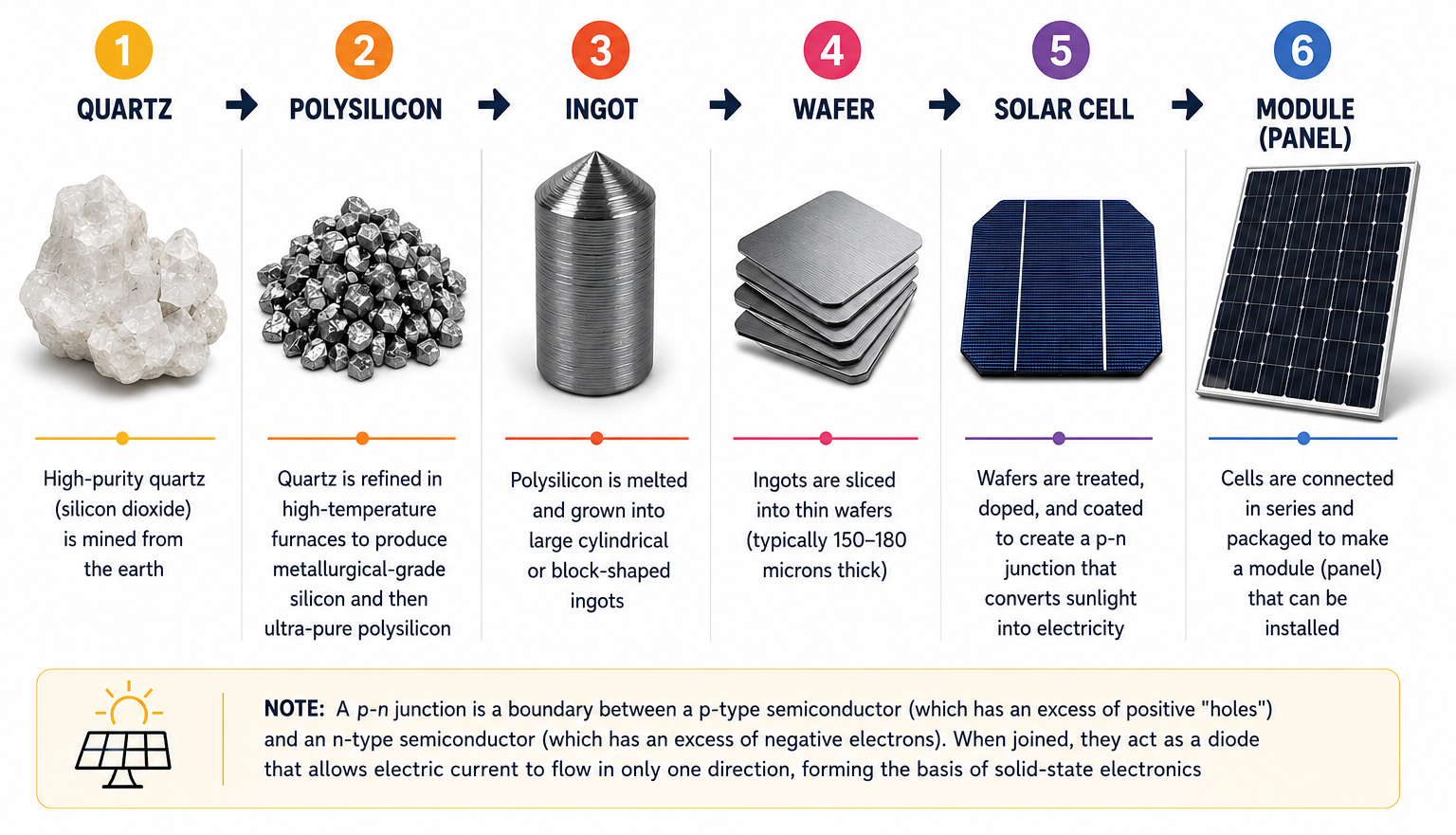
This image has been generated with AI.
India’s manufacturing strategy is essentially to move backwards through this supply chain. It first encouraged domestic production of finished solar modules. Now it wants manufacturers to make solar cells at home. Eventually, the ambition is to localise the entire value chain, from raw materials to finished panels.
| Table: The world’s largest solar markets depend on imports | ||
|---|---|---|
| Rank | Country | Solar capacity & Import status |
| 1. | China | ~600+ GW — Minimal solar equipment imports; manufactures most cells/modules domestically, but imports upstream raw materials like quartz and silver |
| 2. | USA | ~220 GW — High dependence on imported panels and cells imported from Indonesia, Laos, Vietnam and India among other countries (33 GW of panels + 21 GW cells imported in 2025) |
| 3. | India | ~162 GW — High dependence; China accounted for ~61.8% of solar imports in Q4 2025 |
| 4. | Germany | ~100+ GW — Significant dependence on imported Chinese modules and inverters |
| 5. | Japan | ~90 GW — Heavy dependence on imported modules/components, particularly from China |
What is ALMM and why does it matter?
To reduce its dependence on imported solar equipment, the Indian government has spent the past few years trying to build a domestic manufacturing ecosystem. Its primary policy tool is the Approved List of Models and Manufacturers (ALMM), which specifies which solar components can be used in certain categories of projects.
The first phase, known as ALMM List-I, was introduced in 2021 and applied to finished solar modules. Projects ccould procure modules only from manufacturers approved by the Ministry of New and Renewable Energy (MNRE). The idea was simple: create assured demand for locally made modules and encourage companies to invest in manufacturing capacity.
The policy appears to have worked. When ALMM List-I was first notified, India’s approved domestic module manufacturing capacity stood at just 8.2 GW. By March 2026, it had grown to around 172 GW, transforming India from a largely import-dependent assembler into one of the world’s fastest-growing solar module manufacturing hubs.
“ALMM-I changed the dynamics for all local solar module manufacturers overnight,” says Amit Barve, CEO of Rayzon Solar, one of India’s largest ALMM-listed manufacturers. The policy shifted demand away from cheaper imports towards domestically produced modules, he says, opening up significant opportunities across both government and private sector projects.
His only criticism is that implementation timelines kept shifting. “The government should have stuck to the declared timelines rather than postponing the initiative a few times,” he says.
Having succeeded in expanding module manufacturing, the government is now turning its attention to the next and far more technologically demanding stage of the supply chain: solar cells, the semiconductor devices that convert sunlight into electricity.
That is where ALMM List-II, which came into effect on 1 June 2026, enters the picture.
What changes under ALMM List-II?
While ALMM List-I focused on finished solar modules, ALMM List-II moves one step further upstream to solar cells, the components inside a module that convert sunlight into electricity.
From 1 June 2026, solar projects covered under the ALMM framework must use modules manufactured with domestically produced, ALMM-approved solar cells. In effect, developers can no longer import cheaper foreign-made cells and assemble them into compliant modules.
| ALMM List-II applies to: |
|---|
|
If a project covered by ALMM rules is commissioned after 1, the solar modules used in that project must contain domestically manufactured cells approved under ALMM List-II.
For projects covered under these categories, compliance is now mandatory. The policy marks a significant shift in India’s manufacturing strategy. Having successfully expanded domestic module production under ALMM List-I, the government is now attempting to build capacity in a far more sophisticated segment of the solar supply chain.
Unlike module assembly, manufacturing solar cells requires advanced technology, greater capital investment and more complex production processes.
That distinction helps explain why List-II has generated far more debate than its predecessor.
India doesn’t yet make enough solar cells
The challenge is whether India’s manufacturing ecosystem is ready.
While domestic solar module manufacturing capacity has expanded to around 193 GW, India’s solar cell manufacturing capacity remains far lower at between 27 GW and 31 GW, depending on the estimate.
“India-made cells and modules can cost more,” says Charith Konda, Energy Specialist at the Institute for Energy Economics and Financial Analysis (IEEFA).
Just how much more became part of a legal challenge filed before the Karnataka High Court in June, days after ALMM List-II came into force. Industry associations from Karnataka, Kerala and Tamil Nadu argued that domestically manufactured solar cells were selling for around Rs 12 per watt, compared with approximately Rs 5 per watt for imported alternatives. They have asked the court to defer implementation of List-II until domestic manufacturing becomes more competitive in terms of capacity, technology and price.
The petition does not challenge the government’s broader objective of building a domestic manufacturing base. Instead, it argues that the industry needs more time for local supply to catch up with demand.
The challenge extends beyond capacity alone. Much of India’s existing cell manufacturing is based on Mono-PERC, an older technology that is gradually being replaced worldwide by TOPCon, a newer cell architecture that delivers higher efficiencies and better performance. Chinese manufacturers have already scaled up TOPCon production, while India’s transition is still underway.
As a result, developers seeking the latest, most efficient solar technology may find few compliant domestic options. Using older-generation cells may satisfy ALMM requirements, but it can also affect project economics because even small improvements in efficiency translate into higher electricity generation over the lifetime of a solar plant.
The petition in the Karnataka High Court echoes this concern. Although India’s listed manufacturing capacity appears substantial on paper, commercially available TOPCon capacity is concentrated among a small number of manufacturers and remains insufficient to meet market demand.
Manufacturers, however, are more optimistic. Rayzon Solar, for instance, says it is in the advanced stages of commissioning a 5.1 GW TOPCon solar cell manufacturing line.
“We do not see a foreseeable supply chain squeeze,” says Amit Barve, the company’s CEO, offering a markedly more optimistic assessment than many developers and EPC companies.
Small EPCs could bear the brunt
For India’s hundreds of small and medium-sized engineering, procurement and construction (EPC) companies, ALMM List-II comes at a time when margins are already under pressure from a series of regulatory and market shifts.
Bhupesh Trivedi has worked in the solar industry since 2008, watching it evolve from a niche sector of rooftop pilots and donor-funded projects into a 162 GW industry. His Maharashtra-based firm is a seven-member EPC company that primarily serves commercial and industrial (C&I) customers.
Asked how business has changed since ALMM List-II came into force, his response is unequivocal.
“Stress is now all-pervasive. There is no business as of now because of price and regulatory changes.”
Unlike the rollout of ALMM List-I, Trivedi says the latest transition has coincided with multiple policy changes that are hitting developers simultaneously.
When List-I was introduced, import duties on both solar modules and cells had already increased significantly. By the time the domestic sourcing requirement became mandatory, much of the price adjustment had already been absorbed by the market.
“This time,” he argues, “the industry is facing a fresh cost increase alongside several other regulatory changes.”
Those changes include mandatory energy storage requirements in some projects, reduced banking facilities, peak-hour restrictions and tighter limits on system sizing. Individually, each affects project economics. Together, they make new commercial and industrial solar projects significantly harder to finance.
“It is all adding up at the same time,” says Trivedi.
He believes the impact could spread beyond Maharashtra as more states revise banking rules and introduce time-of-day electricity pricing, reducing the financial benefits that have traditionally driven commercial and industrial solar adoption.
The residential rooftop market, however, appears relatively insulated.
Domestic Content Requirement (DCR) rules have already applied to many residential installations for several years, and homeowners continue to benefit from favourable net metering policies that allow surplus electricity to be exported to the grid.
“The IRR squeeze affecting commercial and industrial projects is not, at least for now, a residential story,” Trivedi says.
How ALMM List-II favours large manufacturers
Every industrial policy creates winners and losers. Under ALMM List-II, the immediate winners are likely to be vertically integrated manufacturers that produce both solar cells and modules.
Unlike module assembly, solar cell manufacturing requires significant capital investment, sophisticated technology and years of operational experience. That creates a natural advantage for large companies with deep pockets and integrated production facilities.
Charith Konda of IEEFA says a certain degree of industry consolidation is inevitable as India moves up the solar manufacturing value chain. But he cautions that policymakers must also ensure enough competition over the long term to prevent a handful of companies from dominating the market.
Manufacturers, however, argue that the policy provides exactly the certainty they need to invest.
Rayzon Solar’s Barve believes the government has given the industry sufficient notice before implementing ALMM List-II. Going forward, he says, the most important requirement is policy stability.
“If similar timelines are announced well in advance and stakeholders are involved in the decision-making process, companies can plan investments with confidence,” he says.
For manufacturers investing billions of rupees in new factories, predictable policy can be as valuable as financial incentives. Frequent changes or delays make it harder to commit capital to projects that may take years to become commercially viable.
That is why companies such as Rayzon are already expanding into advanced technologies like TOPCon cells, betting that India’s push for domestic manufacturing is a long-term strategy rather than a temporary policy experiment.
Can India build a solar supply chain without slowing its energy transition?
India’s solar deployment has shown little sign of slowing so far. In the first quarter of 2026 alone, the country added a record 15.3 GW of solar capacity, a 143% increase over the same period a year earlier.
At first glance, that suggests the industry has absorbed the transition with little disruption. But it’s less straightforward than this suggests.
According to Mercom, much of the record installation was driven by developers rushing to commission projects before ALMM List-II came into force and before transmission charge waivers expired. In other words, developers accelerated installations to avoid higher costs and tighter sourcing requirements.
That means the record-breaking numbers may say more about projects being brought forward than about the industry’s ability to sustain the same pace under the new rules.
The broader objective of ALMM List-II is difficult to dispute. Few countries are comfortable depending on a geopolitical rival for a technology that has become central to their energy security. As the United States and Europe introduce their own incentives to localise clean energy manufacturing, India is following a similar path.
This requires careful balancing. Domestic manufacturing capacity is expanding rapidly, but has yet to catch up with demand. Until it does, developers, EPC companies and consumers are likely to bear higher costs, while manufacturers invest in building the supply chains that the government hopes will eventually make India more self-reliant.
Sonam Raina is a Bengaluru-based Independent writer and reporter covering sustainability in business.
Inspired to Take Action?
Tl;dr: A summary for the busy, the curious, and the done-for-today
India has rapidly shifted from relying almost entirely on imported solar equipment to actively building its own manufacturing ecosystem through policies like the Production-Linked Incentive (PLI) scheme and the Approved List of Models and Manufacturers (ALMM).
The strategy has worked for solar modules. Domestic manufacturing capacity has surged to about 193 GW, making India one of the world's fastest-growing module manufacturing hubs.
But solar cells remain the weak link. India can manufacture only about 30 GW of cells, far below module capacity, creating a major supply gap.
To avoid disrupting solar installations, the government has temporarily extended deadlines for mandatory domestic cell sourcing, acknowledging that manufacturing capacity has not yet caught up with policy ambitions.
India's solar transition now faces a balancing act. Policymakers must build long-term energy security and manufacturing capability without slowing the country's rapid expansion of clean energy.