“Vegan leather.” Few labels carry as much moral weight as the word “vegan”. For many shoppers, it has become shorthand not only for compassion towards animals, but also for environmental responsibility. If a handbag isn’t made from animal hide, surely it must be better for the planet.
That assumption has helped turn vegan fashion into one of the industry’s fastest-growing categories. It has also fuelled one of its biggest misconceptions.
While “vegan” tells us what a product isn’t made from, it says remarkably little about what it actually is. Much of today’s vegan leather is made from petroleum-based plastics. Many products marketed as vegan silk are, in reality, polyester. Even newer alternatives made from plants or fungi often rely on synthetic polymers to hold them together.
The result is a difficult trade-off. Choosing vegan fashion can reduce animal suffering, but it does not automatically reduce a product’s environmental footprint. In some cases, it simply shifts the burden from livestock to fossil fuels.
The halo effect
Interest in vegan fashion has surged over the past decade. Google Search trends show growing curiosity around terms such as “vegan leather”, “vegan silk” and “sustainable clothing”, mirroring a broader shift in consumer attitudes. The global vegan trademark services market reached$13.95 billion in 2025 and is projected to continue growing through 2033, reflecting the increasing commercial appeal of products marketed as vegan.
Part of that appeal comes from what psychologists call the halo effect, a cognitive bias in which one positive characteristic shapes our overall judgement. Because plant-based diets have consistently been shown to reduce greenhouse gas emissions, land use and water consumption compared with diets rich in animal products, many consumers have come to associate the word “vegan” itself with environmental responsibility.
| Veganism then and now |
|---|
|
While the influencer-fed veganism trend is relatively new, its origins date back to November 1944, when the English animal rights activist Donald Watson called a meeting with five other non-dairy vegetarians, marking the beginning of the Vegan Society. Vegans avoid all forms of animal exploitation and cruelty, whether for food, clothing or any other purpose. Fast forwarding to the 21st century, a vegan leather bag or a vegan silk scarf carries the social currency that one cares and advocates for the right reasons – in this case, for animal rights and climate action. Moreover, vegan alternatives to animal products align with more than one United Nations’ Sustainable Development Goals: SDG 12 (Responsible Consumption and Production), SDG 13 (Climate Action), SDG 14 (Life Below Water), and SDG 15 (Life on Land). A 2023 study tracking the diet of over 50,000 people found that every environmental indicator worsened as animal-based food consumption increased. Compared to meat-eaters, vegans generate just one-quarter of the greenhouse gas emissions, use nearly half the water, and require only a quarter of the land. |
The evidence for food is compelling. Producing beef, for example, generates an average of around 50 kilograms of carbon dioxide equivalent (CO2 equivalent) for every 100 grams of protein, while plant-based protein sources such as peas, beans and tofu typically produce between 0.4 and 2 kilograms. Over time, those findings have helped cement the idea that vegan choices are inherently better for the planet.
Fashion brands have been quick to recognise the power of that association. As climate awareness has entered the mainstream, environmental language has become a valuable marketing tool. Labels such as “eco-friendly”, “conscious”, “natural” and “sustainable” increasingly accompany products whose environmental credentials are often far more complex than the labels suggest.
But, while “vegan” tells consumers that no animal-derived materials were used, it says almost nothing about a product’s carbon or water footprint, resource use, durability, recyclability or dependence on fossil fuels.
So when it comes to leather and silk, does vegan actually mean sustainable?
What’s actually inside vegan leather
The term “vegan leather” describes what a material is not. It contains no animal hide. Beyond that, it can refer to an astonishingly wide range of materials with very different environmental footprints.
On one end of the spectrum are newer plant and fungi-based alternatives made from cactus, pineapple leaves, apple waste, coconut husk, mushroom mycelium and other agricultural by-products. These innovations have attracted significant attention because they reduce dependence on animal products and make use of renewable biological materials that might otherwise go to waste.
Yet despite the excitement surrounding these next-generation materials, they remain a small fraction of the global market.
The overwhelming majority of vegan leather sold today is still made from plastics, primarily polyurethane (PU) and polyvinyl chloride (PVC). These petroleum-derived polymers are applied as coatings to a textile backing, producing a material that closely resembles animal leather in appearance, texture and flexibility. In 2020 alone, mainland China produced an estimated 2.5 billion square metres of PVC-based synthetic leather, nearly five times its annual output of genuine leather.
PVC has long been the cheaper and more widely used option. It is durable and inexpensive to manufacture, but relies on plasticisers to remain soft and flexible. PU, by contrast, is generally softer, lighter and more breathable, making it the preferred material for many higher-end synthetic leather products. Both, however, originate from fossil fuels and are non-biodegradable. Once bonded with fabric linings or backings during the production of fashion accessories, they become nearly impossible to recycle.
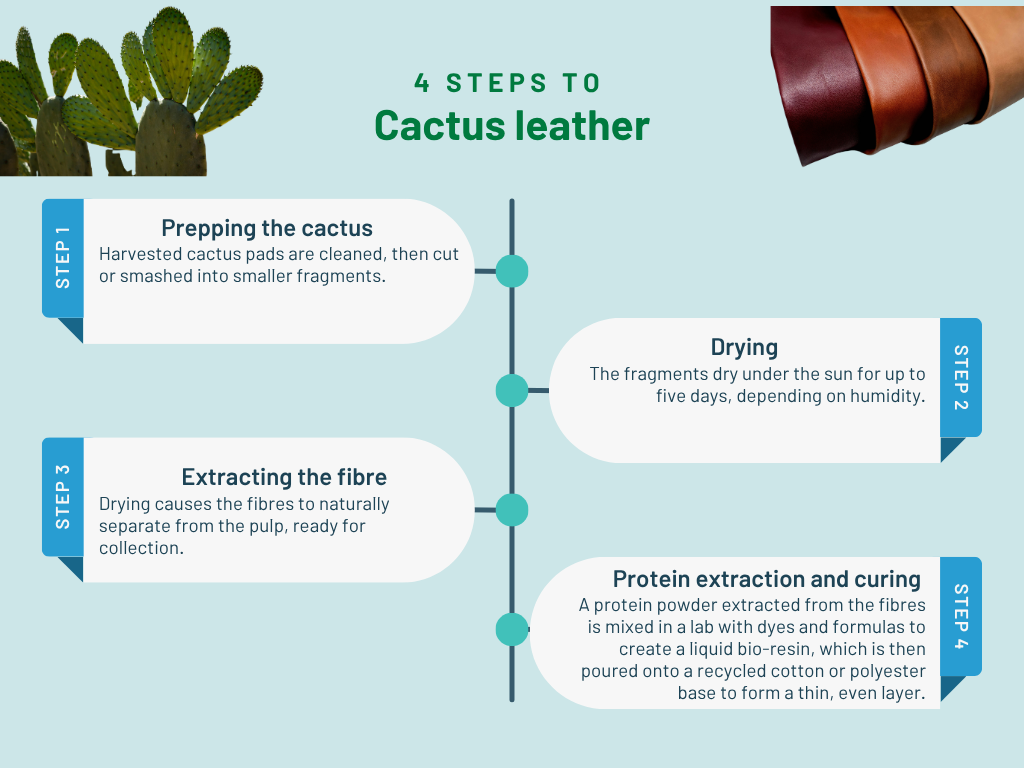
How is cactus leather made. Courtesy: Sanjukta Mondal
Cactus leather, mushroom leather, apple leather and banana leather frequently incorporate a layer of PU or PVC to provide strength, flexibility and durability. Without these synthetic binders or coatings, many plant fibres struggle to withstand the wear and tear expected of shoes, handbags and upholstery.
Whether products are labelled vegan leather, faux leather, imitation leather or pleather, they are often variations of the same underlying technology: plastic engineered to look and feel like leather.
| Material composition and applications | ||
|---|---|---|
| Material | What is it made of | Where it is used |
| PVC leather | Made by coating fabric with a synthetic polymer, polyvinyl chloride Requires plasticisers to stay flexible Contains 57% chlorine by weight Cheaper and more widely available than plant-based leather Petroleum-based |
Jackets, Bags, Shoes, Leatherette bindings for books and diaries, Water-resistant furniture covers |
| PU leather | Made by coating fabric with a polyurethane layer Chlorine-free and needs no phthalate additives Softer and more breathable than PVC Petroleum-based |
Jackets, Handbags, Boots, Belts, Furniture Upholstery, Car Interiors |
As a result, a product advertised as “cactus leather” or “mushroom leather” may contain only a portion of plant-derived material, with the remainder consisting of petroleum-based polymers. The exact composition varies widely between manufacturers, and brands are not always equally transparent about what percentage comes from biological sources and what percentage comes from plastic.
This distinction matters because two products carrying the same vegan label can have vastly different environmental impacts. A handbag made entirely from polyurethane, another made from cactus fibre reinforced with polyurethane, and a third made almost entirely from plant-based material may all be marketed simply as “vegan leather”.
For consumers, the label alone reveals very little. The more important question is not whether a product is vegan, but what it is actually made from.
Vegan silk has the same problem
Leather is not the only material where the word “vegan” can obscure what lies beneath the surface. For many consumers, vegan silk conjures images of fibres spun from plants such as bamboo or eucalyptus, offering the same smooth drape and lustre as traditional silk without harming silkworms. Such alternatives do exist. Fibres derived from bamboo, wood pulp and other cellulose-rich plants can be processed into soft, silk-like textiles, while newer innovations continue to explore materials made from agricultural waste and other renewable feedstocks.
But, as with vegan leather, these materials occupy only a small corner of the market.
The vast majority of fabrics sold as vegan silk today are made from polyester. Rather than referring to a distinct fibre, “vegan silk” often describes the look and feel of the fabric. Polyester filaments are woven using a satin weave to produce the smooth surface and glossy finish traditionally associated with natural silk, allowing manufacturers to recreate its appearance at a fraction of the cost.
Even animal rights organisations acknowledge polyester as a vegan alternative because it contains no animal-derived ingredients. That makes it cruelty-free, but not necessarily environmentally friendly.
Like PU and PVC, polyester is a petroleum-based polymer. It is manufactured by refining crude oil into chemical building blocks that are then polymerised into polyethylene terephthalate, better known as PET. The resulting fibres are strong, lightweight and inexpensive, helping polyester become the world’s most widely used textile.
Its popularity has also made it one of the fashion industry’s largest environmental challenges.
Unlike natural silk, which is a protein fibre that biodegrades under suitable conditions, polyester can persist in the environment for centuries. Every wash also releases thousands of microscopic plastic fibres, many of which pass through wastewater treatment systems and eventually reach rivers and oceans. Synthetic textiles are now estimated to account for around 35 per cent of the microplastics entering marine ecosystems.
This does not mean conventional silk is environmentally benign. Producing silk requires raising silkworms, harvesting cocoons and, in most commercial sericulture, boiling them before the moths emerge to preserve the long, continuous fibres that give silk its strength and sheen. Ethical concerns surrounding animal welfare have driven demand for alternatives, particularly among consumers who wish to avoid animal-derived products altogether.
Environmental comparisons, however, are far less straightforward. Reliable life cycle data for silk remains limited because much of the industry is still dispersed among small producers and family-run enterprises, particularly in China and India. Factors such as water use, energy consumption and emissions vary widely depending on farming methods, processing techniques and local conditions.
The result is another reminder that “vegan” and “sustainable” are not interchangeable terms. A polyester satin scarf and a naturally produced silk scarf may both carry environmental costs, but those costs arise from entirely different causes. One is rooted in animal agriculture and traditional textile production. The other is tied to the fossil fuel and petrochemical industries.
Understanding that distinction is the first step towards making a genuinely informed choice.
| Which actually lasts longer? |
|---|
|
Durability is one of the most overlooked aspects of sustainability. A product that lasts decades generally has a lower environmental impact per use than one that needs replacing every few years, even if the latter is made from a more sustainable raw material. Natural leather Synthetic leather (PU and PVC) Plant-based leather Natural silk Polyester ‘vegan silk’ The takeaway |
The ethical dilemma: Does buying leather kill animals?
For many consumers, the ethical case against leather is clear: Leather comes from animal skin. Buying leather, therefore, supports the killing of animals.
The reality is hardly so straightforward.
The global leather industry is deeply intertwined with the meat industry. Cattle, goats, sheep and buffaloes are primarily raised for meat and dairy, with their hides entering a separate value chain after slaughter. Hence, the leather industry argues, leather is not the reason animals are killed, but rather a way of utilising a by-product that would otherwise become waste.
“There is no question of an animal being slaughtered solely for the purpose of leather; economic reasons would not permit that,” said B. Madhan, Chief Scientist at CSIR-Central Leather Research Institute. “A mature goat may weigh around 20-25 kg, and the meat has far higher economic value than the skin. Goat meat may retail at roughly Rs700-1,000 per kg, while the raw skin may fetch only around Rs100-150. So it makes no economic sense for an animal to be slaughtered just for the skin.”
From this perspective, leather occupies an unusual position in the sustainability debate. Unlike many raw materials that require dedicated extraction or cultivation, leather makes use of a resource already generated by another industry. The tanning and leather-processing sector converts billions of tonnes of animal hides and skins into products ranging from footwear and upholstery to bags and jackets.
Supporters of leather argue that without this outlet, much of that material would end up in landfills or incinerators. Hides are rich in proteins and organic matter. If discarded, they eventually decompose, releasing greenhouse gases including carbon dioxide and methane.
Animal welfare advocates, however, reject the idea that leather can be separated from the livestock industry that produces it. Even if leather is technically a by-product, they argue, its commercial value contributes to the overall economics of animal agriculture and therefore remains linked to systems that treat animals as commodities.
The ethical concerns extend beyond slaughter itself. Intensive livestock systems have long been criticised for overcrowding, confinement, stressful transportation and other welfare issues. For consumers who oppose the use of animals altogether, the by-product argument does little to resolve the fundamental moral objection.
Environmental concerns: Another layer of complexity
According to a report by Collective Fashion Justice, producing a single pair of leather boots requires about 12,370 litres of water, while one square metre of cow leather generates roughly 110 kg of CO2 equivalent.
Globally, cattle ranching remains one of the leading drivers of land-use change. In the Amazon, it is responsible for roughly 80 per cent of deforestation, contributing to habitat loss in one of the planet’s most biodiverse ecosystems. The expansion of pastureland threatens countless species, from jaguars and giant otters to birds, reptiles and insects that depend on intact forests for survival.
Yet the environmental burden associated with leather does not end once the hide leaves the slaughterhouse.
Transforming raw animal skin into a durable material requires tanning, a process that stabilises the collagen fibres and prevents decomposition. Today, most leather is chrome-tanned, a method favoured for its speed, consistency and ability to produce soft, supple leather.
The process relies on chromium salts, which can become significant pollutants if wastewater and solid waste are not properly managed. Under certain conditions, chromium compounds may also be converted into more toxic forms that pose risks to human health and ecosystems.
The industry points out that modern treatment systems can dramatically reduce these impacts when regulations are enforced and facilities are properly operated. Researchers and manufacturers have also worked to improve waste recovery and chemical management within tanneries.
Others argue that the continued reliance on chrome tanning highlights the environmental costs embedded in conventional leather production.
An alternative exists in the form of vegetable tanning, which uses tannins derived from plants rather than chromium salts. The method generally requires more time and often costs more, but proponents regard it as a less polluting option that produces durable leather capable of developing a distinctive patina over time. Once the dominant tanning method, vegetable tanning now represents only a small share of the global market.
The debate over leather ultimately exposes a tension that runs through much of sustainable fashion. Animal welfare, waste reduction, resource efficiency and environmental protection do not always point in the same direction.
A consumer choosing a leather bag may see a durable product made from a material that would otherwise be discarded. Another may see participation in a system built on animal exploitation. Both perspectives draw on real evidence. Both leave important questions unanswered.
Plastic has its own environmental cost
If leather’s environmental impacts stem largely from livestock and tanning, vegan leather’s challenges begin much earlier in the supply chain, with fossil fuels.
Most synthetic leather, whether made entirely from PU or PVC or blended with plant fibres, ultimately depends on petroleum. Manufacturing these plastics comes with its own chemical footprint. Producing PU typically involves solvents such as N,N-dimethylformamide (DMF), a chemical associated with liver and kidney toxicity following prolonged occupational exposure. While regulations and handling practices can reduce these risks, concerns remain about worker safety and chemical pollution where environmental controls are weak.
PVC presents a different set of challenges. To give the material its leather-like softness and flexibility, manufacturers add phthalate plasticisers that are not permanently bound to the polymer. Over time, these chemicals can leach into surrounding soil and water, where some have been linked to endocrine disruption in wildlife and humans.
The environmental impact does not end when the product leaves the factory.
Everyday use gradually turns synthetic textiles into a source of microplastic pollution. As PU-coated fabrics, PVC leather and polyester garments wear down or are washed, they release microscopic plastic particles that often escape wastewater treatment systems and enter rivers, lakes and oceans.
Unlike animal leather and genuinely plastic-free plant-based alternatives, these plastics do not readily biodegrade. Discarded bags, shoes, jackets and garments can persist in landfills for centuries, slowly fragmenting into ever smaller pieces without fully disappearing. Blended materials pose an additional challenge. Combining plant fibres with synthetic polymers often makes mechanical recycling impractical, meaning many of these hybrid products also end their lives in landfill.
None of this makes conventional leather environmentally benign. Rather, it highlights that the two materials are embedded in fundamentally different systems. Leather is tied to livestock agriculture and the environmental costs that come with it. Synthetic vegan leather is tied to the fossil fuel and petrochemical industries, bringing with it a different set of environmental trade-offs.
The question, then, is not which material is entirely free of impact. It is which impacts consumers are willing to accept, and whether they are being given enough information to make that choice knowingly.
What happens at the end of life?
Natural leather is biodegradable under the right conditions, though chrome tanning can slow that process and introduce chemicals that require careful waste management. Purely plant-based leather alternatives also have the potential to biodegrade, provided they contain no synthetic coatings or binders.
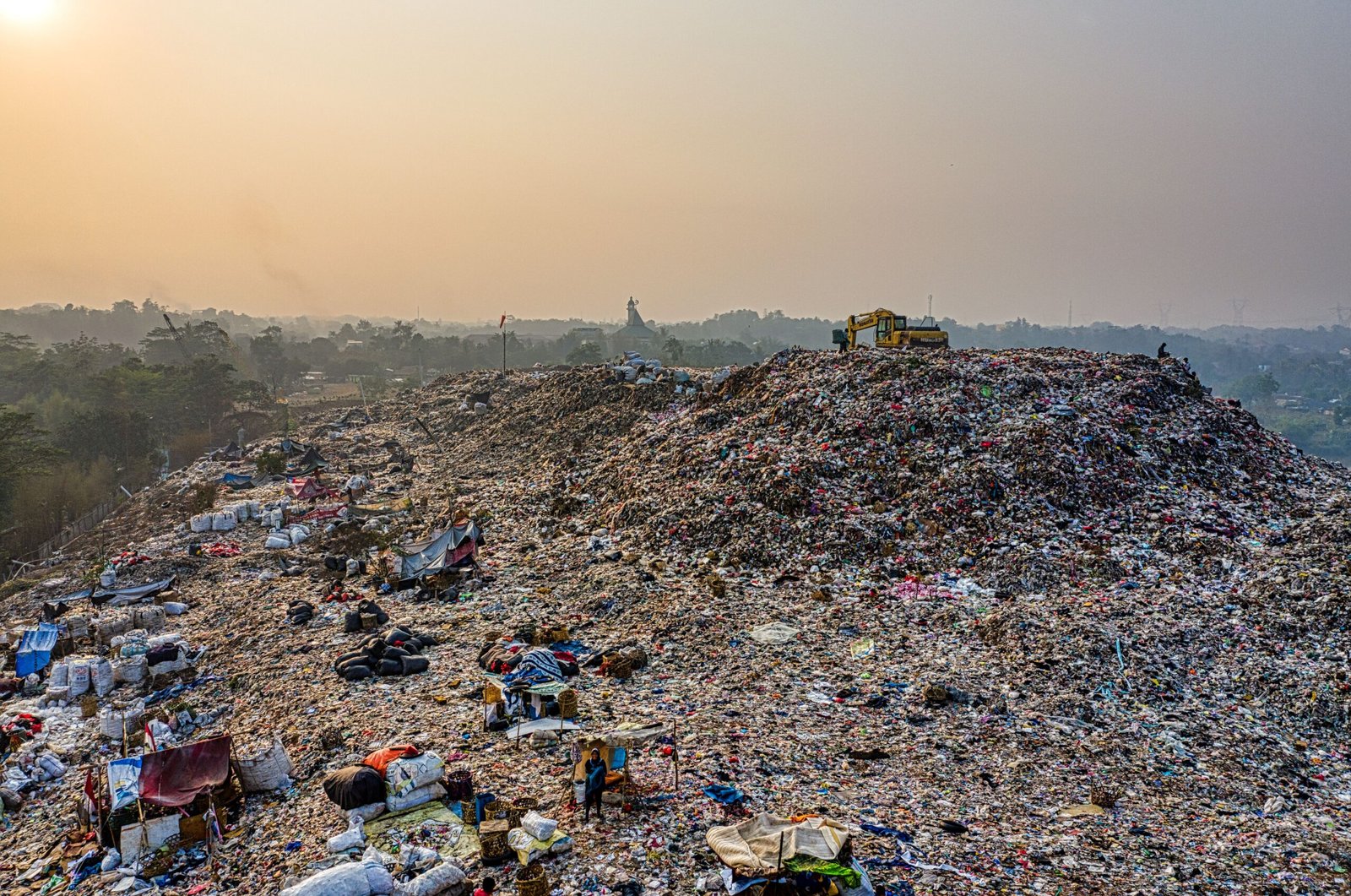
Ghana and Kenya bear the brunt of the fashion waste crisis fueled by secondhand clothing shipped from the West. Photo by Tom Fisk for Pexels.
Plastic-based materials follow a different path. PU leather, PVC leather and polyester can persist for hundreds of years, gradually breaking down into smaller plastic fragments rather than fully decomposing. Hybrid materials, which combine plant fibres with plastic, present another challenge. Because the natural and synthetic components are difficult to separate, they are rarely recycled and usually end up in landfill.
The most sustainable product, therefore, is often not the one with the greenest label, but the one you already own or the one that stays in use the longest. The most sustainable fashion choice is not choosing between leather and vegan leather, but buying fewer products, using them longer and understanding what they’re actually made of.
| A checklist to choose better, for you and the planet |
|---|
| ✔️ Look beyond vegan claims and check the label for material composition.
✔️ Prioritise durability and repairability. ✔️ For leather, ask where the hides come from and whether the tanning is vegetable-based or chrome-based. ✔️ Buy fewer, better products. ✔️ Support brands that disclose material sourcing. ✔️ Learn the right washing methods to prolong the life of your garments. ✔️ Upcycle pieces you no longer wear. ✔️ Dispose of products through the right channels. |
Sanjukta Mondal is an independent journalist and science communicator who covers health, environment and science.
Inspired to Take Action?
Tl;dr: A summary for the busy, the curious, and the done-for-today
The term "vegan" describes the absence of animal-derived materials, not a product's environmental footprint.
Most vegan leather sold today is still made from petroleum-based plastics such as polyurethane (PU) and polyvinyl chloride (PVC), while many vegan silk products are simply polyester.
Plant and fungi-based alternatives are promising but often still rely on synthetic binders and currently represent only a small share of the global market.
Leather and vegan alternatives create different environmental and ethical trade-offs, making simplistic claims of sustainability misleading.
The most sustainable fashion choices come from understanding material composition, prioritising durability and buying fewer, better-made products rather than relying on marketing labels alone