
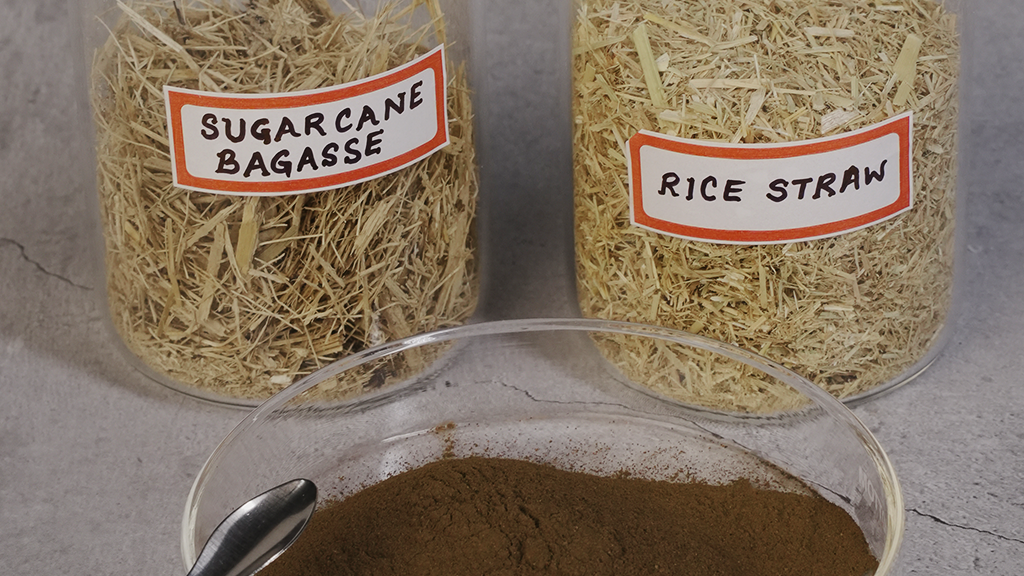
Every year, India generates an estimated 350 to 500 million tonnes of agricultural residue, almost as much as the country produces in foodgrains. Some becomes fodder or fuel, but around 92 million tonnes is still burned, polluting the air and releasing carbon back into the atmosphere. What if that waste could instead become the raw material for everyday products?
That is the question Bengaluru-based altM is trying to answer. The startup believes crop residue can replace fossil-derived ingredients in everything from cosmetics and paints to adhesives, creating a new market for agricultural waste while reducing dependence on petroleum-based materials. If that vision succeeds, it could do more than build a successful company. It could help lay the foundations of an entirely new materials industry.
It begins by breaking agricultural waste down into its most valuable building blocks.
Inside altM’s biorefinery
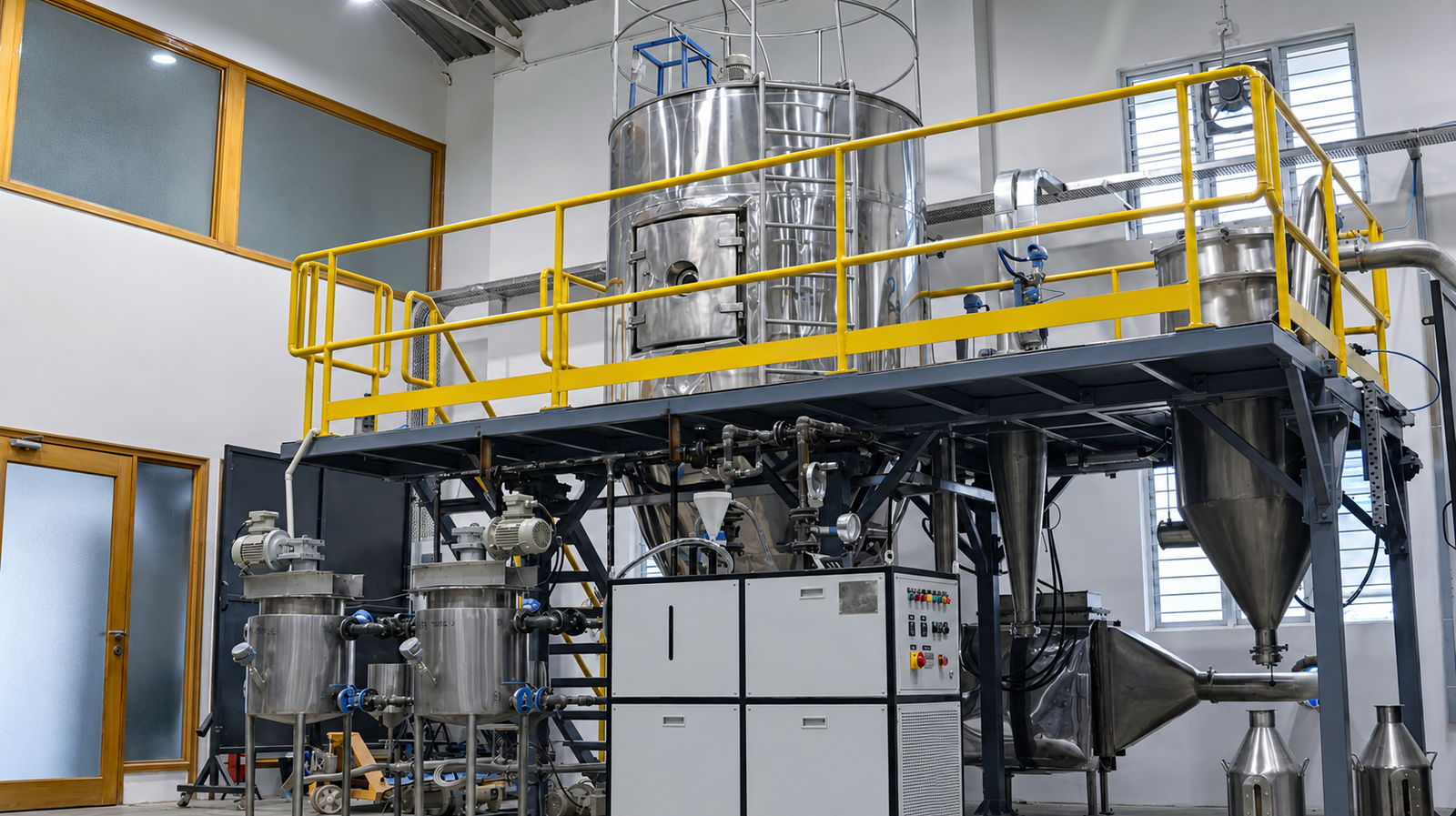
altM’s biorefinery. Photo by Aisiri Amin
At first glance, altM’s facility resembles a small chemical plant. But instead of crude oil, the raw material arriving at its gates is agricultural residue: rice straw, sugarcane bagasse, cotton waste and other crop by-products that are often burned or discarded.
Agricultural residue is rich in carbon. Yet much of it is burned for energy or simply discarded instead of being used for higher-value applications. “What we are doing is re-engineering it in our biorefinery,” Yugal Raj Jain, co-founder and chief operating officer of altM. The company’s ambition is to extract valuable chemicals from plants in much the same way that a petrochemical refinery extracts them from fossil fuels.
Jain likens the process to a conventional petrochemical refinery. Crude oil is separated into different fractions that become fuels and petrochemicals. “What we want to do is swap that feedstock from naphtha into something that is derived from crop residue,” he says.
Crop residues are collectively known as lignocellulosic biomass. Put simply, they are made up of three structural components that give plants their strength: cellulose, hemicellulose and lignin. While these have traditionally been used for biofuels, altM believes they can become the building blocks for a new generation of materials.
The crop residue is first loaded into a 100-litre reactor, where it is broken down into its constituent components. The resulting slurry is passed through a centrifuge that separates the solid and liquid fractions before cellulose, hemicellulose and lignin are extracted and stored for different applications. Depending on the chemistry involved, the company uses either stainless steel or glass-lined reactors.
The process is “feedstock agnostic”, meaning the same equipment can handle different agricultural residues with adjustments to temperature, pressure and chemical concentrations. “We may need to change temperature, pressure and chemical concentration conditions, but the equipment is agnostic,” Jain explains.
The pilot plant bridges the gap between laboratory research and commercial production. Researchers and engineers work side by side, allowing the company to rapidly test ideas, scale them up and troubleshoot problems before moving to industrial-scale manufacturing.
As Jain walks through the facility from the laboratory to the demonstration area and finally the pilot plant, he points out that they were deliberately designed side by side. “We wanted to make sure they are all under one roof so there is constant communication between researchers and engineers,” he says, implying that this shortens the feedback loop between research and manufacturing. “If something feels off, it can be looked into immediately. This is something most companies miss,” he adds.
Beyond biofuels: Building everyday materials
For years, lignocellulosic biomass has been seen primarily as a feedstock for biofuels. altM believes it can command far greater value by replacing fossil-derived ingredients in products people use every day.
The company’s first target is the cosmetics industry, for which it has developed two products. One is a rheology modifier, an ingredient that controls the flow and texture of liquid formulations such as creams, paints and adhesives. These additives are typically derived from wood or fossil-based feedstocks. altM instead uses cellulose extracted from agricultural waste.
“Cosmetics are the first bucket,” says Jain. The founders say they chose cosmetics first because speciality ingredients command higher margins and require relatively small production volumes, making them a practical entry point for a young materials company. “But these materials can also go into paints and coatings to stabilise the backbone of liquid formulations.”
Its second product, altScreen, uses lignin extracted from crop residue as an SPF booster for sunscreens. According to Jain, the SPF booster can increase the effectiveness of sunscreen formulations by between 60 and 300%, reducing the amount of conventional UV-filtering ingredients required.

altScreen uses lignin extracted from crop residue as an SPF booster for sunscreens. Photo from altM’s product portfolio
Beyond cosmetics, altM has developed a lignin-based wood adhesive and functionalised lignin that can replace fossil-derived ingredients in polymer systems, potentially extending the technology into coatings, adhesives and other industrial applications.
For Apoorv Garg, co-founder and chief executive officer, the objective is not simply to make bio-based substitutes, but to fit seamlessly into existing supply chains. “Our rheology modifiers are biodegradable,” he says. “By converting agricultural residues into materials like thermoset binders and SPF boosters, we are creating a circular loop that keeps carbon within the industrial value chain.” (Thermoset binders are rigid chemical glues or resins that permanently harden when heated or mixed with a curing agent.)
Does the chemistry add up?
Turning agricultural waste into high-value materials may sound like an obvious environmental win. But scientists say the benefits depend not just on what goes into the process, but also on how much energy, water and chemicals are needed to make it work at scale.
One of the biggest technical challenges is separating lignin from cellulose, says Sounak Roy, Dean of Research and Innovation at BITS Pilani, Hyderabad. “Once that separation is achieved, it opens up a wide range of downstream applications.” But the process must also be energy-efficient. “If it consumes significant energy, it will fail to deliver a net environmental benefit and will not be economically viable.”
Roy adds that claims about sustainability must ultimately be backed by rigorous life cycle assessments and techno-economic analysis, rather than simple comparisons with crop burning or fossil-based materials. If companies can demonstrate both economic and environmental advantages through independent assessments, biomaterials from agricultural residue could become an important part of India’s low-carbon manufacturing transition.
The founders argue that their process is designed with those concerns in mind. Operating temperatures remain below 150°C, compared with the much higher temperatures often required in petrochemical manufacturing (usually above 800°C).
Because most of its feedstock comes from nearby sugar mills and cotton-processing units, transport emissions are also lower than they would be if biomass had to be hauled over long distances, Garg says. They also say the process uses relatively low concentrations of chemicals, relies largely on locally sourced agricultural residue and is designed to recycle 80-85% of its water at commercial scale.
One way to assess how closely a material is derived from natural sources is through a “natural index”, which measures the proportion of a material or ingredient that comes from natural sources. ISO 16128 provides definitions and guidelines for calculating natural and organic indices for cosmetic ingredients, although the concept is not a general measure of a product’s environmental impact.
Garg explains that, under altM’s framework, a completely natural material such as an oil has a natural index of 1, while fully synthetic materials score close to zero. Most of altM’s materials fall between 0.7 and 0.95, he says. Performance materials, which are engineered to deliver properties such as high strength, durability or stability under demanding conditions, generally require some chemical or structural modification and therefore rarely achieve a perfect score.
Garg argues that altM’s process starts with an inherent carbon advantage. “We begin with biogenic carbon captured by the plant itself. Every processing step adds emissions, but even after accounting for those, our products typically have a substantially lower carbon footprint than conventional alternatives.”
He acknowledges, however, that one important piece of evidence is missing. A full life cycle assessment, the industry standard for measuring a product’s overall environmental impact, has not yet been completed.
From pilot plant to production
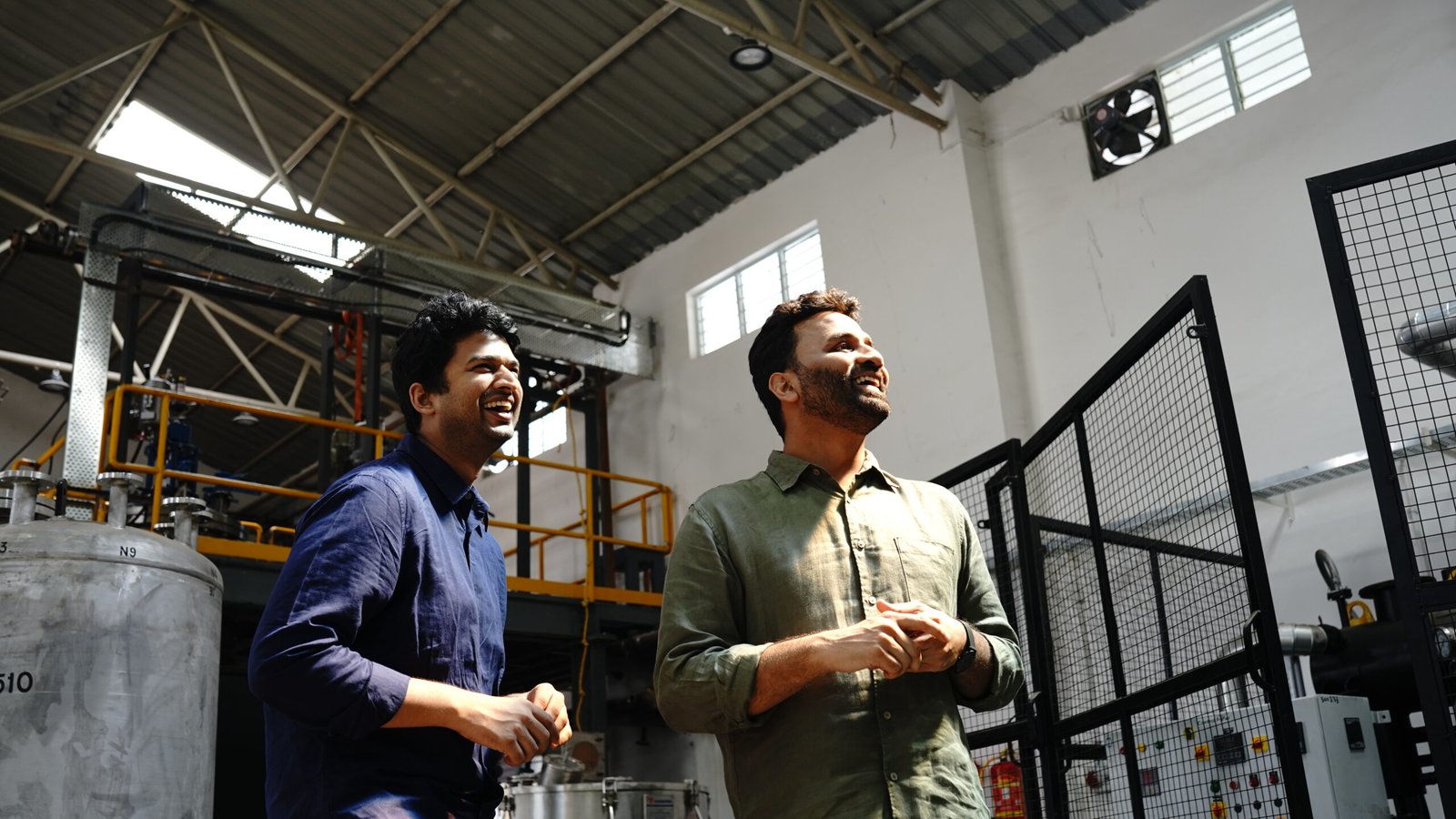
Co-founders Apoorv Garg and Yugal Raj Jain. Photo by Aisiri Amin
Turning a promising technology into a viable business is often harder than inventing it. Many companies working on bio-based materials have raised substantial funding only to struggle when they tried to scale from the laboratory to commercial production.
The founders say they were mindful of those pitfalls from the outset. Incubated at the Bangalore Bioinnovation Centre until 2024, altM built its technology in stages before moving to its own facility after raising $3.5 million in seed funding in 2023 from investors led by Omnivore. The funding helped the company move from laboratory research to a pilot-scale facility capable of validating its manufacturing process before commercial deployment.
Scaling, however, has brought its own challenges. One has been building an equipment ecosystem almost from scratch. Rather than buying expensive off-the-shelf systems, the company worked with suppliers to develop smaller production-representative reactors, sometimes persuading manufacturers to make components they had never built before, or applying a special coating on a reactor.
The founders say many companies underestimate what comes after science. “If you think your research will be complete on day 100, production will begin on day 101, and sales will follow immediately after, you’re underestimating the complexity of scaling,” says Garg. Treating manufacturing and commercialisation as straightforward, he argues, has been one of the reasons several alternate materials ventures have failed.
The company’s first commercial plant is expected to begin operations in the second half of 2027, with an initial capacity of 1,000 to 2,000 tonnes a year.
For a virtual loop to operate seamlessly, the process must benefit the farmers who often struggle to dispose of crop residue. “The hope is that when this becomes more organised, and opportunities become more real, the farmers will eventually get a cut out of it,” Garg explains, “Then there will be an economic solution to the crop burning problem.
What it will take to scale
The company’s first commercial plant is expected to begin operations in the second half of 2027, with an initial capacity of 1,000 to 2,000 tonnes a year. The founders hope to scale production significantly over the following five years.
For that to happen, the equipment ecosystem will need to mature. Today, many of the specialised reactors and processing systems still need to be custom-built.
Feedstock economics will be just as important. Agricultural residue is only a viable industrial raw material if it can be collected and transported at a competitive cost while giving farmers a better economic alternative to burning or discarding it. That will require the biogas, bioethanol and biomaterials industries to grow together, creating enough demand for residue to support a functioning supply chain.
Finally, long-term policy certainty will be essential. Programmes such as India’s E20 blending targets, the production linked incentives for biofuels and the momentum created by international initiatives like the European Green Deal to decarbonise transport point in the right direction, the founders say, adding that companies investing in large-scale manufacturing need confidence that those policies will endure.
If those pieces fall into place, agricultural residue could become more than a waste stream to be managed. It could become a renewable industrial feedstock, supplying the raw materials for products that today depend on fossil resources. AltM’s experiment is an early test of whether that promise can work not just in the laboratory, but economically and environmentally at scale.
Aisiri Amin is a journalist based in Bengaluru who writes about environment, gender, rights and culture.
Inspired to Take Action?
Tl;dr: A summary for the busy, the curious, and the done-for-today
India generates 350 to 500 million tonnes of agricultural residue every year, with around 92 million tonnes still burned.
Bengaluru-based altM is turning crop waste into cellulose, hemicellulose and lignin that can replace fossil-derived ingredients in everyday products.
Its applications already span cosmetics, paints, adhesives and coatings, moving agricultural residue beyond its traditional role as a biofuel feedstock.
The big question is whether the chemistry delivers a genuine environmental benefit, with energy use, water, chemicals and a full life cycle assessment still critical to proving the case.
With a commercial plant planned for 2027, altM's bigger bet is that crop waste can become a competitive renewable industrial feedstock and help build an entirely new materials industry.