

We’ve all seen viral WhatsApp messages, social media posts and promotional emails that use impressive-sounding scientific jargon, partial truths or urgency to make questionable claims sound credible. If we’re honest, we’ll admit we’ve even fallen for some.
This story is a basic manual for people who’d really like to know the truth behind claims that sound too good to be true. Because, they usually are.
Most seasoned and scrupulous science journalists will tell you that they spend a lot of time doing one thing. No, it’s not scoping for stories, pitching to editors or even chasing after payments.
It’s fact-checking. Making sure that a claim or a story survives basic scientific scrutiny.
Sometimes, long words, jargon-filled explanations, urgent warnings and a slick infographic can sound incredibly convincing. Nearly every journalist, over years of experience, develops a checklist to separate credible science and technical-sounding rubbish. It is usually a set of simple questions they ask before believing a claim.
Here are three examples where such questions have helped me separate hype from reality.
The jargon test: Can you find the science anywhere else outside the advertisement?
In early 2021, during the height of the COVID-19 delta wave in India, a miraculous “breakthrough” device called the “Shycocan” came to market. It claimed to operate on a regular 110/240V-50/60 Hz wall socket to produce trillions of electrons that would float around a room and inactivate the coat protein of the offending virus. This “coat protein” refers to the virus’s outer protein layer (made of envelope proteins and spike proteins), which protects the viral genetic material and allows it to attach to host cells.
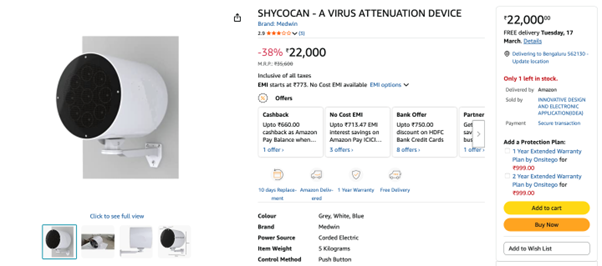
The Shycocan “virus attenuation device”. Screenshot by Anusha Krishnan
The description was impressive, with words like “photoelectric effect”, “electrons”, “charged particles”, “coronavirus spike protein”, “inactivate” and “safe” sprinkled throughout the product description. The device supposedly emitted specific frequencies that would cause virus particles to “clump together” and fall out of the air.
The Times of India and the Economic Times featured this device in articles, as did a video on NDTV.
There was just one small problem. There was no credible source that supported the science.
The first place a science journalist looks for such information is usually Google Scholar, which is a search engine for pulling up peer-reviewed scientific papers. If a technology works, there is usually a trail of published research describing how it works.
In this case, there was no independent published literature explaining the mechanism that the advertisement for the Shycocan claimed it used.
Now, that doesn’t automatically mean that something is fake; sometimes new technologies can exist before papers are published, but it does mean the claim deserves scrutiny. And bingo! The Indian Express and the Deccan Herald did have pieces that questioned its abilities.
The next step was to check with experts.
Scientists began to speak up about the Shycocan. That the description of the device was packed with a lot of technical jargon, but that the mechanism of its working made no sense either in physics or in biology. Free electrons can’t just be pumped into the air to magically and accurately target specific proteins on certain viruses.
Put simply, the explanation was scientific-sounding, but not scientific.
This is a useful red flag. If a claim relies heavily on jargon, cannot be explained in plain language, and has no supporting published literature, you should be sceptical.
The label test: Are data being interpreted correctly?
This second example is about a WhatsApp message that was making its rounds in an apartment group. The last few lines of the message were alarmist, claiming, “This is most dangerous of all. Your health is priceless.”
The subject was the stickers that one sometimes finds on fruit. The gist of the message was: If fruit stickers have 4 digits starting with 3 or 4, they are grown with pesticides. If they have 5 digits starting with 9, they are organic. If they start with 8, they are genetically modified. The message implied that such fruits were bad for health.
A quick internet search revealed that some of the information was true. The numbers on the stickers are Price Lookup codes or PLUs, which are used by retailers to identify produce much like a barcode. The system was created by the International Federation for Produce Standards to handle the increasing variety of food products flowing into markets.
But the solicitous WhatsApp message leaves out some key details.
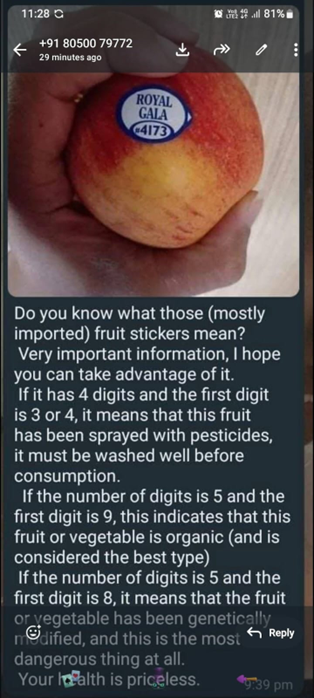
Can fruit labels tell us if they’re bad for health? Image by Anusha Krishnan
Most fruits have 4-digit PLU codes, which just mean that these are conventional produce. They don’t tell you whether pesticides were used. The 5-digit codes beginning with 9 do signify organic produce, and the one beginning with 8 do indicate genetically modified organisms (GMOs), but this was not widely adopted and is rarely seen in markets.
The issue, though, is not the PLU code. It is the scaremongering regarding genetically modified fruit. While GMOs are problematic for the environment, and may cause unexpected allergic reactions, they are not inherently “dangerous to health”.
For example, FLAVR SAVR tomatoes produce fruit resistant to damage and Arctic apples are designed to not turn brown when cut, both of which are measures to reduce food waste. In both cases, scientists prevented specific genes from being turned on to increase the shelf life of the produce. More broadly, genetically modified crops have been developed to resist pests, tolerate drought or improve nutrition.
In a warming world where climate stress is already affecting harvests, such traits may become increasingly important. This, of course, doesn’t mean that every GMO is automatically good, but, the idea that all genetically modified food is inherently dangerous is not supported by scientific evidence.
The complexity test: Does the simple explanation hide a complicated reality?
This third example is not a WhatsApp message or a social media post, but a much more personalised approach – an email.
The subject line promised an unusual investment opportunity involving carbon credits. The message was upbeat with statistics on booming carbon markets, large profit margins and untold opportunities for early investors. All that was required was a quick download and installation of the app attached to the email, creating an account and making a seed investment.
Even if you aren’t a cybersecurity specialist, this should be suspicious. Unsolicited emails with downloadable apps that are not available on the Google Play Store are gigantic red flags that should set off high-decibel alarm bells in your head. If you see attachments ending with .exe, .scr, .apx, or others that seem unfamiliar, do not engage with the communication. The attached files are likely to be software that can steal information, install malware or hijack your computer or phone.
But the email itself relied on a familiar trick by using a real concept to sell a fake opportunity.
Carbon credits are real. One carbon credit represents one tonne of carbon dioxide that has been prevented from being emitted or removed from the atmosphere. Carbon markets are a growing global effort to reduce greenhouse gas emissions, and companies or people can buy these credits to offset their carbon footprints.
Projects that generate carbon credits include restoring forests, protecting wetlands, capturing methane from landfills, installing renewable energy or implementing measures that reduce carbon emissions. However, legitimate carbon credit projects must go through verification processes, where an independent third party checks whether the claimed emission reductions are real.
None of this complexity appeared in the email. Instead, the message promised easy profits, a fast-growing market, and a convenient app to start investing immediately. Fraudsters are exploiting the fact that most people have heard of carbon trading, but don’t fully understand how it works. Some schemes sell ‘ghost credits’ that are worthless or non-existent credits, some overstate their impacts, others may use carbon trading as a front for forcing indigenous communities to resort to resource-for-cash transactions. Still others direct investors to fake trading platforms that simply collect deposits and disappear.
Legitimate carbon markets do exist. But they operate through regulated exchanges, established registries and recognised brokers; not through random emails with downloadable software.
In other words, when climate solutions start sounding like a get-rich-quick scheme, it’s worth taking a closer look.
Five questions worth asking
So, given that WhatsApp forwards and bombastic social media posts are not going to stop in the near future, how can we tell true solutions from fakes? Here is a checklist that might help; a set of five simple questions to ask before believing the next viral claim:
-
Where/what is the evidence? Does the evidence only exist in social media or is there any peer-reviewed research, credible data source or independent verification?
-
Who else has checked it? What do experts or scientists in the same field, but who are not connected to the claim/study, say about it?
-
Does the explanation actually make sense? If the description of the claim relies on jargon but is vague when reduced to simpler terms, dig deeper.
-
Is the story too neat? Solutions to scientific and environmental problems are usually complicated and messy. So, “simple solutions” with a too-good-to-be-true vibe which hides that complexity, aren’t telling the whole story.
- Is someone trying to sell you something? Messages about miracle devices, investments or health solutions are often steeped in urgency. Exhortations to “act now, before this opportunity disappears” are calculated to overturn logical thought processes.
The challenge: Misinformation and disinformation move faster than verification
Before our ever-present mobile phones and personal computers, questionable scientific claims travelled slowly. But in today’s digital world, they move through WhatsApp groups, Instagram reels, X posts and YouTube channels very quickly.
By the time someone finishes fact-checking, the claim is likely to have reached thousands, if not millions of people.
This is why a healthy amount of doubt is a useful skill for everyone; the Latin term “cum grano salis”, which means “with a grain of salt” should be applied to much of the information we consume.
We don’t need a laboratory to test every claim; sometimes all it takes is a few simple questions, and a quick Google query to clarify a vague yet urgent-sounding claim. The real challenge is to take a healthy pause and resist the urge to click, download or forward.
Because bad science spreads fast, but scepticism can slow it down.
Anusha Krishnan is a science journalist and editor who writes about climate change, environmental research, biodiversity and conservation to translate complex scientific studies into engaging accessible stories. She holds a Ph.D. in ecology, is a published children’s book author, and aims to bring science to both adult and young audiences.
Inspired to Take Action?
Tl;dr: A summary for the busy, the curious, and the done-for-today
Misinformation often sounds credible because it uses scientific jargon, urgency, and partial truths – making it easy for even informed people to fall for misleading claims.
Science journalism relies heavily on fact-checking, using simple but critical questions (about evidence, experts and logic) to test whether a claim holds up under scrutiny.
Red flags include jargon without evidence, misused data and oversimplified explanations, as seen in examples like the “Shycocan” device, misleading fruit label claims, and scam carbon credit investments.
Real science is usually complex and verifiable, involving peer-reviewed research, expert validation and nuanced trade-offs – unlike “too good to be true” claims promising easy fixes or quick profits.
Before you believe or forward something, pause, question sources and resist the urgency. This can help prevent the spread of bad science and misinformation.