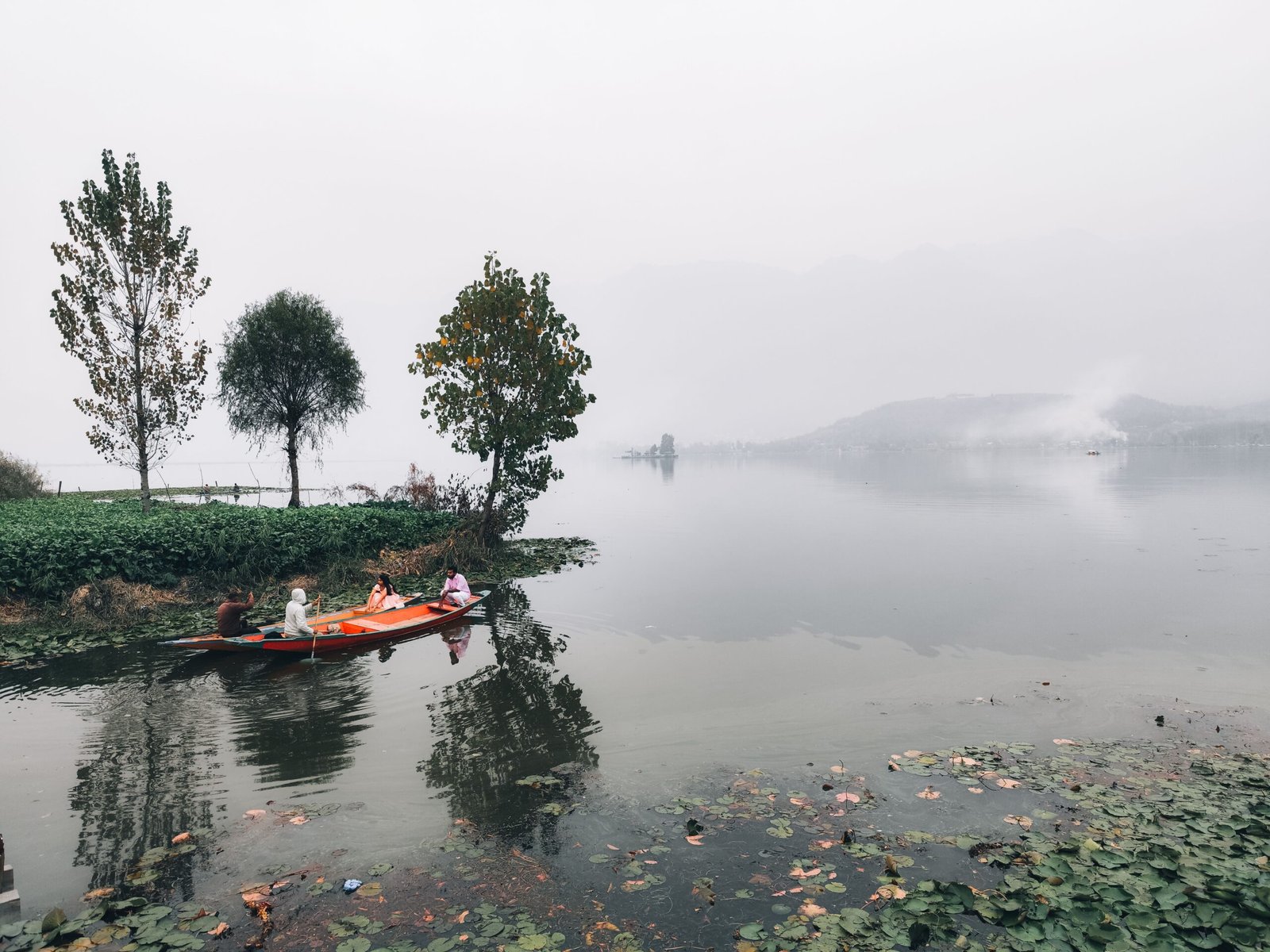
The uncontrolled growth of aquatic plants has become a major environmental challenge in Dal lake, an important freshwater lake in the Kashmir Himalaya. A new study has tested a way to convert these excess plants into fermented liquid fertilisers, offering a potential solution to manage weed overgrowth while producing a useful agricultural input.
Dal, a culturally and ecologically important lake in Kashmir, has been showing visible symptoms of eutrophication, with runoff from surrounding areas, untreated sewage, and other pollutants adding excess nutrients to the lake and leading to the rapid growth of aquatic plants. While aquatic vegetation can be useful as food, medicine, and fodder, overgrowth disrupts water quality, alters ecohydrology, and threatens native biodiversity.
“While the overgrowth of aquatic plants and algae blooms follows a seasonal cycle, the underlying decline in water quality is palpable year-round. We’ve seen the lake struggle under the weight of these excess nutrients, which is exactly why we are focused on repurposing that biomass into something useful for our land,” Kowsar Majid, one of the study authors and a professor in the department of chemistry at National Institute of Technology, Srinagar, told Mongabay-India. The study was published in ACS Sustainable Resource Management journal in March 2026. The findings are a proof of concept, with further studies needed to assess costs, large-scale feasibility and regulatory approval before the approach can be adopted widely.
Majid explains that most previous work on Dal lake biomass has focused on solid soil amendments such as compost, vermicompost or hydrochar. The researchers instead explored whether the vegetation could be converted into liquid fertilisers, which delivers nutrients in a form that plants can absorb quickly through roots or leaves, and can be especially beneficial during critical growth stages such as root development, vegetative growth, flowering, and fruiting.
Turning weeds into a solution
Removing aquatic weeds is already part of routine lake management. Rather than treating the harvested vegetation as waste, the researchers investigated whether it could become a nutrient source for agriculture. The team collected mixed aquatic plants from nine sites across Dal lake, including native and invasive species including water chestnut (Trapa natans), shining pondweed (Potamogeton lucens), curly-leaf pondweed (Potamogeton crispus), white water lily (Nymphaea alba), Yellow water lily (Nymphaea mexicana), Sacred lotus (Nelumbo nucifera), whorled watermilfoil (Myriophyllum verticillatum), Eurasian watermilfoil (Myriophyllum spicatum), hornwort (Ceratophyllum demersum), Water thyme (Hydrilla verticillata), and yellow floating heart (Nymphoides peltata).
The biomass was fermented for two months to produce a potent extract. “For the fermentation process, we utilised simple lactic acid bacteria (LAB) which we cultivated from milk and rice-washed water. This “frugal” microbial inoculum was then used to ferment the aquatic biomass and convert it into the final liquid fertiliser,” Akhil Paul, the lead author of the study says.
The researchers then analysed the nutrients and heavy metal content and then tested the produced fertilisers at specific dilutions on two crop systems: collard greens (Brassica oleracea var. viridis) and radish (Raphanus sativus). Seeds treated with the liquid fertiliser showed an improved rate of germination. Unlike conventional fertilisers like urea, which primarily supplies nitrogen, Paul says the formulations contained both macro- and micronutrients.
However, independent experts suggested that these liquid formulations could complement, rather than replace, conventional products.
“India has already promoted several alternatives to chemical fertilisers, including vermicompost, farmyard manure, city compost, biofertilisers and nano-fertilisers,” says Wajid Waheed, assistant professor and DBT-Ramalingaswami Fellow at Sher-e-Kashmir University of Agricultural Sciences and Technology of Kashmir, who was not involved in the study.
While many alternatives have shown promise, adoption has often been limited by inconsistent quality, low nutrient density and logistical challenges. Weed-based liquid fertilisers face similar constraints, he says. “It is unlikely to completely substitute chemical fertilisers in intensive farming systems. However, it can significantly reduce dependence on them when integrated into nutrient management programmes, particularly in horticulture, vegetable cultivation and organic farming.”
Waheed says one major advantage is that the raw material is already being collected during lake restoration. “The economics appear promising because the feedstock is essentially free and is already being collected for lake management purposes,” he says. However, collection, transportation, fermentation, processing and distribution costs would still need detailed economic assessment.
Paul says liquid fertilisers also offer advantages over compost because nutrients are immediately available to plants and can be applied through the soil, as foliar sprays or in hydroponic systems. The researchers, however, stress that safety remains a priority. “Because aquatic plants act like sponges for their environment, we conducted rigorous testing for heavy metals alongside our growth trials,” says Majid. Although only trace levels were detected, the team plans to investigate how these elements behave over the long term in soils and crops to ensure the fertilisers remain safe.
Their next step is to study the long-term dynamics of these elements in the soil-plant system. “This ensures that our ‘waste-to-wealth’ solution remains safe for the land and the entire food chain,” Majid notes.
Strengths and limitations of the study
Independent experts describe the study as a promising proof of concept while noting that important questions remain.
Debajit Thakur, professor at the Institute of Advanced Study in Science and Technology (IASST), Guwahati, says one of the study’s strengths is its comprehensive design. Biomass was collected from nine different locations across Dal lake, allowing researchers to account for spatial differences in nutrient composition. Detailed chemical analysis of both the raw biomass and fermented fertilisers also strengthens the findings. However, Thakur notes that the study does not assess production costs or commercial feasibility, both of which are essential for evaluating large-scale implementation. The research also relied on biomass collected during a single season, even though nutrient composition in aquatic plants varies with environmental conditions. Longer-term studies will therefore be needed.
Waheed adds that the study provides limited information about the microbial communities responsible for fermentation, making it difficult to judge whether the process can be reproduced consistently. He also calls for more extensive testing of heavy metals and other contaminants, as well as long-term field trials to assess soil health after repeated applications.
Ashaq Hussain, professor and chief scientist (Agronomy) at SKUAST-Kashmir, says fermentation is not a new approach for processing aquatic weeds and believes composting may ultimately prove more practical because it reduces biomass volume while concentrating nutrients. “The liquid extracted from fermented material usually contains only small amounts of nutrients and plant growth hormones,” he says. Once diluted before application, nutrient concentrations fall even further. “More detailed studies are needed to determine whether these products can meaningfully improve crop growth and yields under real farming conditions.”
Can this work in the real world?
Researchers and experts agree that the key challenge is not whether aquatic weeds can be converted into fertilisers, but whether the process can be scaled economically and integrated into existing lake management.
Waheed says locally produced fertilisers could reduce dependence on chemical fertilisers transported from other states while creating value from biomass that is currently treated as waste. He notes that weed-based compost from Dal lake has already been marketed to local farmers, suggesting there may also be demand for liquid products, particularly among apple and saffron growers seeking lower chemical inputs.
The biggest hurdle, he says, is regulation. “To sell a fertiliser legally in India, it needs to comply with the Fertiliser Control Order, and getting a new product category approved takes years. That’s the single biggest economic barrier right now, not the production cost.”
Majid says agencies responsible for cleaning Dal lake already collect large amounts of vegetation. The researchers hope their low-cost fermentation process could shorten the gap between collection and reuse while creating opportunities for government programmes or local startups. “Our ultimate goal is a zero-waste model,” she says. The solid residue left after fermentation could also be converted into compost so that the entire biomass is put to productive use. “Most importantly, this approach targets the excess vegetation driving the problem without disturbing the lake’s ecological balance,” Majid says. “Since every water body has its own unique ecological story, the framework can be adapted by other regions to develop their own waste-to-resource solutions.”
This story was first published in Mongabay India.