

Increasingly, every job is becoming, at least partly, a climate job.
That is why the most successful climate career transitions are rarely dramatic. Many professionals do not begin by quitting their jobs or reinventing themselves entirely. They begin by recognising how climate is already reshaping the work they do, and preparing for the requirements and opportunities this brings.
An operations professional starts tracking emissions alongside costs. A marketer begins working on sustainability campaigns. A finance analyst develops expertise in renewable energy projects.
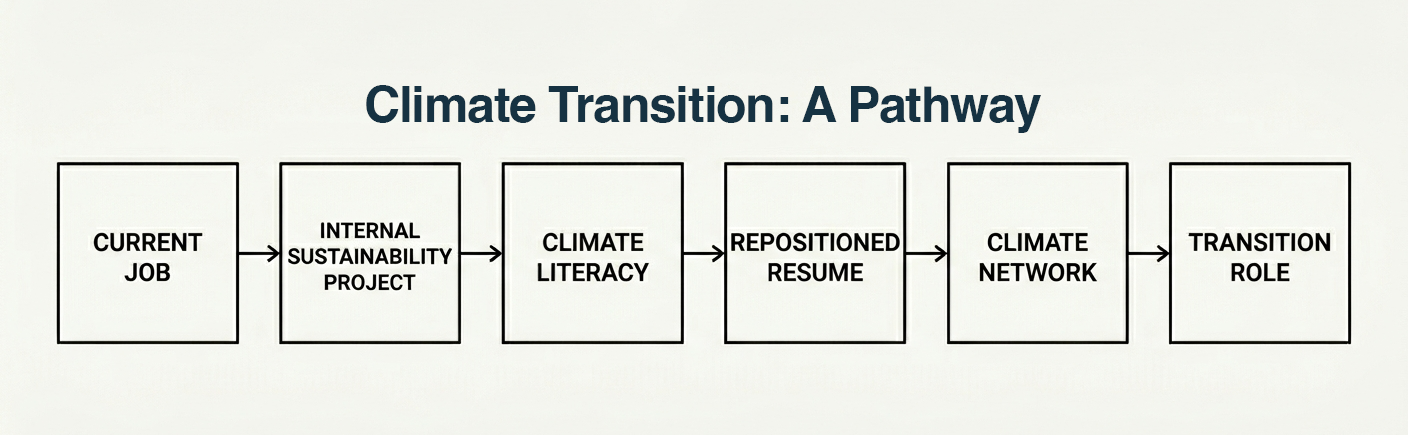
The transition often starts before the job title changes. Here’s a tactical guide on how you can build climate literacy and reposition your experience.
Step 1: Build targeted climate literacy
You do not necessarily need another degree. What matters more is developing enough climate context to understand how your function intersects with sustainability challenges.
Short certifications, industry reports, webinars and online courses are often enough to begin. There’s a host of courses, even free ones available. Opt for those from credible organisations, those that culminate in a project or hands-on experience, and those that offer an industry-relevant certification.
| Areas worth understanding include | |
|---|---|
| Basics of climate science | |
| Carbon accounting | |
| Net-zero frameworks | |
| Renewable energy economics | |
| Climate policy and regulation | |
| Circular economy concepts | |
| Sustainable supply chains | |
| Potential resources | |
|---|---|
| Coursera climate courses | |
| Terra.do fellowships | |
| IEA reports | |
| IPCC summaries | |
| World Resources Institute explainers | |
| CEEW and TERI reports in India | |
Step 2: Reposition your existing experience
One of the most important shifts is narrative. Professionals often frame climate transitions as though they are abandoning expertise and starting from zero. That weakens positioning.
Instead of saying: “I want to switch industries”, frame your experience around transferable outcomes. For example: “I have spent eight years optimising supply networks and improving operational efficiency. I now want to apply that expertise to decarbonised and resilient supply chains.”
| Resume Reframing Examples | |
|---|---|
| Before | After |
| Reduced logistics costs by 15% | Reduced logistics costs through route optimisation with applications for carbon-efficient transport strategies |
| Managed supplier relationships | Managed supplier ecosystems with experience relevant to sustainable sourcing and supplier disclosure frameworks |
| Led product marketing campaigns | Led consumer campaigns focused on behaviour change and adoption |
| Improved manufacturing efficiency | Improved operational efficiency and resource utilisation across production systems |
| Important note Add climate language only where it is authentic and defensible. Overusing sustainability terminology without real relevance can weaken credibility. |
|
Step 3: Start inside your current organisation
Many professionals overlook the climate opportunities already available inside their own companies.
Across sectors, organisations are under increasing pressure to measure emissions, improve efficiency and strengthen sustainability reporting.
That creates opportunities for employees to initiate projects, build exposure and develop climate-adjacent experience.
Questions professionals can ask include: Can we measure emissions in our process? Can we evaluate lower-emission suppliers? Or: Can we improve energy efficiency? Can we pilot circular material systems?
Further: Can marketing test sustainability messaging?
Internal projects often become the bridge between conventional roles and climate-focused careers.
Step 4: Network strategically
Climate transitions often happen faster through conversations than applications. Many professionals already working in climate-focused roles are open to sharing experiences, especially because the ecosystem itself is still evolving.
| Box 4: Networking & Questions | |
|---|---|
| Useful people to connect with include: | Useful questions include: |
| • Alumni in climate startups • Sustainability professionals inside large companies • Function-specific climate experts • Climate-tech operators • Investors and ecosystem builders |
• Which skills are most valuable? • What surprised you about the transition? • Which capabilities are hardest to hire for? • What climate knowledge matters most in practice? |
| Reality check: Networking in climate is often less formal | |
|---|---|
| The climate ecosystem is still relatively young compared to sectors like finance or consulting. Conversations, communities and referrals often matter significantly. | |
Step 5: Think long-term
The climate transition is one of the largest industrial and economic transformations of this century. It will reshape infrastructure, mobility, finance, agriculture, construction, energy systems and global supply chains.
That means climate careers are unlikely to remain confined to specialist sustainability teams. Increasingly, climate literacy may become a core professional competency across industries.
Professionals who understand both business fundamentals and sustainability context are likely to become increasingly valuable.
You do not need to be perfectly qualified before beginning. You need to:
- Recognise your transferable skills
- Understand climate context
- Reposition your experience
- Take strategic first steps
- The climate sector is not only looking for specialists.
- It is looking for capable professionals willing to apply their expertise to a changing economy.
Aastha Bharadwaj is the founder of ClimateHires, a talent advisory firm for climate focused organisations. She brings over a decade of experience building and scaling global teams at technology companies, and now applies that craft to the people behind climate solutions.
In the next and final part of this series, we’ll examine hiring trends and the sectors you could focus on. The previous part focused on mapping your skills to climate-aligned jobs.
Inspired to Take Action?
Tl;dr: A summary for the busy, the curious, and the done-for-today
Climate work is increasingly becoming part of every profession, with many career transitions beginning through small shifts within existing roles rather than complete reinvention.
Building climate literacy through short courses, reports, fellowships and certifications can help professionals understand how sustainability intersects with their field without requiring another degree.
Reframing existing experience through a climate lens, such as linking operational efficiency to decarbonisation or marketing to behaviour change, can strengthen career positioning.
Many professionals can gain climate-related experience within their current organisations by initiating sustainability projects, improving efficiency, measuring emissions or supporting climate communication efforts.
Long-term demand will grow for professionals who combine core business skills with climate understanding, making transferable skills, strategic networking and climate literacy increasingly valuable across industries.