
In 1958, riverine communities of the Kosi River, called “the sorrow of Bihar”, celebrated the construction of the Kosi Barrage that would relieve them of frequent destructive flooding. Decades later, the dam and hundreds of kilometres of embankments have failed to tame the river’s ferocity. Instead, experts say, it has made the floods catastrophic by altering sediment flow and how river water interacts with the landscape.
Dams, barrages and embankments have rarely worked to control floods. China, around the same time as Kosi, built a mammoth Sanmenxia Dam on the Huang He (Yellow River), known as China’s sorrow, with the dual intention of controlling floods and utilising its hydropower potential. However, a large-scale accumulation of sediments and changing rain patterns due to climate change, embankments have been routinely breached, causing widespread floods.
Bihar, according to a government study, recorded 408 breaches from 1987 to 2018. Nearly 73% of north Bihar’s geographic area faces catastrophic floods. Communities living there are caught in an unending cycle of destruction and rebuilding. By the time they rebuild their flood-ravaged homes, raging waters damage them again in the next monsoon season.
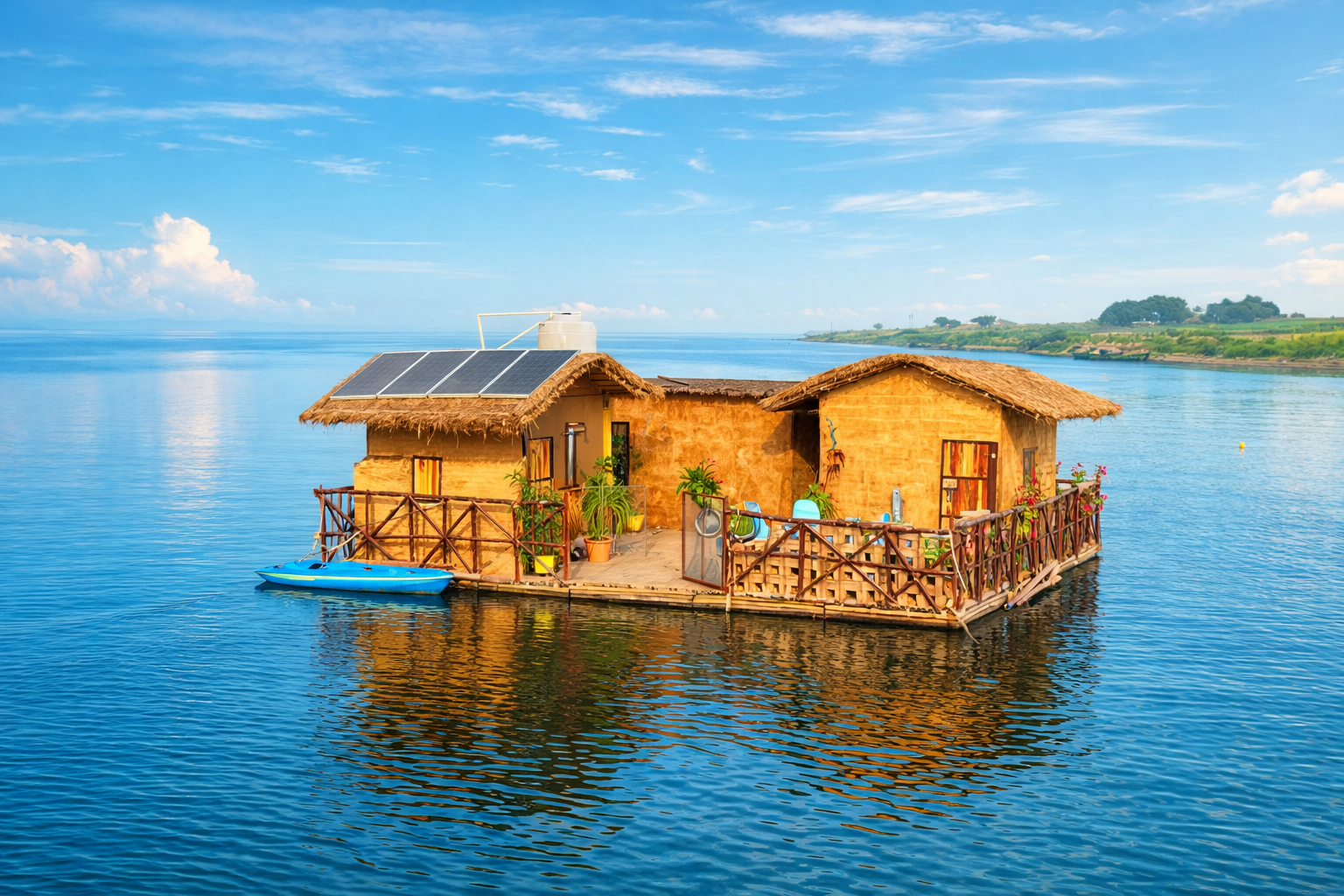
Bihar-based Centre for Resilience, in collaboration with Waterstudio, which specializes in architecture in, on or near water, has been showcasing a floating house since 2022, positioning it as a transformative adaptation response to Bihar’s annual floods.
The initiative has received an encouraging response from the state government, which spends millions of rupees every flood season on reconstruction of houses, relief camps and rescue operations. Officials are testing the design and understanding whether communities will adapt to the new lifestyle, before scaling it.
A prototype: Design, cost and promise
Roughly half a million people get affected due to floods in North Bihar each year. They move to relief camps, shift to embankments or temporarily migrate to other places to escape the fury of the Kosi, Ganga, Bagmati and Gandak rivers..
The floating house measures 900-square-feet, making for a compact home for a family of four and a few cattle. It is currently on display in the Buxar and Bhojpur districts on the Ganga river.
The house uses light-weight and locally available building materials. The base comprises discarded plastic drums, sealed watertight. An anchor, connected to the ground, ensures the house rises with the flood water and prevents it from getting displaced from its original location. The floor, walls and roof are made of bamboo and thatched using a mixture of soil and cow dung, as is traditionally done in the region.
Once the flood water recedes, the structure glides back to its original base. It has survived three flood seasons and remained unscathed when the river’s water level touched the danger mark, Water Studio claims.
Waterstudio specializes in floating structures and its website lists dozens of completed projects, mostly in developed countries, to solve the problems caused by urbanization and climate change.
“We have tested this house for three years and continuously improved its design to ensure that it’s flood-proof and low-cost,” said Kumar Prashant, co-founding director of the Centre of Resilience. The centre spent Rs 6 lakh to build the prototype locally, and plans to bring the cost down to Rs 2 lakh.
Providing stability and conceptualizing a strong anchor took months, Prashant recounted. Uniform weight distribution was necessary to prevent the structure from swaying in strong floodwater currents. “We were able to resolve the issue by applying scientific concepts and also by understanding the nature of the region’s flood. It took months of trials,” he added.
When Climate Action Live contacted Prashant, he was fixing the floating house toilet’s flushing system, while instructing his colleagues to fix the solar panel. “In these three years, we have tried to fine-tune facilities that a family would need when surrounded by water,” he said.
Tanay Sultania, district magistrate of Bhojpur, who has inspected the floating house to explore the possibility of scaling it, said bringing down costs to Rs 2 lakh would be essential to scaling adoption of the prototype.
Learning from elsewhere: Traditional wisdom and global precedents
Traditionally, riverine communities have designed their houses to withstand inundation.
States like Assam have bamboo houses built on stilts, called Chang Ghar, so that floodwater can pass underneath, preventing it from touching the floor and walls.
Countries in the Mekong Delta, including Vietnam and Thailand, have built floating villages and markets to harness the potential of their rivers. Communities in neighbouring Bangladesh have started building floating schools, which are essentially boats. In Kerala’s Kuttanand, floating houses are being made of steel and cost around Rs 35 lakh.
Until the 1950s, when rivers were free of embankments, dams and barrages, water levels during the monsoons would rise gradually, said Dinesh Mishra, an expert on rivers in North Bihar. Riverine communities used traditional knowledge to estimate the intensity of floods, and had a system to manage all but the worst floods.
The anticipated rise in river water was categorised as: high enough to submerge agricultural land; high enough to splash the village’s cattle sheds; and high enough to reach doorsteps.
River water submerging agricultural fields is considered a good flood, as it boosts soil fertility, but a flood spreading to the cattle shed would be considered a first warning sign and a signal to move cattle to higher ground while stepping up vigilance of the water current.
“It’s not that there were no catastrophic floods during pre-embankment years. There were rare instances of flood water hitting the roof of a house, which was called a once-in-a-lifetime disaster,” said Mishra, adding, “Embankments and dams changed the nature of floods, making traditional knowledge for managing floods obsolete.”
A recent study analysed changes in flood frequency and intensity in the post-embankment period in the Kosi region found: communities had developed coping mechanisms to flooding events during the pre-embankment period, but now are forced to find new strategies to deal with increased flood frequency, magnitude and duration, it said.
Climate change and high sediment deposit have changed the equation. Today, rivers frequently breach embankments, causing sudden, catastrophic floods that give villagers little time to evacuate. Farmers lose their houses, cattle, stored grains and household goods. “Climate change has made floods more destructive,” said Ben Reid-Howells, co-director of the Centre of Resilience, who is a community organiser and educator.
Engineering reality
A decade ago, K.M. Soni, a retired Central Public Works Department engineer, had also come up with the concept of floating houses for flood-affected states such as Bihar, Odisha and Assam. He suggested floating houses be designed to rise during floods and subside during dry conditions to prevent loss of life and property. The idea didn’t create much interest from the government. “A floating house is capable of managing vertical and horizontal movements [of water], and requires a robust anchoring system to keep it stable,” said Soni, explaining, “Thus, constructing them becomes expensive.”
This time around, in case of the prototype in Bihar, senior bureaucrats have visited. “Funding is not an issue for innovative ideas in the state,” said Bhojpur district magistrate Tanay Sultania, adding that funding could come from various sources, including Disaster Management Authority’s compensatory housing scheme, or a combination of other policies.
The challenges lie elsewhere, such as convincing people to adopt a different lifestyle. “We are trying to motivate three or four families to accept the challenge,” Sultania said.
Communities are worried about their daily chores, such as how they will move their cattle from the floating house to the field everyday, and connectivity to the house during floods to the relief camps from where they get dry ration, cooked meals, medicines and polythene sheets.
Senior bureaucrats hinted that trials would begin in the Kosi region of North Bihar to establish safety standards and address the practical difficulties.
The project’s proponents believe floating homes are a viable and long-term alternative to the “jugaad” (low-cost improvisation) that locals typically use – lining up boats to build temporary bridges to cross a swollen river, shovelling sand for months to raise the height of their land before erecting modest huts, and building boats from banana trunks for transportation and rescue during the flood season. There have even been reports of a floating cremation system on boats.
In the floodplains of North Bihar, permanence has always been an illusion. The river changes course, the land shifts, embankments crack. Perhaps the question is no longer how to hold the water back, but how to float forward with it.
If the experiment works, Bihar may discover that the way out of its cycle of destruction is not stronger walls, but lighter foundations.
Alok Gupta is a Delhi-based freelance environment journalist. He has reported from the US, China and Hong Kong.
Inspired to Take Action?
Tl;dr: A summary for the busy, the curious, and the done-for-today
Flood-control infrastructure like dams and embankments on rivers such as the Kosi has often worsened flooding by disrupting natural sediment flow, leading to frequent breaches and more catastrophic floods.
In response, a floating house prototype in Bihar offers a climate adaptation solution – designed to rise with floodwaters using lightweight, locally available materials and anchored for stability.
The model has survived multiple flood seasons and could provide a safer, cost-effective alternative to repeated rebuilding and temporary coping strategies used by flood-affected communities.
Traditional flood-resilient practices (like stilt houses) and global examples show that adapting to water, rather than resisting it, can be more effective – especially as climate change intensifies floods.
Key challenges to scaling include reducing costs, ensuring infrastructure and services access, and convincing communities to adopt new living patterns, even as government interest grows.