The Andhra Pradesh Community Managed Natural Farming (APCNF) programme, which involves over a million farmers practising forms of natural farming, recently won the 2026 Food Planet Prize. Awarded by the Curt Bergfors Foundation, this is the world’s largest environmental award for changing global food systems.
As governments across India invest in programmes to reduce farmers’ dependence on synthetic chemicals – and avoid the ₹1.75 lakh crore fertiliser subsidy bill – all eyes are on Andhra Pradesh’s experiment that has grown into one of the largest natural farming movements in the world, with over 50 countries adapting the model to their own agroecological contexts.
The question is: Can a farming model built over decades through women’s collectives, farmer networks and local institutions be scaled across a country of 140 crore people?
(Not forgetting that the National Mission on Natural Farming, which targets 40 lakh farmers across 28 Indian districts by 2030, was allocated ₹616 crore in the 2025-26 budget: 0.35% of the fertiliser subsidy of ₹1,75,099 crore.)
The unlikely origins of a farming revolution
APCNF did not begin as a climate programme.
The year was 1992. At a SAARC summit in Colombo, South Asian heads of state commissioned a study on rural poverty. The resulting document, Meeting the Challenges, landed on one core insight: the poor cannot be helped through technocracy alone. They have to be organised.
UNDP took this seriously and ran pilots across South Asia. The model that worked best came from Pakistan – Shoaib Sultan Khan’s National Rural Support Program. In India, UNDP chose the three most “backward” districts in Andhra Pradesh, namely Anantapur, Kurnool and Mahbubnagar.
The logic was: if it works there, it will work anywhere.
In 2000, Andhra Pradesh scaled the pilot through a new body, the Society for Elimination of Rural Poverty SERP. The Chief Minister chaired it. The vice-chairman was B.N. Yugandhar (a civil servant and father of Microsoft CEO Satya Nadella).
A young IAS officer named Vijay Kumar Thallam joined as co-Leader. Over the next decade, SERP organised 11.5 million rural women in Andhra Pradesh into “Self-Help Groups”. The groups federated at village, mandal and district levels. They became parallel institutions of the rural poor, capable of holding the panchayat, the bank and the welfare departments to account.
These networks also became the backbone through which agricultural knowledge could spread. In 2004, the state began experimenting with non-pesticide management (NPM), using these women’s collectives to help farmers reduce chemical pesticide use.
NPM is the direct precursor of APCNF. The vehicle was the same: women’s federations. The principle was the same: community professionals embedded in villages doing the teaching. WASSAN (Watershed Support Services and Activities Network, a non-profit and resource support organisation based in Hyderabad) and the Centre for Sustainable Agriculture in Delhi built early proof-of-concept. Deccan Development Society contributed millet recipes and traditional food knowledge. The ASHA Kisan Swaraj network kept the policy conversation alive across governments.
In 2011, Vijay Kumar moved to Delhi to lead the National Rural Livelihoods Mission. He extended SHG support from three to 10 years, arguing that people poor for centuries cannot be lifted out by a single subsidy. By 2023, the architecture he championed had organised 100 million rural women across India. He returned to Andhra Pradesh in 2015 and the next year took over a new mission, APCNF, as Vice Chairman of Rythu Sadhikara Samstha, a parastatal authority originally set up for farm loan waivers but given a deliberately broader mandate.
The early years drew on Subash Palekar’s Zero Budget Natural Farming, but, as Vijay Kumar points out, the conversion rates from Palekar’s trainings were only 2-5%. APCNF needed its own scientific foundation.
It found one in 2018. Vijay Kumar had been watching a four-hour YouTube lecture by Walter Jehne, an Australian soil microbiologist, on the carbon cycle. He listened seven times. And invited Jehne to Andhra Pradesh.
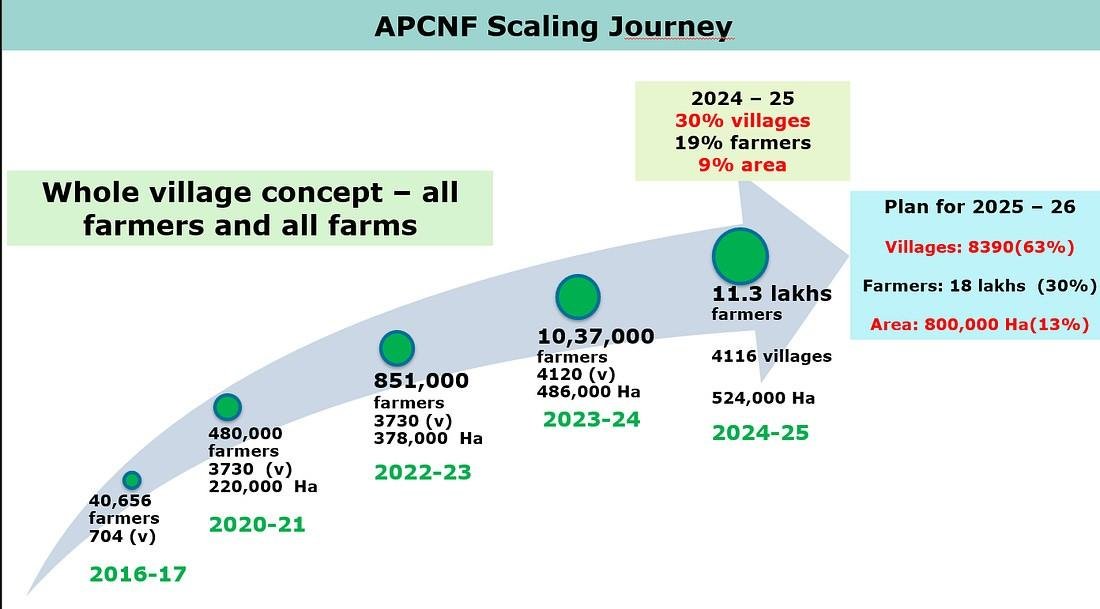
From Vijay Kumar Garu’s presentation at the recent Mysore Kisan Swaraj Sammelan event
Together they experimented with pre-monsoon dry sowing – pelleted seeds planted before the rains, and the soil covered with mulch. Eleven farmers tried it in 2018 in arid Anantapur. The rainfall was poor, but their fields stayed green. By 2023, 850,000 farmers were using the technique.
But who actually benefits from APCNF?
A 2024 peer-reviewed paper from Coventry University and the Food Sovereignty Alliance India documented that APCNF’s SHG credit infrastructure primarily benefits land-owning farmers. The programme uses women’s self-help group networks as its delivery vehicle. That architecture works well for small landholding households. Agricultural labourers – more than half of India’s agricultural workforce – are structurally excluded.
To be fair to APCNF, as Vijay notes, natural farming has changed tenancy rates and provides a pathway for the landless to move towards leased lands.
“There are 522,935 landless families in the project, who have enrolled themselves in Natural Farming. Out of this, 352,262 have raised seasonal nutri-gardens (67%) and 73,922 have raised 365-day nutri-gardens. More than 50% of these families are Dalits. The data on further graduation to leasing lands for food production is not being captured in our MIS.” – Vijay Kumar Thallam
Would the national programme attempting to scale it inherit these blind spots?
Let’s be clear. NMNF and APCNF are apples and oranges.
The national programme uses a lighter delivery model: routed through Krishi Vigyan Kendras and Bio-Input Resource Centres rather than the intensive SHG-embedded Community Resource Person network that APCNF spent a decade building in Andhra Pradesh.
Andhra Pradesh’s results required a pre-existing, dense women’s federation infrastructure that most Indian states do not have.
There is also the Sikkim precedent.
In 2016, Sikkim became India’s first fully organic state, winning the FAO
Future Policy Gold Award in 2018. Within a few years, yields of cardamom, the state’s primary cash crop, had fallen sharply, with over 60% of plantations becoming barren. A CSE survey of 16 farms across Sikkim’s four districts found that only two of 14 private farmers reported any yield increase after the transition; ginger production on some farms reportedly fell to a third of earlier levels.
The state now imports significant food from outside its borders. Critics note that organic certification benefited tourism and premium export markets far more than it helped the average farming household.
Sikkim’s organic transition was state-mandated, fast and uniform. Synthetic inputs were banned outright. APCNF’s model is the opposite of Sikkim: the transition is voluntary, gradual and community-managed, with crop diversification built in from the start.
Sikkim’s yield decline did not appear immediately. It emerged several years after transition, precisely the horizon at which APCNF is now operating in its earliest villages.
So what changes when a farmer moves away from chemicals?
Natural farming is not a single technique. It involves multiple practices, including reduced dependence on synthetic inputs, locally prepared bio-inputs, soil cover, crop diversification and techniques such as pre-monsoon dry sowing.
In 2018, APCNF experimented with dry sowing techniques in drought-prone Anantapur district. Early trials involved 11 farmers. By 2023, the programme reported hundreds of thousands of farmers adopting similar approaches.
Supporters argue that the model can reduce input costs, improve soil health and increase resilience in climate-stressed regions.
But scaling any agricultural transition requires more than promising examples.
It requires evidence.
Does natural farming actually deliver better outcomes?
The answer so far is complicated.
Studies associated with APCNF have reported improvements in farmer incomes, lower input costs and improved yields in some contexts. An impact assessment by analytics provider GIST from across 12 villages and multiple agro-ecological zones reported an average 11% yield increase and a 44% reduction in input costs.
However, independent research has also found that results vary by location and crop.
A University of Reading study found yield improvements in some districts but not others, suggesting that natural farming outcomes depend heavily on local conditions.
This matters because India’s agricultural landscape is extremely diverse. A model that works in drought-prone Andhra Pradesh may not automatically translate to Punjab’s rice fields, Maharashtra’s cotton farms or Assam’s smallholder systems.
Natural farming also increases labour hours: bio-stimulant preparation, intensive crop management, diversified planting systems are all labour-intensive. The income improvement figures measure the return on cash expenditure, not total economic cost. Scarcity of hired labour is a growing constraint for APCNF farmers, 35% of farmers reported facing this in 2018-19, rising to 60% in 2021-22.
Scaling the ecosystem, not the technique
The strongest argument for APCNF is also the hardest part to replicate.
APCNF works because it is not simply a training programme. It relies on community resource persons, farmer networks and women’s collectives embedded in villages.
The central government’s National Mission on Natural Farming aims to expand natural farming across India. But its delivery architecture is different, relying more heavily on existing agricultural extension systems rather than the intensive community model developed in Andhra Pradesh.
This creates the central scaling challenge: Andhra’s system was built through decades of institution-building; it may not lend itself well to a five-year policy cycle.
The concerns India cannot ignore
There are legitimate questions around natural farming.
The first is yield risk. Critics argue that farmers cannot afford a transition period if yields decline before benefits appear.
The second is labour. Natural farming can require more labour for activities such as preparing bio-inputs and managing diversified cropping systems.
The third is inclusion.
Because APCNF relies heavily on farmer collectives and self-help group networks, questions remain about how effectively landless agricultural workers can benefit from the transition.
These are not reasons to dismiss the model. They are the questions that must be addressed if APCNF’s model is to be turned into a national solution.
What would real scaling require?
A successful transition would need two things.
First, knowledge systems.
Farmers need locally rooted experts who can teach, adapt and troubleshoot. APCNF’s farmer-as-teacher approach may be one of its biggest innovations.
Second, markets.
Farmers need reliable buyers and value chains that reward sustainable production.
APCNF has experimented with farmer-owned stores, women-led retail models and direct supply systems. The next stage will require stronger producer enterprises, processing infrastructure and market access.
The climate question
India’s agricultural future will be shaped by climate stress.
Heatwaves, erratic rainfall, groundwater depletion and soil degradation are already affecting farm livelihoods.
The real promise of natural farming is therefore not simply reducing chemicals. It is whether farming systems can become more resilient in a changing climate.
APCNF has not yet proven that it can replace India’s dominant agricultural model.
But it has demonstrated something important: Farmers can change behaviour at scale when transitions are built around communities, trust and local institutions.
The next challenge is whether India can invest in that transition with the same seriousness with which it built the system it now wants to move beyond.
Venky Ramachandran is agritech analyst, consultant and researcher. He runs a popular Substack, Krishi.System and agri-preneurs’ network. This is an abridged and edited version of a story published on Krishi.System.
Inspired to Take Action?
Tl;dr: A summary for the busy, the curious, and the done-for-today
Andhra Pradesh's Community Managed Natural Farming programme has become one of the world's largest farmer-led agroecological transitions, earning the 2026 Food Planet Prize and attracting global attention.
Its success is rooted not just in natural farming techniques, but in decades of institution-building through women's self-help groups, community resource persons and local farmer networks.
While studies suggest the model can lower input costs, improve resilience and increase yields in some contexts, evidence remains mixed and outcomes vary by crop, geography and local conditions.
Scaling the model nationally will require replicating Andhra Pradesh's community ecosystem, addressing concerns around labour demand, yield risks and the exclusion of landless agricultural workers.
As climate change intensifies pressure on Indian agriculture, the real test is whether India can invest in the social infrastructure needed to make natural farming work at scale, rather than simply promoting the techniques themselves.