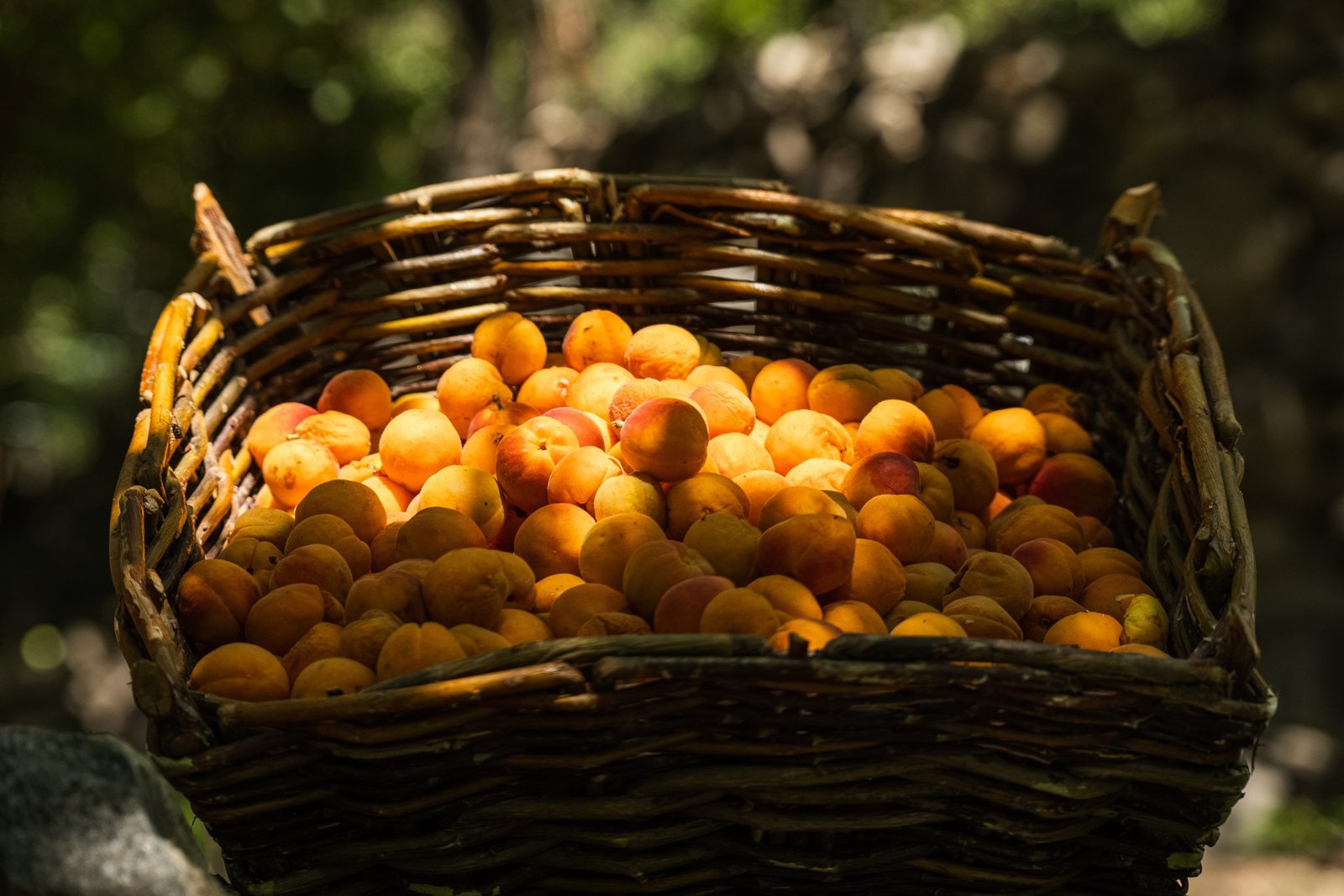
On a clear autumn morning, Nargis Bano, 27, stands in her family’s apricot orchard, surrounded by a soft golden mat of fruit laid out on grass. The apricots, growing in Gargadoo village of Kargil, Ladakh, are Halman A-quality, carefully spaced, slowly drying in the open sun. Nargis moves lightly between them, turning each where needed.
Our ancestors dried apricots like this, she says. They understood the weather and timed everything right.
Seven generations of her family have farmed apricots here. But the weather they relied on has changed.
Unseasonal snowfall, sudden rain and shifting temperatures now disrupt both harvest and drying. For farmers like Nargis, adapting to climate uncertainty is imperative. It determines whether the crop survives at all.
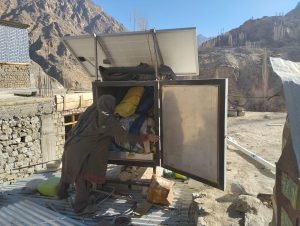
Villagers now use solar dryers for storage. Photo by Safeena Wani
Weather no longer keeps time
Research on climate change in the Himalayan region, such as this paper, shows that shifting rain and snowfall patterns are changing mountain water systems. In Kargil, growers feel it during harvest and post-harvest: rain now arrives when fruit is on trees or spread out to dry, sometimes at both stages.
There is a real need to study apricots, especially how global warming is affecting our farming, says Nasreen Fatima, senior scientist and head of Krishi Vigyan Kendra, Kargil. But only one or two studies exist on this crop.
For farmers, the consequences are immediate: damaged fruit, shortened drying windows, more waste and less income.
A fragile crop, a narrow window
Ladakh produces about 62% of India’s apricots, with 15,789 tonnes grown over roughly 1,675 hectares. In Kargil, apricot is the main cash crop and a cultural anchor.
Once ripe, apricots last barely hours. For decades, farmers sold fresh apricots locally and dried most of the harvest for markets outside Ladakh. But the lack of processing facilities means nearly 60% of the produce goes to waste.
We keep B-grade apricots for jam, juice and oil, says Sadiq Hardasi, a grower from Hardas village. But without processing units, losses are unavoidable.
Kargil has four private processing units. The only government-owned unit has been operating at low capacity for three years. In 2024, we produced around 500 kilos of apricot pulp, says Mohammad Akhoon of the Fruit Growers Cooperative Marketing and Processing Society. Most of it went to waste because there was no clear marketing strategy outside Ladakh.
The entire harvest is completed in just 20 days. Once picked, farmers have five to six hours to sell the fruit fresh or begin drying. Cold storage works only for a week, Akhoon says. Drying remains the most practical option.
Exports help, but not everyone
The Ladakh government has begun exporting fresh apricots to West Asian markets to reduce waste and support incomes. The approach is right, says Ali Raza, Chief Horticulture Officer, Kargil. But the fruit must be packed before ripening so it reaches markets at the right stage.
Officials say exports have helped some farmers, but there are no government cold storage facilities yet. We are working on a refrigerated van for transport to northern India, Raza adds.
Many growers are cautious. Apricots that ripen on the tree have the real taste, Hardasi says. Selling them early can damage our reputation.
Fresh apricots sell for under Rs 100 per kilogram. Dried apricots fetch around Rs 700. Official data shows Kargil produced about 9,834 metric tonnes of apricots in 2024-25. Most farmers are from tribal communities, with holdings of around 0.5 hectare. Apricot farming contributes roughly Rs 43 crore to Kargil’s economy.
Processing is not optional here, says Zakir Zaid, a grower and entrepreneur. It’s about income, food security and survival in a fragile ecosystem.
Solar dryers: Promise and failure
To reduce post-harvest losses, the government in 2018 introduced solar dryers to speed up drying and protect fruit from rain. They were supplied through a tender by Gurugram-based solar energy solutions company Neochlorus, with support from the Horticulture Department and the National Institute of Solar Energy (NISE).
Around 300 dryers were installed with horticulture department support, each covered by a two-year maintenance contract that ended in 2024. By then, 312 units had been distributed in Kargil at a cost of Rs 2.6 lakh each, with a 10% subsidy for purchasers.
The results were disappointing.
In Karkitchoo village, Ghulam Mohammad, the village head, had encouraged farmers to adopt the machines. This was the biggest mistake of my life, he says. Everyone suffered losses.
Farmers say apricots often turn black inside the dryers. Officials acknowledge technical problems, and say the farmers are also not following the instructions. The solar dryer chamber has seven trays, with a heat system at the bottom, Raza explained, The first tray gets the most heat, while the others get only steam and stay moist. The machine needs modification, and we will prepare a separate budget for it. Farmers were advised to switch the top and bottom trays to balance the heat, he says, adding, they don’t follow the guidelines because it is time consuming.
Nargis’s family bought a solar dryer in 2023 with a subsidy. For two years, we couldn’t sell our produce, she says, adding that despite changing trays as instructed, the produce turned black. We went back to open drying.
In response to an email to Director General, NISE, Mohammad Rihan, we were informed that the organisation has received no formal complaints, and suggests that blackening occurs when the fruit is dried whole, without removing the kernel. All dryers supplied under the project were covered by a two-year Annual Maintenance Contract, and the vendor remained fully accountable for servicing and repairs throughout this period, which concluded in 2024, the email said.
Today, Nargis uses the solar dryer as a cupboard. Her leather shoes rest inside. Across Kargil, many subsidised dryers serve similar domestic roles.
When technology fails the real-life test
Growers insist the solar dryers needed essential redesign. Equal heating and exhaust fans are basic requirements, says Akhoon. He adds that these dryers should offer both solar and electric options, as they stop working entirely during cloudy weather and rain.
The story of solar dryers in Kargil echoes an earlier experiment across India: the widespread distribution of clean cooking stoves that promised efficiency and reduced smoke but were quietly abandoned over time. In both cases, well-intentioned technologies arrived with subsidies and ambition, yet failed to account for everyday realities and local habits.
Just as many households returned to traditional hearths that offered reliability and warmth, apricot farmers drifted back to open sun drying when machines proved unreliable during peak harvest. The lesson is similar and increasingly clear to growers in Kargil: solutions endure not because they are new or climate-friendly on paper, but because they fit seamlessly into lived experience and local knowledge.
We contacted the manager of Neochlars in Ladakh for comment, and this story will be updated once we hear from him.
Pack houses: A local fix
After solar dryers failed, many farmers turned to pack houses under government horticulture schemes. A pack house is a simple 30×20-foot structure costing around Rs 4 lakh, with half the cost subsidised by the horticulture department and the rest borne by the farmer. Designed to face the sun, with airflow and polycarbonate roofing, it traps heat without scorching the fruit. Farmers say it dries large quantities evenly and reliably.
Any technology in the Himalayas must be tested locally, says environmentalist Irfan Ahmad. What works elsewhere won’t automatically work here.
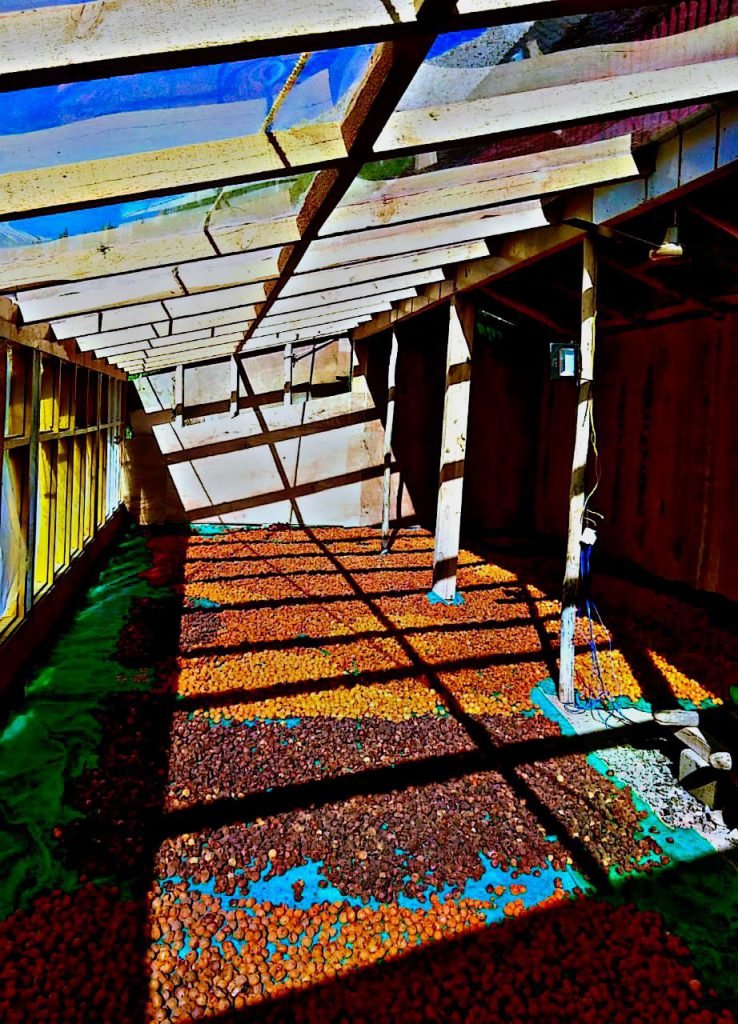
A local solution, hot houses, are working well, farmers say. Photo by Safeena Wani
According to officials, 1,048 pack houses have been provided in Kargil. Yet, access is uneven. Local councillors decide who gets them, says Ghulam Mohammad. Politics becomes another hurdle.
Still, for many growers, pack houses offer something rare: a climate-resilient solution that works with Ladakh’s geography rather than against it.
Back in Gargadoo, Nargis continues turning apricots in Gargadoo’s orchard, carrying forward a centuries-old practice shaped by new realities. Between failed machines and emerging alternatives, and pitted against a changing Himalayan climate, she keeps the harvest alive, reflecting the hope, hard work and deep connection to the land that defines farming in the Himalayas.
Safeena Wani is an award-winning journalist based in Kashmir, whose work focuses on climate solutions.
Inspired to Take Action?
Tl;dr: A summary for the busy, the curious, and the done-for-today
Unseasonal rain and snowfall, and shifting temperatures are damaging crops and shortening the already narrow harvest and drying window for apricot farmers. Apricots are Kargil’s main cash crop, but with limited processing and storage, up to 60% of produce is wasted; farmers must sell or dry fruit within hours of harvest.
Subsidised dryers introduced with support from the National Institute of Solar Energy faced design and usability issues, leading to crop losses. Farmers soon abandoned them.
Simpler “pack houses” aligned with local conditions are proving more reliable, highlighting that climate solutions must fit ground realities, not just technological ambition.
Solutions, to be successful, must be designed in collaboration with those whom they are intended to help.