
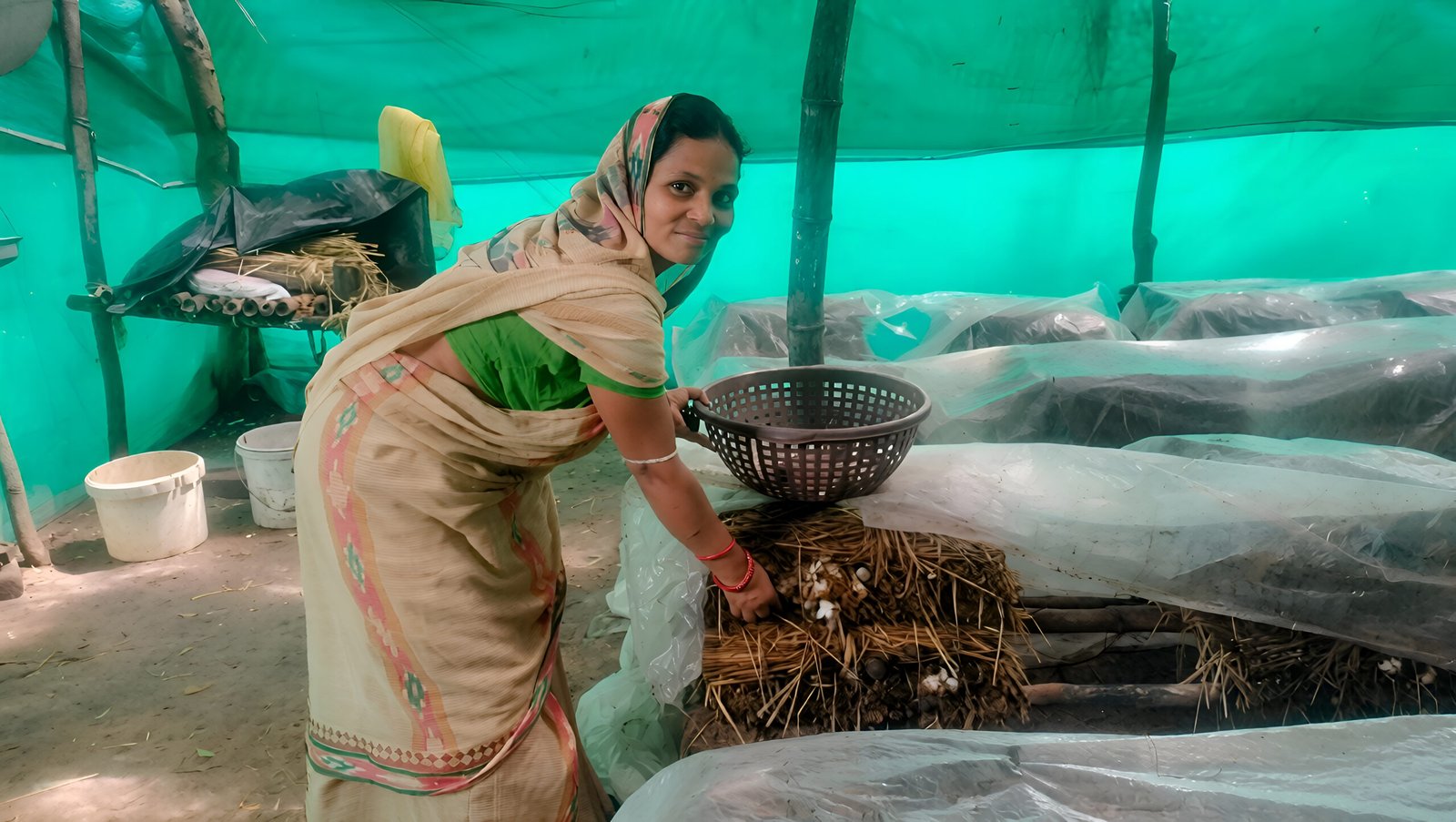
At a shed beside her home in Barihapali village in Odisha’s Bargarh district, 42-year-old Basanti Sahu gently lifts a cluster of freshly grown straw mushrooms from a bed of paddy straw. The earthy smell of moist straw fills the room as rows of neatly stacked bundles await harvest.
A few years ago, much of this straw would have been burned after the paddy harvest. Today, it provides the family’s monthly income before returning to the fields as organic manure.
“Earlier, we looked at paddy straw as something left behind after harvest,” Sahu says, arranging mushrooms into bamboo baskets for traders waiting outside. “Now every bundle has a purpose. It earns for us before it feeds our soil.”
Basanti’s story reflects a larger transformation taking place across rural Odisha: farmers are no longer burning paddy straw as it is being put to valuable use.
That simple idea may determine whether Odisha avoids the stubble-burning crisis that has engulfed the northern agrarian states of Punjab and Haryana.
Unlike north-western India, where crop-residue burning has become deeply entrenched after decades of mechanised rice cultivation, Odisha is at an earlier stage of industrialisation. Since 2019, incidents of paddy stubble burning have been reported from districts including Koraput, Kendrapada, Jagatsinghpur, Sambalpur and Puri. The state has no systematic mechanism to monitor or publicly report the practice, making it challenging to quantify its true extent.
The conditions that encouraged large-scale residue burning elsewhere in India are beginning to emerge in Odisha too. Seasonal migration has reduced the availability of farm labour, use of combine harvesters has rapidly expanded, livestock ownership has declined, and many of the traditional uses of paddy straw have gradually disappeared.
Thus far, the story of stubble burning has been of pollution and enforcement. But Odisha presents a different question: can a state prevent the problem before it takes root?
How paddy straw lost its value
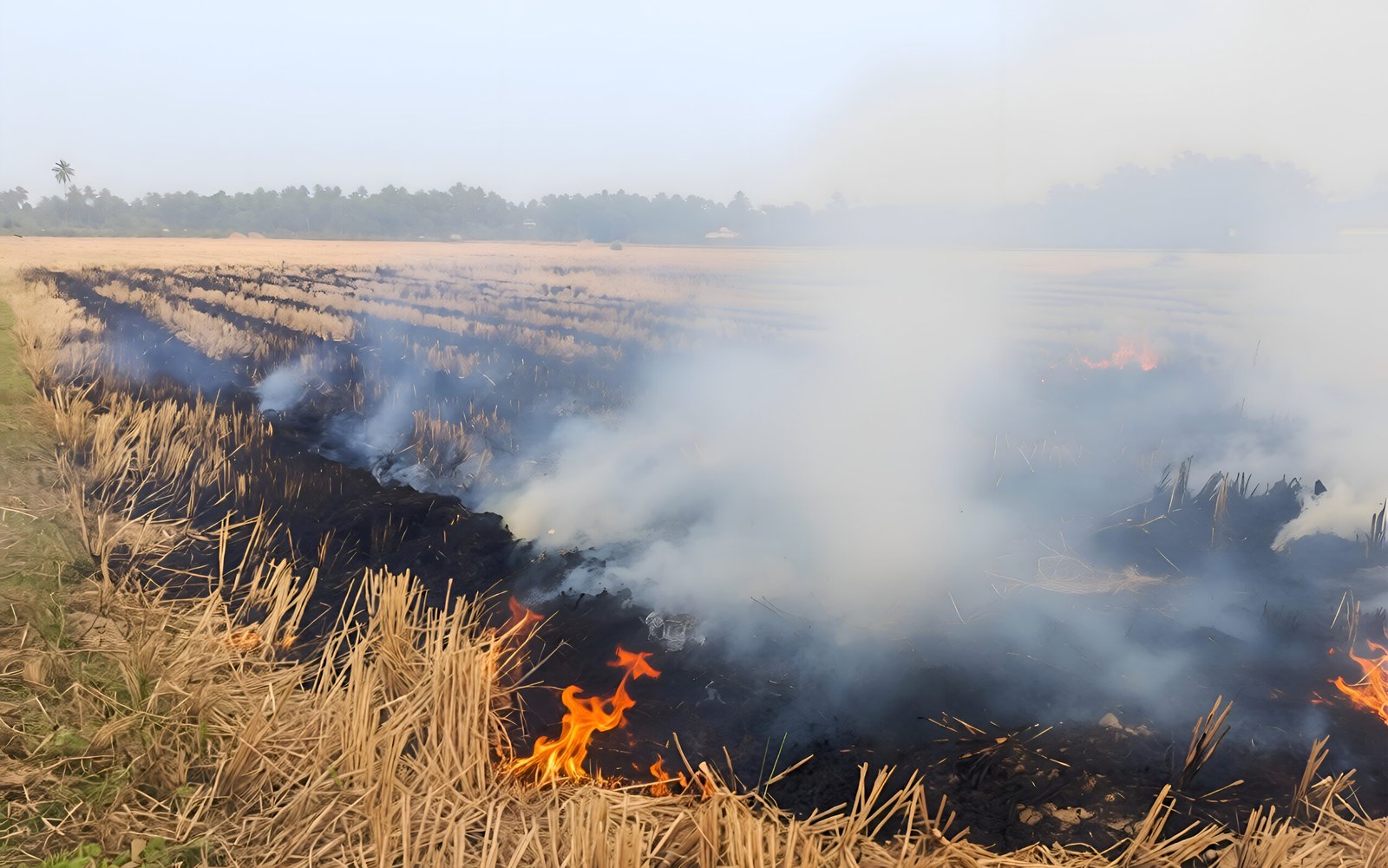
Paddy stubble set afire in a harvested field in Koraput district, Odisha, to clear the land for the next crop. Photo by Abhijit Mohanty
In Odisha, paddy is harvested during November and December, when low temperatures and calm wind conditions have already trapped smoke and other pollutants close to the ground. Stubble burning add to this pollution, and also degrades soil health by destroying beneficial microorganisms and reducing soil fertility.
A 2023 study conducted in the Attabira block of Bargarh district found that repeated burning reduced soil organic carbon, weakening the soil’s long-term productivity and resilience.
For generations before, paddy straw was woven into the fabric of rural life. It fed cattle, roofed thatched houses, enriched soil through composting and mulching, and served countless household needs. Very little of it was treated as waste because almost every family depended on it in one way or another.
That relationship has steadily weakened.
Every year, an estimated 3-5 lakh people emigrate from Odisha in search of work in construction, brick kilns, factories and other sectors to states such as Andhra Pradesh, Telangana, Tamil Nadu, Kerala and Gujarat. Paddy harvesting, once carried out collectively by families and neighbours, has become increasingly difficult due to labour shortages and rising wages.
Mechanisation has filled the gap.
According to the Odisha Economic Survey 2024-25, nearly 97,000 agricultural machines were subsidised during 2023-24. Some 2,800 Custom Hiring Centres now provide farm machinery on rent, making combine harvesters increasingly accessible to small and marginal farmers.
For farmers like Dambrudhar Muduli from Koraput district, the choice is largely economic.
“Manual harvesting needs around 12 labourers and costs nearly Rs 4,800 an acre,” he says. “A combine harvester finishes the same field in about an hour for around Rs 2,000. Why would any farmer choose the more expensive option?”
Mechanised harvesting has reduced costs and saved labour, but it has also changed how crop residues are managed. Unlike manual harvesting, combine harvesters leave chopped paddy straw spread across the field. Farmers growing short-duration pulses such as green gram and horse gram often have only a narrow window before the next sowing, leaving little time to collect or recycle the residue.
According to Subhasisa Bal, former Principal Scientist at the Indian Council of Agricultural Research (ICAR), the changes are part of a broader transformation in rural agriculture rather than a problem caused by machines alone.
“Mechanisation has become necessary because agriculture can no longer depend on abundant manual labour,” he says. “The entire farming system has changed. Labour migration, less livestock and new harvesting practices have all altered the role that paddy straw once played on farms.”
The value of straw has declined for another reason as well.
Odisha’s cattle and buffalo population has fallen by more than 30% since 1997, sharply reducing the demand for straw as fodder. At the same time, millions of thatched houses have been replaced by permanent homes under rural housing schemes, eliminating another traditional use. Yet Odisha continues to produce nearly 19.5 million metric tonnes of paddy every year, generating an estimated 10 million tonnes of paddy straw.
As traditional uses disappear, more straw is left behind in the fields after harvest. For many farmers, paddy straw has lost its place in the farming system and is increasingly treated as residue to be cleared before the next crop.
This is when burning begins to look like the quickest and cheapest option. But the consequences extend far beyond a single harvest.
According to the Food and Agriculture Organization of the United Nations, burning one ton of paddy straw results in the loss of approximately 5.5 kg of nitrogen, 2.3 kg of phosphorus, 25 kg of potassium and 1.2 kg of sulphur. The intense heat destroys beneficial soil organisms while releasing greenhouse gases and fine particulate matter into the atmosphere.
Susanta Sekhar Choudhury, an agriculture expert with Watershed Support Services and Activities Network, says we often underestimate what is happening beneath the surface.
“People notice the smoke, but the real damage happens in the soil,” he says. “Repeated burning reduces biological activity, weakens the soil’s ability to retain moisture and gradually increases dependence on external inputs. Healthy soil takes years to build, but it can be degraded very quickly.”
For Debabrata Panda, Associate Professor at the Central University of Odisha, the more important question is whether Odisha can avoid repeating the experience of Punjab and Haryana.
“Punjab is trying to solve a problem after it became deeply entrenched,” he says. “Odisha is in a different position. Crop-residue burning here is still scattered rather than routine. The state has an opportunity to intervene early by creating better uses for paddy straw before burning becomes part of the farming system.”
Making straw an asset
Six years ago, Basanti and her husband, Bisarga Sahu, routinely burned the paddy straw left behind after harvesting their fields. Today, the same straw generates a steady monthly income, improves soil fertility and supports a small circular economy on their farm.
The turning point came in 2019 when Bisarga Sahu attended a mushroom cultivation training programme organised by the NGO Bhitti Bhumi. Keen to experiment, he invested Rs 500 and prepared a few mushroom beds using paddy straw from his own farm.
The experiment gradually grew into a thriving enterprise. Today, the couple manage nearly 500 mushroom beds, earning Rs 30,000-35,000 a month in addition to income from paddy and millet cultivation. The couple jointly prepare the straw beds, maintain humidity inside the shed, harvest mushrooms and market the produce.
The straw continues to generate value even after the mushrooms are harvested. The spent mushroom substrate is transferred to a compost pit, mixed with cow urine and allowed to decompose before being returned to their paddy and millet fields as organic manure. “The straw gives us two harvests,” Bisarga says. “First it gives us mushrooms. Then it feeds our fields. We don’t waste anything.”
The additional income has enabled the family to educate both their sons. Their elder son is pursuing a diploma in electrical engineering, while the younger one is studying in Class XII.
The idea has spread beyond their own farm. Around 30 farmers from neighbouring villages, including Jamla, Ichapali, Bisipali and Baidapali, have also stopped burning paddy straw and begun using it for mushroom cultivation.
Mushroom cultivation is expanding rapidly in Odisha. According to the Department of Agriculture and Farmers’ Empowerment, the state produced around 63,000 metric tonnes of mushrooms during 2025-26, up from 35,359 metric tonnes in 2024-25. Odisha now contributes nearly 11% of India’s total mushroom production, making it one of the country’s leading mushroom-producing states.
The Odisha government launched Mushroom Mission in 2022 to double mushroom production in the state. By 2026-27, it aims to establish 40,000 paddy-straw-and-oyster mushroom units, supported by spawn production centres, mushroom preservation units and farmer training programmes.
Building new markets for crop residue
Mushroom cultivation is only one example of how paddy straw can once again become a resource that farmers can put to multiple economic uses.
Across India, paddy straw is increasingly being converted into compost, paper, biodegradable packaging, biochar, biomass pellets and biofuels. According to the Ministry of Power, more than 2.04 million tonnes of biomass pellets made from crop residues have been co-fired in thermal power plants over the past three years, creating a growing market for agricultural waste that was once routinely burned.
Odisha is beginning to move in the same direction.
In July 2026, Bharat Petroleum Corporation Limited (BPCL) commissioned India’s first integrated first- and second-generation bioethanol refinery in Bargarh. (First-generation (1G) bioethanol is made from food crops like corn, wheat, and sugarcane using simple sugar fermentation. Second-generation (2G) bioethanol is made from non-food, plant waste like straw, wood chips and bagasse using complex chemical and enzyme breakdown.) Built at a cost of Rs 1,775 crore, the refinery is expected to produce 2 lakh litres of ethanol every day, with paddy straw accounting for nearly half of its feedstock. BPCL estimates it will procure around 480 tonnes of paddy straw daily from nearly 1.6 lakh acres through an organised biomass supply chain.
Even so, the refinery will utilise only a small fraction of the 10 million tonnes of paddy straw produced annually in Odisha. “The refinery is an important beginning, but it cannot be the only answer,” says Subhasisa Bal. “No single industry can consume all the paddy straw produced in the state. Farmers need multiple markets for the same resource – mushroom cultivation, livestock, composting, biomass industries, paper, packaging and biofuels. The stronger these value chains become, the less likely farmers are to burn their residue.”
Researchers say this diversity of markets is what could prevent Odisha from following the trajectory of Punjab and Haryana.
Policy support for crop residue management in Odisha is still evolving. While the state does not yet have a dedicated strategy to prevent stubble burning, several initiatives indirectly encourage the productive use of paddy straw.
The Department of Fisheries and Animal Resources Development, for instance, supports farmers in converting paddy straw and other crop residues into nutrient-enriched cattle feed through its Support to Farmers for Promoting Fodder Cultivation–Enrichment of Crop Residue scheme. Similarly, under the Sub-Mission on Agricultural Mechanization, farmers can also access subsidies for balers, shredders and other machinery that help collect and manage crop residues.
Back in Barihapali, Basanti Sahu places another bundle of paddy straw inside the mushroom shed. In a few weeks, it will produce another crop before returning to the family’s fields as compost.
On her farm, paddy straw has completed a full circle from crop residue to income, and back to the soil.
Across Odisha, millions of tonnes of paddy straw will soon be left behind after the harvest. Whether that straw becomes smoke in the sky or a source of income for farmers will depend on one simple question: does it still have value?
Abhijit Mohanty is a Bhubaneswar-based independent journalist who reports on sustainable food, livelihood, gender and climate change with a special focus on tribal and other marginalized communities of India.
Inspired to Take Action?
Tl;dr: A summary for the busy, the curious, and the done-for-today
Odisha is beginning to face the same agricultural changes that fuelled large-scale stubble burning in Punjab and Haryana.
Labour shortages, mechanisation and declining livestock have stripped paddy straw of many of its traditional uses.
Farmers like Basanti Sahu are proving that straw can generate income through mushroom cultivation before returning to the soil as compost.
New industries, from bioethanol to biomass and packaging, are creating fresh demand for crop residue but need stronger value chains.
Researchers say Odisha still has a rare opportunity to prevent a stubble-burning crisis by making paddy straw economically valuable.