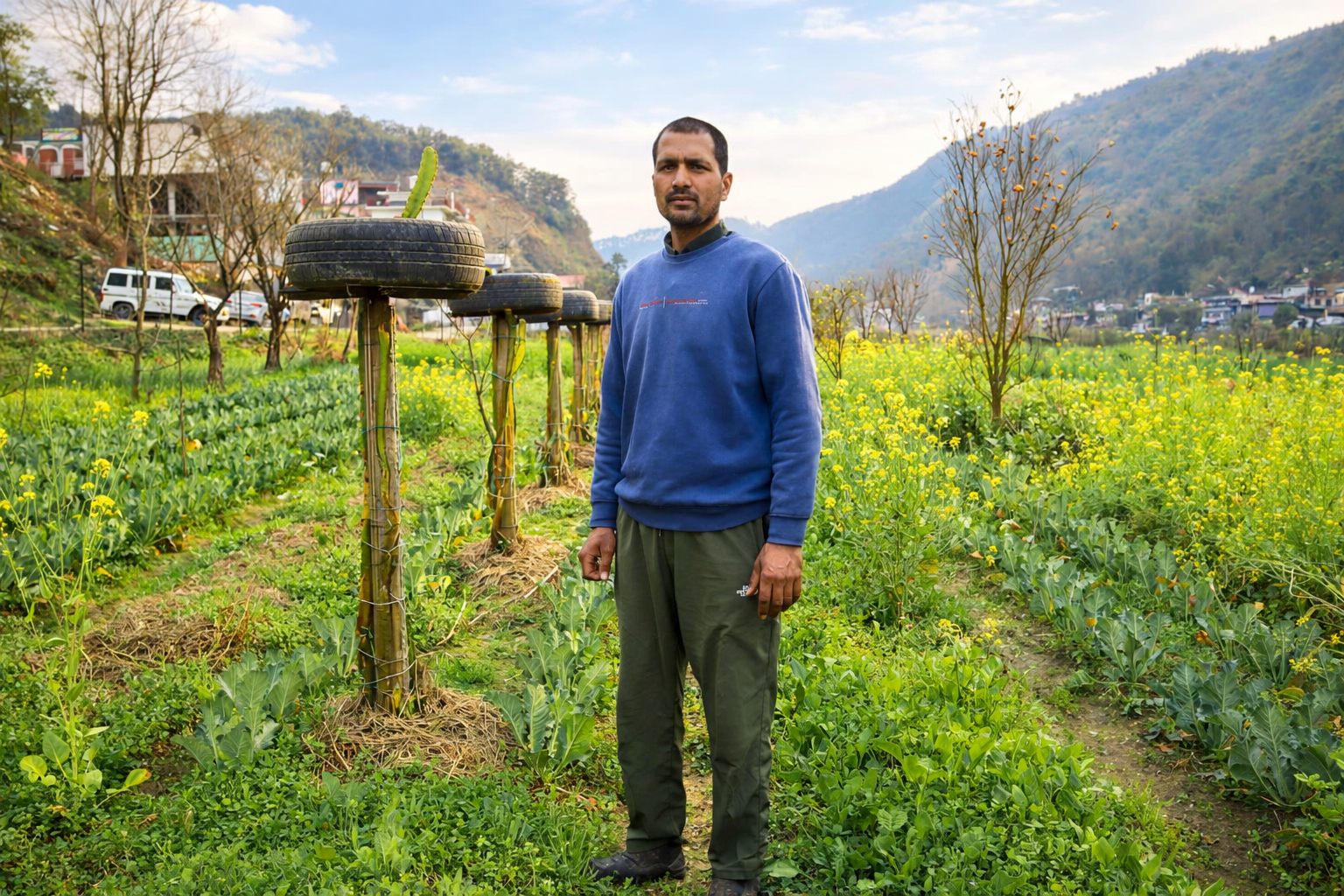
Just after sunrise, before traffic thickens on the four-lane highway skirting his house, Tajender Thakur walks into his field with a hoe resting on his shoulder. Beyond the boundary wall, trucks and buses will soon gather speed. Inside, across eight bighas, the morning is quieter. His wife, Poonam, follows him between rows of crops, stopping occasionally to turn a leaf over or press the soil with her fingers.
What stands on the field is not a single crop but the absence of uniformity. Wheat and maize grow in blocks, vegetables climb trellises, pulses fill the gaps, and fruit trees mark the edges. By Thakur’s count, 23 kinds of crops and vegetables grow here along with 10 kinds of fruit. There is wheat, maize, barley, finger millet and rice, besides pulses. Vegetables range from cauliflower and broccoli to okra, radish, turnip, peas, potato, colocasia, capsicum, brinjal and gourds. The fruit trees include mango, guava, banana, pomegranate, orange, sweet lime, plum, peach and dragon fruit.
Asked what he buys from the market, Thakur does not take long to answer. “Salt,” he says. “Nothing else.”
In his early 30s, Thakur is not new to farming. He grew up working in these fields with his parents and, for years, followed the same path as most farmers in the area: chemical-intensive commercial agriculture. Fertilisers and pesticides were part of the routine, and in crops such as cauliflower, he says, spraying had to be done almost every week. “In the beginning, it seems manageable. Then the costs keep rising. Pests become harder to control. One day you realise that whatever you earn is going straight back into inputs,” he says.
He also noticed changes in the land itself. The soil, he says, became hard, “almost like cement”. Water did not percolate the way it used to, and crops seemed to need increasing support just to maintain yields. At the same time, health concerns from chemical-laden foods began to worry him.
After he got married in 2016, he became more worried about the food his family was eating. “I had decided that my children should not grow up eating food produced with so many chemicals,” he says. Before his son was born, he stopped using them altogether.
The transition was not guided by any formal training at first. Thakur began by watching online videos on natural farming methods on preparing jeevamrit and beejamrit (cow-based bio-formulations used to nourish the soil and protect seeds), on mulching, on mixed cropping and on ways of restoring life to the soil. In 2018, he joined the Himachal Pradesh government’s natural farming initiative. Since then, all eight bighas of his land have been managed without chemical fertilisers or pesticides, a self-certified three star – the highest category – under the Certified Evaluation Tool for Agricultural Resource Analysis-Natural Farming of Himachal government. Although the natural farming initiative has implemented a self-certification system for farmers, efforts are still needed to develop an independent certification mechanism at the national and international level. This would enhance the credibility of Himachal’s natural farming produce in global markets, opening up more international opportunities for regional products.
“The fear is real in the beginning” Thakur says. “People tell you yields will fall; insects will destroy crops. But when you grow many crops together and keep the soil covered, nature starts balancing things on its own.”
His field today reflects that approach. No single crop dominates. Cereals, vegetables and pulses are intercropped, and fruit trees are interspersed to provide shade and structure. The diversity, he says, reduces risk and dependence on external inputs.
The economics of the farm have changed along with its ecology. Thakur estimates that he earns up to ₹60,000 a month from selling surplus produce. Just as important, he says, is the fact that his household no longer depends on the market for everyday food. “Whatever cooks on our stove is grown by us, without chemicals,” Poonam says. “It feels like the right decision. There is a different satisfaction in eating what your own land produces.”
Their children move freely through the fields, sometimes plucking vegetables and eating them raw. “We don’t worry,” she says. “There is no fear about what is on that food.” For Thakur, this is as significant as the income. “Money matters,” he says. “But if your health is getting worse and your land is getting weaker every year, then something is wrong with the system.”
His experiment is part of a broader shift underway in Himachal Pradesh. The state government says around 2.25 lakh farmers have adopted natural farming practices in recent years. To encourage the transition, it has announced what it describes as the country’s highest minimum support price for naturally grown grains, reported to be nearly three times the MSP for conventionally produced wheat set by the Centre. The state has also launched marketing initiatives under brands such as Him Bhog and Him Prakritik, under which products like dalia, wheat flour, maize flour, barley flour and turmeric are being sold.
“This kind of assurance matters,” Thakur says. “When there is a clear price and a market, farmers are more willing to change how they farm.”
In Himachal’s lower altitude Mandi district, farms like Thakur’s are increasingly being used as demonstration sites. Rakesh Kumar, District Project Director of the Agriculture Department’s Agricultural Technology Management Agency (ATMA), says such models help persuade farmers who are unsure about shifting away from chemicals. “We now have several good natural farming examples in the district,” he says. Farmers like Tajender become reference points. We bring other farmers here so they can see for themselves how this approach works.”
By late afternoon, the highway outside Thakur’s field hums with steady traffic. Goods and commuters move past at speed, largely indifferent to the small patch of land beyond the road’s edge. Inside the field, the pace is slower. Thakur walks the rows, checks leaves for pests, feels the soil, adjusts a support for a climbing plant.
“We are not against development,” he says. “But if we cannot protect our food, our soil and our children’s health, then we need to ask what kind of development this is.”
His eight bighas lie between a house and a highway, between two ideas of progress. One is measured in speed and volume. The other is built on diversity, soil health and a degree of self-reliance that has reduced his dependence on the food market to a single item.
Rohit Prashar is a journalist who specialises in climate change, agriculture, rural livelihoods and Himalayan ecology, with a deep focus on the Himalayan region.
Inspired to Take Action?
Tl;dr: A summary for the busy, the curious, and the done-for-today
Himachal farmer Tajender Thakur moved away from chemical-intensive agriculture due to rising costs, soil degradation and health concerns, adopting natural farming practices.
His eight-bigha farm now grows 20+ crops and multiple fruits through mixed cropping, meeting nearly all his family's food needs.
Natural methods like mulching and bio-inputs have restored soil health, reduced pest issues and cut input costs, while earning up to ?60,000/month from surplus produce.
Backed by state support (higher MSPs, branding and farmer outreach), natural farming is expanding, with model farms like Thakur’s helping convince others to shift.
Farmers can currently self-certify their farms as natural, but an independent certification mechanism at the national and international level will reassure more buyers.