On the southwest coast of India, long before policymakers began speaking of “nature-based solutions” or “ocean literacy”, fishers in Kerala already knew where life thrived beneath the waves. They called these underwater ecosystems “paru” – reefs, rocky outcrops and seabed formations where fish aggregate, breed and take shelter. For generations, this knowledge guided when to fish, where not to fish, and how to avoid damaging the sea that sustained them.
Today, that same indigenous knowledge forms the backbone of Friends of Marine Life (FML), a fisher-led organisation working at the frontline of ocean conservation and climate resilience in South India. At a time when climate change, pollution and unregulated maritime trade are converging into overlapping crises, FML offers a grounded solution: protect the ocean by empowering those who live with it every day.
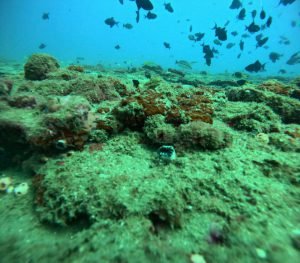
Photo by Aishwarya Bajpai
Seeing the unseen
One of FM’s most effective interventions addresses a basic but persistent gap in marine governance – the absence of the seabed from public and policy imagination.
“Most decisions about the ocean are made by people who have never seen what exists below the surface,” says Robert Panipillai, Founder and Chief Coordinator of Friends of Marine Life. “Fishers, on the other hand, have always known where life concentrates. That knowledge was just never taken seriously.”
Soon after the devastating 2004 tsunami, Panipillai, himself a fisherman, learnt diving from professional divers and trained six fellow fishers, laying the foundation of Friends of Marine Life with modest community support and volunteer funding. What began as an effort to “see” climate change underwater soon drew young fishermen eager for skills and income beyond fishing.
FML trained fishers in documenting nearshore ecosystems through underwater photography and seabed mapping. Local fishers and collaborators who already knew where paru existed, documented coral patches near St Andrews beach, and recorded rare sponges and nudibranch species for the first time in India.
“These ecosystems were never unknown,” Kumar Sahayaraju, Marine Researcher with FML says. “They were unknown to science and policy. Fishers always knew where paru was.”
The images quickly became tools for change. Schools and colleges began using them in ocean literacy programmes, and they began to use the word paru. Traditional ecological knowledge entered formal marine science not as anecdote, but as visual, verifiable evidence.
“When people see the seabed, the conversation shifts,” Sahayaraju says. “Earlier, underwater ecosystems were abstract. Now people can see what exists – and what we stand to lose.”
Conservation without criminalising livelihoods
FML’s model challenges a dominant conservation narrative that frames fishing communities as threats to biodiversity. Instead, it centres livelihoods as a condition for protection. “Fishers are usually brought into conservation discussions as a problem to be managed,” says Panipillai. “Our work shows that fishers are already managing ecosystems – they just aren’t recognised for it.”
Kerala has established community-led protection for more than 10,000 sq km of terrestrial ecosystems. But no similar framework exists for the state’s nearly 13,000 sq km of coastal waters. “That absence matters,” Panipillai says. “Marine ecosystems are treated as open-access spaces, even though communities depend on them every day.”
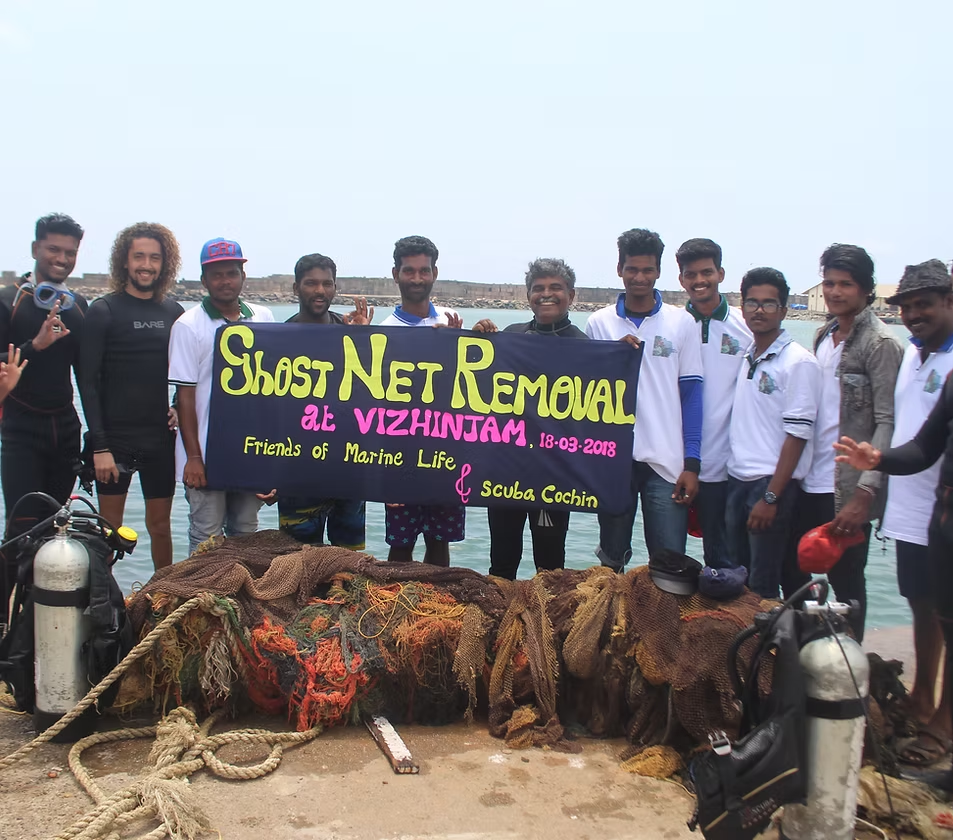
FML’s work fills this gap through practical, low-cost interventions: documenting spawning grounds, mapping sensitive habitats, and removing ghost nets that continue killing marine life long after being abandoned. “These are not expensive solutions,” Panipillai says. “They depend on trust, local knowledge and continuity – not technology alone.”
The ecological benefits are clear. Healthy seabeds support fish stocks, stabilise sediments and buffer coastal ecosystems against shocks. In a warming ocean where fish are migrating deeper and species composition is shifting, local stewardship functions as a climate adaptation strategy, even if it is rarely recognised as such.
Scientists and researchers such as A. Biju Kumar, Vice-Chancellor at Kerala University of Fisheries and Ocean Studies, have collaborated with FML in documentation of marine biodiversity. Waste samples collected during FML’s seabed clean-ups have been tested by the Department of Aquatic Biology at the University of Kerala in Thiruvananthapuram, linking their citizen science work with formal research. The findings have been shared with the Environment Committee of the Kerala State Legislative Assembly, giving their work policy relevance.
Responding to disasters
FML’s community-led monitoring became especially visible in mid-2025, when two cargo vessels sank off Kerala’s coast within weeks. One, the 28-year-old MSC Elsa 3, was carrying hazardous cargo, including calcium carbide and plastic pellets.
Rather than waiting for official assessments, fishers began documenting impacts themselves – from pellet accumulation on beaches to changes in fishing grounds during peak spawning season. “Fishers could immediately tell something was wrong,” Sahayaraju says. “This was not just another wreck. The cargo mattered.”
Shipwrecks can sometimes evolve into biodiversity hotspots as algae and phytoplankton colonise submerged structures, Saharajyu says. Fishers off Thiruvananthapuram have relied on such wreck ecosystems for generations. But this process depends on what sinks with the ship.
“Plastic pellets and chemicals change water quality, seabed chemistry and the food chain,” Sahayaraju explains. “The reproductive cycle of species is disrupted. That affects biodiversity and livelihoods at the same time.”
FML has consolidated community observations, documented ecological risks and raised the issue internationally. It has since called for specific reforms: hazardous shipping containers should be tracked via GPS, spills should invite corporate liability, and plastic and chemical cargo should be governed by international regulations.
“The solution is not banning shipping,” Panipillai says. “It is making those who profit from it responsible for its impacts.”
Strengthening science through fisher knowledge
For Sebastian Rodrigues, General Secretary of the National Federation of Small-Scale Fishworkers, FML’s work demonstrates what becomes possible when fisher knowledge is treated as expertise rather than folklore.
“Fishworkers understand climate, temperature, biodiversity and seabed habitats as systems,” Rodrigues says. “The problem is not whether this knowledge is scientific. The problem is that science refuses to meet it halfway.”
Rodrigues points to rare but successful collaborations. In Goa’s Zuari river, scientists from the Indian Council of Agricultural Research trained fishers to photograph and document fish species. Data collected by fishers was published in international journals. “But these are exceptions,” he says. “At a larger scale, fishers are never treated as partners, only as data sources.”
Fisheries departments, Rodrigues notes, are largely staffed by administrators rather than people with lived fishing experience. “As climate impacts intensify, this institutional gap becomes dangerous,” he says. “Everything gets blamed on climate change, [when in fact] impacts are magnified by pollution, overexploitation and hazardous shipping. Small-scale fishers bear the worst burden.”
If you’re inspired to get involved, here are some ocean conservation organisations that welcome volunteers:
- Reefwatch, which has worked with individuals in the fields of science, government, filmmaking, photography and the media. Working to protect and nurture the diversity of life in India’s coastal and marine environments, they currently have projects in Karnataka, Goa, Gujarat and the Andaman Islands.
- The Society for Marine Research and Conservation (SMRC), Cochin, Kerala, works to improve understanding of the marine ecosystems of India, its flora and fauna, through dedicated field research.
- Coastal Impact, based in Goa, that studies and monitors India’s marine ecosystems to support awareness, outreach, research and conservation initiatives across the country.
- Wildlife Conservation Society – India that works to conserve unique habitats and biodiversity by working with communities and partner organisations on the ground.
Climate adaptation rooted in daily practice
Fishers in Kerala describe climate change not through distant projections, but through daily disruptions. Monsoon patterns have become erratic. Winds arrive unpredictably. Upwelling events that once triggered plankton blooms no longer follow seasonal rhythms.
“After Cyclone Ockhi in 2017, storms are no longer rare events,” Sahayaraju says. “Fishers now spend almost half the month monitoring weather warnings instead of fishing.”
FML responds by co-producing climate knowledge – combining traditional ecological observations with scientific monitoring to generate information that fishers can actually use. “When knowledge comes from outside, it often arrives too late or is too abstract,” Sahayaraju says. “When it is produced with fishers, it becomes actionable.”
This approach improves accuracy and trust, but remains underfunded.
From participation to leadership
Despite its demonstrated impact, FML operates with minimal resources, drawn from their community. It has no steady institutional funding and relies heavily on volunteer labour, even as it is invited into national and international policy spaces.
“Community voices are welcomed on panels,” Panipillai says. “But funding flows to large institutions. Citizen organisations provide access and legitimacy without resources.” Rodrigues sees this as a structural contradiction. “Global conservation depends on local enforcement and monitoring,” he says. “But communities are still treated as beneficiaries, not leaders.”
He argues that funding agencies must engage directly with fisher organisations and move from what he calls a “trust deficit” to a “trust surplus”.
No universal answers
FML does not claim to offer universal answers. What it demonstrates is a working model: fisher-led seabed documentation, debris removal, integration of indigenous knowledge and climate adaptation grounded in lived experience.
Rodrigues argues that legal reform is the missing link. Fisheries fall under state jurisdiction within 12 nautical miles, yet no Indian state grants legal rights over water – only customary access. “Good fish needs good water,” he says. “And good water needs legal protection.”
As global leaders debate ocean targets and climate pathways, Kerala’s fisher communities offer a reminder: solutions already exist. They are diving, mapping, cleaning, documenting and teaching – often without recognition, often without pay.
Protecting life below water, they show, is inseparable from protecting life above it.
Aishwarya Bajpai is a Haryana-based freelance journalist and researcher focusing on climate and environmental reporting.
Inspired to Take Action?
Tl;dr: A summary for the busy, the curious, and the done-for-today
In Kerala, traditional fisher knowledge of “paru” (underwater ecosystems where marine life thrives) is being used by Friends of Marine Life (FML) to guide conservation and climate resilience efforts.
FML empowers fishers as knowledge holders and practitioners – training them in seabed mapping, underwater documentation and debris removal – bridging indigenous knowledge with formal science and policy.
Their work challenges mainstream conservation approaches by showing that protecting livelihoods and ecosystems can go hand in hand, with community-led stewardship improving biodiversity and climate adaptation.
Fishers also play a critical role in disaster response and monitoring, documenting impacts of events like shipwrecks and pollution, and advocating for stronger regulation and corporate accountability.
Despite proven impact, such initiatives face structural barriers – limited funding, lack of legal rights over marine resources, and weak integration into formal governance – highlighting the need to shift from token participation to true community leadership.