
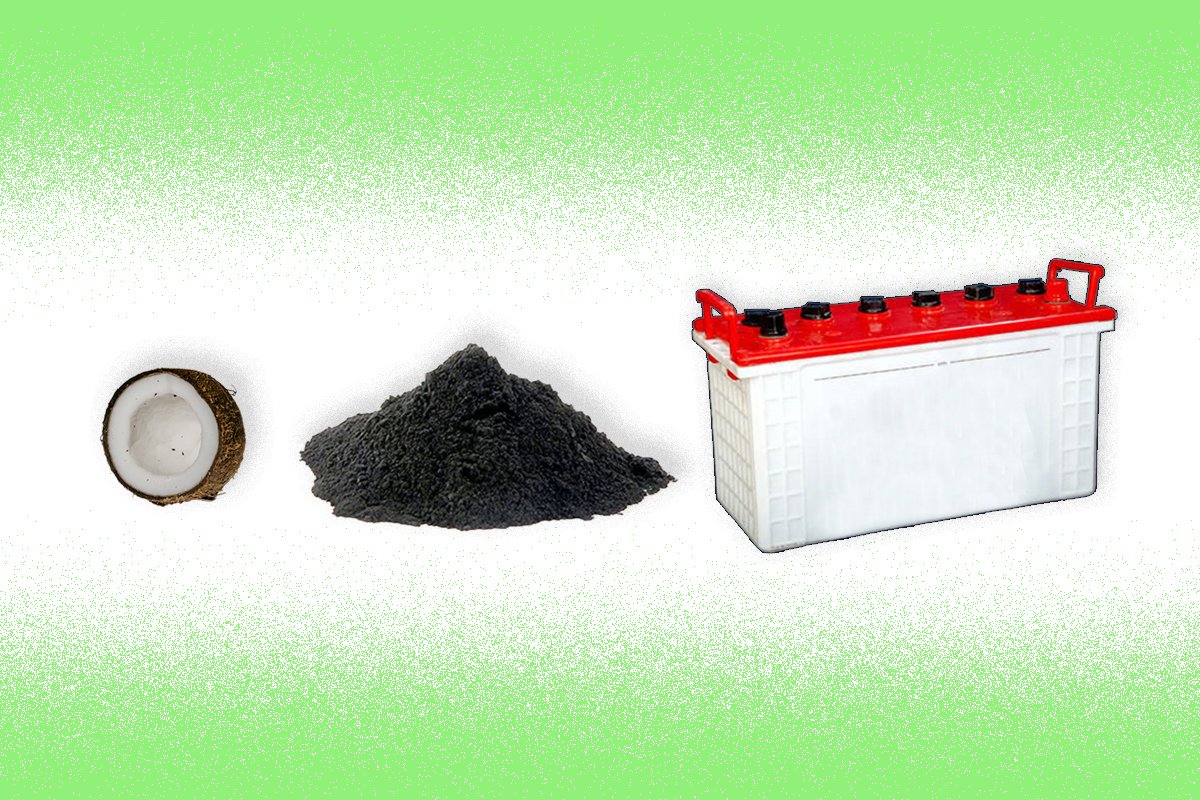
Every time an Indian household backs up its power with a UPS during a blackout, or an e-rickshaw squeezes out one more ride before charging, there is an invisible material working behind the scenes: carbon.
Batteries are not just about lithium. Increasingly, the real innovation battleground is around the supporting materials inside batteries, materials that influence conductivity, heat generation, charging speed and battery lifespan.
Most batteries today depend on fossil-derived carbon additives to help conduct electricity efficiently. These conductive additives make up only a small share of a battery’s total mass, but they play an outsized role in performance.
That carbon comes with an environmental cost. Now, a Jaipur startup claims it has found a cleaner alternative in a place few would look: discarded agricultural residue.
Founded in 2020 by Akshay Jain and Mahi Singh, Jaipur-based Cancrie is converting agricultural waste into nanocarbon, a conductive material used inside batteries and capacitors. Its founders say the material can improve battery efficiency, extend battery life and reduce dependence on fossil-derived carbon, all without requiring manufacturers to redesign their batteries.
In a country racing to electrify transport and scale renewable energy, the company is among a small group betting on biomass-derived nanocarbons. The company is named after the planet 55 Cancri e, which is abundant in high-quality carbon, diamonds and graphite.
Why batteries are becoming India’s climate bottleneck
India’s clean energy ambitions are massive. At COP26 in 2021, India committed to achieving 500 GW of non-fossil fuel energy capacity by 2030, sourcing 50% of its electricity from renewables and reaching net-zero emissions by 2070.
At the same time, India is pushing for 30% EV penetration by 2030 under the National Mission on Transformative Mobility and Battery Storage.
But solar panels and electric vehicles are only as clean as the batteries that support them.
Mining lithium, cobalt, nickel, manganese and graphite for batteries has already triggered environmental concerns and geopolitical anxieties around supply chains. Conventional battery manufacturing also relies heavily on fossil-derived carbon black, which generates emissions during production.
Most efforts in the battery sector focus on recycling spent batteries. Cancrie is trying to intervene earlier in the chain, at the manufacturing stage itself.
Specifically, the company is targeting conductive carbon additives inside batteries.
Where nanocarbon is used in batteries
Nanocarbon is used to enhance performance and life of electric storage batteries, which, technically, it does by improving electrolyte penetration and electrode conductivity. In a lead-acid battery – which your typical UPS uses – the negative electrode is composed of lead oxide (processed into spongy lead for use in this case). When Cancrie nanocarbon is added, this lead gets porosity, so that the electrolyte can enter, react and generate electricity more efficiently.
In a lithium-ion battery, nanocarbon is incorporated into the anode and the cathode, reducing the need for critical materials while delivering superior performance in energy density and power density. This makes the battery safer with a longer lifecycle.
With increased “volume porosity” through the use of this nanocarbon, the electrodes ‘breathe’ better, speeding up energy generation, and the battery works much better. This is how nanocarbon improves the battery’s output capacity.
Why nanocarbon matters inside a battery
Think of nanocarbon as the internal conductive network inside a battery electrode. It helps electrolytes and electrons move more efficiently, improves ion flow and reduces energy losses during charging and discharging. It improves chemical reactions and conductivity inside batteries.
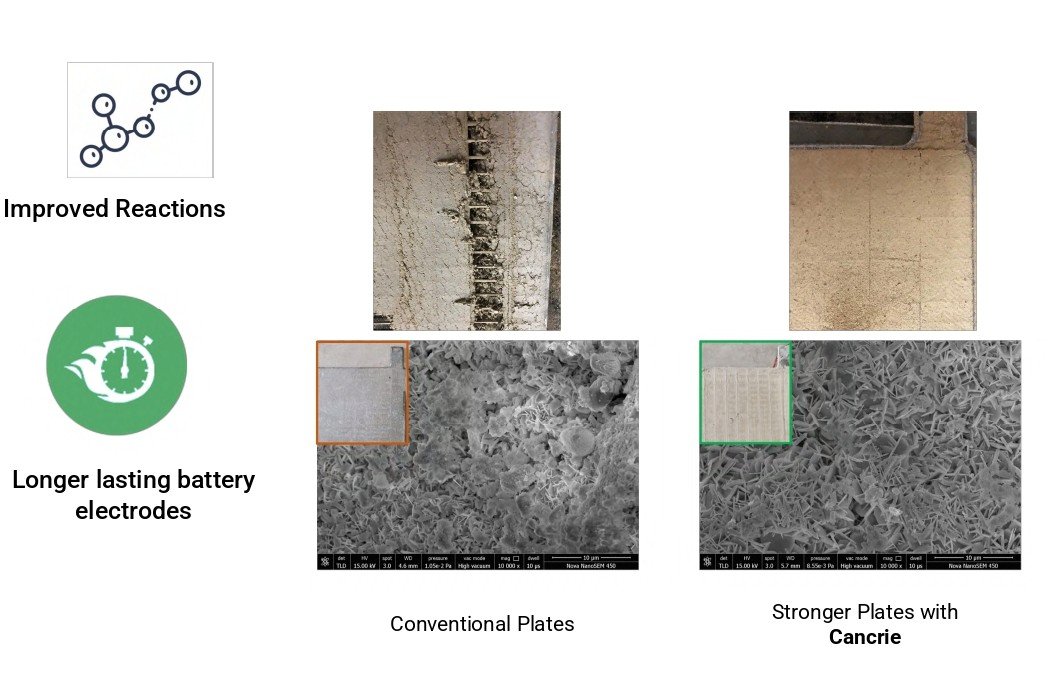
“Under an electron microscope, the nanocarbon/lead sulfate structure looks like a spider web, holding together all materials and keeping it strong. Not only is the electrode porous, but it has four times the bonding strength of a normal battery plate,” said Rajarshi Sen, battery expert and founder of Luminous Renewable Energy Solutions, who provides technical advice to Cancrie.
Sen explained that battery manufacturers often compress electrode materials tightly, “like cement”, to prevent crumbling – or “active material shedding”. But tighter packing can reduce electrolyte and ionic flow and efficiency. “The Cancrie nanocarbon structure binds the active material, like a web on the negative plate, compared to the amorphous structure of the carbon black in a normal battery,” he said.
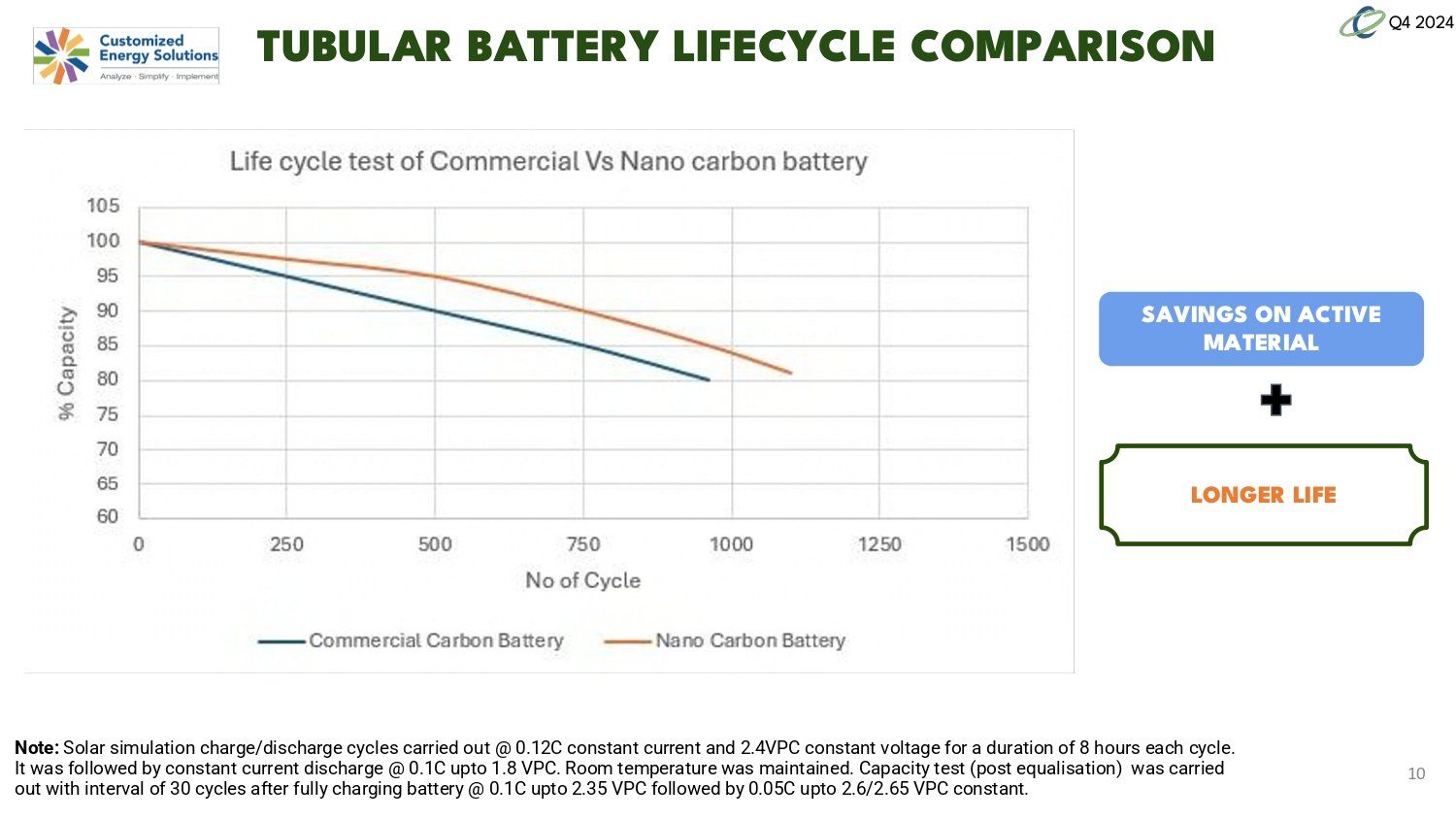
The clincher? “If the battery with Cancrie nanocarbon runs for 1100-days’ cycle, discharging 80% of its capacity, a similar battery with carbon black would run for 900 days cycle; till the plates failed,” Sen said.
What Cancrie claims its tech can do
Cancrie says its nanocarbon improves battery performance in four major ways.
First, it reduces heat generation by lowering internal resistance.
Second, the company claims ampere-hour efficiency rises to as much as 98-99%, compared to 90-94% in conventional batteries.
Third, it improves high-rate charging and discharging capability.
Fourth, battery cycle life improves by 20-25%.
In simpler terms, an e-rickshaw that usually runs eight hours on a charge could stretch to 10-11 hours. A solar battery storing daytime power could absorb significantly more energy during the same sunlight window.
Third-party verification of Cancrie’s performance
It is the battery equivalent of replacing a leaky plastic water tank with a better insulated steel one. You lose less along the way.
Bengaluru-based Megamp Industries Pvt Ltd has been using 16 kg of Cancrie nanocarbon powder for a batch of 2,000 batteries, its General Manager, Technical Department, Rajesh M.E., told Climate Action Live. Rajesh has followed Cancrie since 2022, through field trials to use in batteries for Future Energy, his former employer.
He says his experience has been positive: Technically speaking, when a load (electronic device, EV or solar storage system) is connected to a battery, there is a voltage drop and a subsequent voltage settling point under load. A Cancrie nanocarbon battery stabilises at 12.1V, compared to a normal carbon battery that stabilises at 11.8V. “The nanocarbon reduces internal resistance within the battery, and more energy is delivered to the load rather than dissipated as heat, thus extending the life of the battery,” he explained.
Cancrie says it has spent more than 12 years on R&D and tested over 250 carbon optimisation variants. It also claims multiple patents and third-party testing through labs such as ARAI, CES and NABL-accredited facilities.
Choice of biomass
Cancrie experimented with more than 20 kinds of biomass, ranging from sawdust to coconut husk, before settling on coconut shells for commercial feasibility.
Coconut shells are abundant, cheap and encourage the circular economy by upcycling agricultural byproducts, promoting rural livelihoods and reducing emissions.
Cancrie sources coconut shells from rural areas in Karnataka, Tamil Nadu and Maharashtra. Usually, shells are dumped as agricultural waste or burned in the open air, causing pollution and emissions.
Globally, research on biomass-derived nanocarbon from agricultural byproducts, food waste, animal waste and forest residue has expanded significantly.
Why manufacturers are paying attention
Cancrie says the economics are surprisingly favourable.
According to Jain, adding nanocarbon increases the cost of a Rs 10,000 solar battery by only around Rs 20. In automotive batteries, he claims there is effectively no cost increase.
Future Energy, one of its customers, reportedly switched entirely to Cancrie nanocarbon after trials in 2023. “We exported 90 per cent of our batteries to the Middle East and Africa,” says Rajesh M.E., former technical head at Future Energy. “The Cancrie trials showed better capacity and efficiency in batteries.”
Manufacturers, Rajesh says, can market premium batteries with longer warranty periods without significantly increasing prices.
How Indian battery startups are building an edge
There is ongoing research on biomass-derived carbon and cost-effective, sustainable energy storage technologies in India. From pilot projects to commercial-scale production, several startups are emerging.
This year, the Technology Development Board extended financial assistance to Indi Energy, a startup from IIT Roorkee, to commercialise biowaste/agricultural waste-derived hard carbon for sodium-ion batteries. The company makes high-performance sodium-ion batteries and their components, providing a viable alternative to expensive lithium-ion and lead-acid batteries. These have applications in low-mobility EVs, grid-scale energy storage, inverters and solar street lighting.
Rajasthan-based Aloe Ecell, founded by Nimisha Varma and Naveen Suman, commercially manufactures Aloe Vera-powered, non-rechargeable, sustainable batteries in AA/AAA sizes, an alternative to hazardous dry cell batteries. “We use no hazardous metals, like mercury, lead or nickel, no corrosion inhibitors and harmful chemicals in the battery,” says co-founder Nimisha Varma. The battery components include aloe vera gel as the electrolyte and binder, lead-free zinc as the anode, a form of manganese as the cathode, and a paper-based washer and separator. The eco-friendly batteries are easy to recycle.
Aloe Ecell is moving from the pilot project to the compliance phase of recycling spent batteries and upcycling them into sustainable fertiliser. Any non-rechargeable AA/AAA batteries’ toxic materials are removed, and micronutrients are used as fertiliser for foliage.
The bigger question: Can biomass batteries scale?
The technology sounds promising, but scientists caution that biomass-derived carbon comes with serious challenges.
“Biomass variability leads to heterogeneous carbon products,” says Malati Raghunath, scientific advisor at ITEL Foundation and an expert in green chemistry from the Indian Institute of Technology Madras.
Since agricultural waste differs widely in lignin, cellulose and impurity content, the resulting carbon materials can vary significantly from batch to batch. “The need for battery manufacturers is at a mega-tonne level; biomass-derived carbon can never scale to the level of the need, as it is a very niche segment,” she says. Businesses must develop strong process benchmarks to maintain product consistency, she adds. Multiple studies have emphasised that consistent product quality depends more on process control than on the “green” origin of biomass.
Santosh K. Tiwari, Associate Professor at NMAM Institute of Technology, points to another challenge: the environmental footprint of the carbonisation process itself. The production process can require temperatures of 700°C and above, substantial energy use, chemicals, wastewater treatment and transportation logistics.
“The biomass-derived carbon businesses have to solve a lot of issues in the environmental impact of the carbonisation process,” he says, adding that the technology’s benefits truly kick in if renewable energy powers the manufacturing process and emissions are tightly controlled. “It may work if you are using solar energy, integrating any modern emission control mechanism, and the environmentally hazardous ash can be transformed into carbon-negative solid materials,” he says.
Although making nanocarbons from crop residues that would otherwise be burned in fields is climate-positive, Cancrie is working on reducing its own carbon emissions too.
It has installed a four-stage scrubber approved by the pollution control board to reduce emissions, plans to shift to solar energy, and is currently calculating Scope 1, 2 and 3 emissions across its value chain.
The company argues that extending battery life itself reduces environmental impact because fewer batteries need replacing over time, lowering mining demand and e-waste generation.
Perhaps the bigger hurdle may not be technology, but trust.
“Cancrie technology and product are good, but the key challenge is changing the mindset of large battery manufacturers to adopt new technology,” says Sen. “If things are going alright, no one wants to disrupt the system.”
Battery supply chains are notoriously risk-averse. Even a small material change can affect performance, warranties and safety certifications.
That means startups like Cancrie must prove not only that the technology works in a lab, but that it can consistently deliver at industrial scale. Most experts agree that the challenge lies in producing highly consistent material at scale for conservative battery manufacturers who cannot tolerate variability.
And in the rapidly expanding battery race, consistency may matter as much as innovation.
Other startups using similar approaches
- Indi Energy
An IIT Roorkee-linked startup working on agricultural waste-derived hard carbon for sodium-ion batteries. The company received support from India’s Technology Development Board to commercialise sodium-ion battery components using biomass-derived carbon. This is one of the strongest adjacent examples to Cancrie’s approach. - Ivar Carbons
Primarily an activated carbon manufacturer using coconut shells. Their focus is water treatment and industrial applications rather than batteries, but the underlying coconut-shell carbon ecosystem overlaps with what Cancrie is building. - Indo German Carbon Limited
One of India’s older coconut-shell activated carbon manufacturers. Again, not a battery startup, but relevant because activated carbon manufacturing infrastructure and feedstock networks often become stepping stones towards advanced carbon materials. - Aloe Ecell
Not a nanocarbon company, but part of India’s broader sustainable battery-materials ecosystem. The company develops aloe vera-based batteries and recycling solutions. It represents the same “green chemistry” movement emerging around Indian batteries.
Globally, the field is more mature and diverse.
- CarboRefine
One of the more sophisticated players globally. The company converts second-generation biomass into engineered carbon materials and bio-graphite for industrial applications. - Biovision
Uses hemp biomass to produce graphite and graphene through Flash Joule Heating technology. The company is trying to vertically integrate agriculture and advanced carbon materials manufacturing. - carbonauten GmbH
Works on industrial biocarbon materials from woody biomass residues. Their focus is broader than batteries, spanning plastics, chemicals and construction materials, but they are among the better-known carbon-negative materials firms in Europe.
Kavita Kanan is a freelance journalist who covers the environment, climate change, grassroots innovations, agriculture, food, gender, art & culture, travel, and more. At the intersection of solutions journalism and sustainability, she not only highlights problems but also the people, innovations and cultural traditions driving positive change in the country.
Inspired to Take Action?
Tl;dr: A summary for the busy, the curious, and the done-for-today
Jaipur startup Cancrie is turning discarded coconut shells and other biomass waste into nanocarbon for use in batteries and energy storage systems.
The company claims its material can improve battery efficiency, reduce heat loss and extend battery life by 20-25%.
Unlike fossil-derived carbon black, biomass-derived nanocarbon could lower the environmental footprint of battery manufacturing.
Early adopters say the technology delivers better battery performance with little to no increase in manufacturing costs.
Experts say the real test will be maintaining consistent quality and scaling production while keeping the carbonisation process clean.