Kiraksal, a small village in Maan taluka, Satara district of Maharashtra, is known for its dense scrublands. According to the village elders, this area was once a thriving grasslands ecosystem, home to blackbucks and chinkaras. After the 1950s, ungulate species gradually became locally extinct in this area; the Indian grey wolves, striped hyena, golden jackals, and Bengal foxes survived, but the biodiversity in the village remained undocumented.
Chinmay Sawant, a wildlife biologist from Mumbai whose grandparents live in Kiraksal, decided to change this by scientifically documenting the species in this ecosystem. Sawant spent the COVID-19 lockdown period in Kiraksal for this purpose, and worked on putting together the village’s People’s Biodiversity Register (PBR). “Kiraksal is connected to hilly areas and table mountains but we did not know which animals live there. I was curious to find out and scientifically study this area, so I spent the entire lockdown period here. Amol Katkar, who was a member of the gram panchayat during this time, entrusted me with the task of making the PBR, so I formed a team of likeminded young people interested in conserving nature,” he shares. The Kiraksal Conservation Project was thus started, and this team continued their efforts to document the biodiversity, later supported by a WWF grant from 2023 to 2025.
The WWF-supported project had three objectives: local community engagement and youth training, biodiversity documentation and research, habitat protection and restoration. The first phase of the project (May 2023 to October 2024) involved developing surveys with the local people to build trust. The second phase consisted of GIS mapping of five-year data, which revealed that 1.67 sq km of grasslands had been converted into agricultural fields or built up area. The project also involved camera trap monitoring to study the species richness of mammals. “We found 606 species of flora and fauna through a community-led scientific survey, including 212 birds, 160 plants, 34 herpetofauna, and 18 mammal species. Through this work, we realised that this is a high priority area for species conservation,” shared Sawant. As a result of the project, a proposal has been submitted to the Deputy Conservator of Forests, Satara Forest Division to declare 23 villages spanning 4,793 hectares (47.93 sq km) of Maan (Dahiwadi) and Khatav (Vaduj) forest ranges as Kiraksal-Kukudwad Conservation Reserve. “We are working on a landscape level to include the continuous stretch of three clusters (Kiraksal, Kukudwad, and Kaledhon clusters) to be conserved with legal protection,” said Sawant.

A 150-year-old Ficus bengalensis tree, locally called janubaicha vad, in Kiraksal. Through community-led surveys, researchers documented 606 species of flora and fauna, and submitted a proposal to declare 4,793 hectares as Kiraksal-Kukudwad Conservation Reserve. Image by Chinmay Sawant.

Bengal fox pups rest near their den site in Kiraksal. The survey found 18 mammal species, including the Bengal fox, Indian grey wolf, striped hyena, and more. Image by Chinmay Sawant.
How did the wolves survive without their prey?
Arnav Gandhe, one of the field biologists working on the Kiraksal Conservation Project, shared that the wolves in Kiraksal’s grasslands prey on rodents, black-naped hare, civets, mongoose, poultry and poultry waste. During the monsoons, they sometimes prey on the sheep of the Dhangar community. “The ungulates in the area disappeared due to hunting and lack of food but wolves survived because they are one of the toughest species. They require less water than other animals, can survive on carcasses, and can survive in harsh landscapes. That said, it is possible that some wolves got wiped out and only a few survived,” he shared.
Abi T. Vanak, Senior Fellow at the Ashoka Trust for Research in Ecology and the Environment (ATREE), shared over email, “A healthy prey base is essential for carnivore populations. However, in the absence of wild prey, adaptable carnivores can quickly switch to human derived food such as livestock and poultry. Indian wolves have been dependent on small ruminants for a very long time.”
However, rodents and hares alone are unlikely to fulfil the long-term dietary requirements of wolves, especially when the pack is more than three to four individuals, shared Mihir Godbole, founder and president of Pune-based Grasslands Trust, over an email interview. “While deer populations may no longer be critical for the immediate survival of wolves in such areas, the presence of native wild herbivores is important for maintaining a healthier and more ecologically balanced grassland ecosystem,” he said.
Amol Satpute, Deputy Conservator of Forests, Satara, suggests that reintroducing deer into this ecosystem, especially if done holistically, could help reduce depredation of sheep by wolves and reduce the human-wolf conflict. This, he said, could be done if the area is declared a conservation reserve.
There is a fear among the conservationists and local people that with the increase in sugarcane farming in the area, leopards could come to the area, especially if the wolf population reduces. “Wolves cannot out compete leopards,” warns Y.V. Jhala, former dean of the Wildlife Institute of India.
Mihir Godbole, founder and president of Grasslands Trust, echoes this warning. “While there may be temporary overlap, leopards tend to become dominant as vegetation increases. Indian wolves are highly adapted to open, semi-arid grassland ecosystems and tend to avoid densely vegetated habitats,” he said. As sugarcane cultivation expands, the landscape may gradually become less suitable for wolves and more favourable for leopards, potentially leading to the displacement of wolves from the area, he added.

Waghjai Lake, a seasonal water source in Kiraksal-Bombale forest, dries out in the summer. While the ungulates in the area disappeared, the wolves survived the harsh landscape, requiring less water and feeding on carcasses. Image by Chinmay Sawant.
The three-point ban
Kiraksal has implemented a three-point self-imposed ban: “kurhad bandhi” (tree felling ban), “vanva bandhi” (forest fire control), and “shikar bandhi” (hunting ban). An additional ban, “charai bandhi” (grazing ban) is selectively applied to non-residents of Kiraksal, to control the amount of grazing here. “Under the Adarsh Gaon Prakalp, we were already working on these bans to achieve adarsh gaon (model village) status, but with the WWF grant, we pushed to effectively implement the bans here,” said Sawant. Signage boards were installed in two places, and the forest department was activated.
Prathmesh Katkar, member of Kiraksal’s Biodiversity Management Committee, shared that it was a traditional practice to kill animals during the nag panchmi hunt, and bury the head of the animal near the village temple. “In my childhood, my relatives would join the hunt, and it was risky to suggest that we should not hunt — that’s how integral hunting was to our culture,” he shared.
Hunting for leisure, to reduce the population of some animals, and retaliatory killings when predators would attack livestock were all common. “I participated in the annual hunts earlier but recently hunting has completely stopped because the forest department patrols the area regularly,” shared Bhagwat Vitthal Katkar, a shepherd in Kiraksal.
Vishal Katkar, another youth from Kiraksal and member of the Biodiversity Management Committee, shared that the objective of the tree-felling ban was to ensure that the smaller trees had the opportunity to grow. “Earlier, people would take their sheep to the hilly regions and cut trees, even when they had little use for the wood. Kurhad bandhi put a stop to this, and combined with our watershed work, it made a difference,” he said. Kiraksal has small patches of forests along open grasslands. “Grassland conservation has happened on a massive scale due to kurhad and charai bandhi. On the nearby hills, the grasses come up to one’s waist. People can cut the grass from here and take it back for their cattle,” he explained.
Bhimrao Shankar Bhosale, Vanrakshak (forest guard) posted in Kiraksal since 2024 shared that the forest department patrols the forest area both day and night. “In Kiraksal, we do not allow hunting and tree felling. If people from outside come here for grazing, we give them a warning and send them away,” he shared. That said, such incidents have become increasingly rare, he added; as the wild animal population has grown due to reduced human interference, people have naturally stopped venturing into the forest area to graze.
About controlling forest fires, he shared that fire lines are drawn in sensitive areas of 10-12 metres, as there are windmills in the area, sometimes leading to forest fires due to short circuits. “Whenever an accidental forest fire starts, our team reaches the area with fire blowers. The villagers from Kiraksal also join in,” he added.
Farmers from Kiraksal shared that all the villagers, especially the young people from Kiraksal, are vigilant about forest fires, and that once the news spreads about the location of forest fires, everyone goes with gunny bags and helps put it out.

Bhagwat Vitthal Katkar, a shepherd, once participated in the annual hunting ritual before a three-point ban was implemented on tree felling, forest fires and hunting wildlife. Image by Vinaya Kurtkoti.

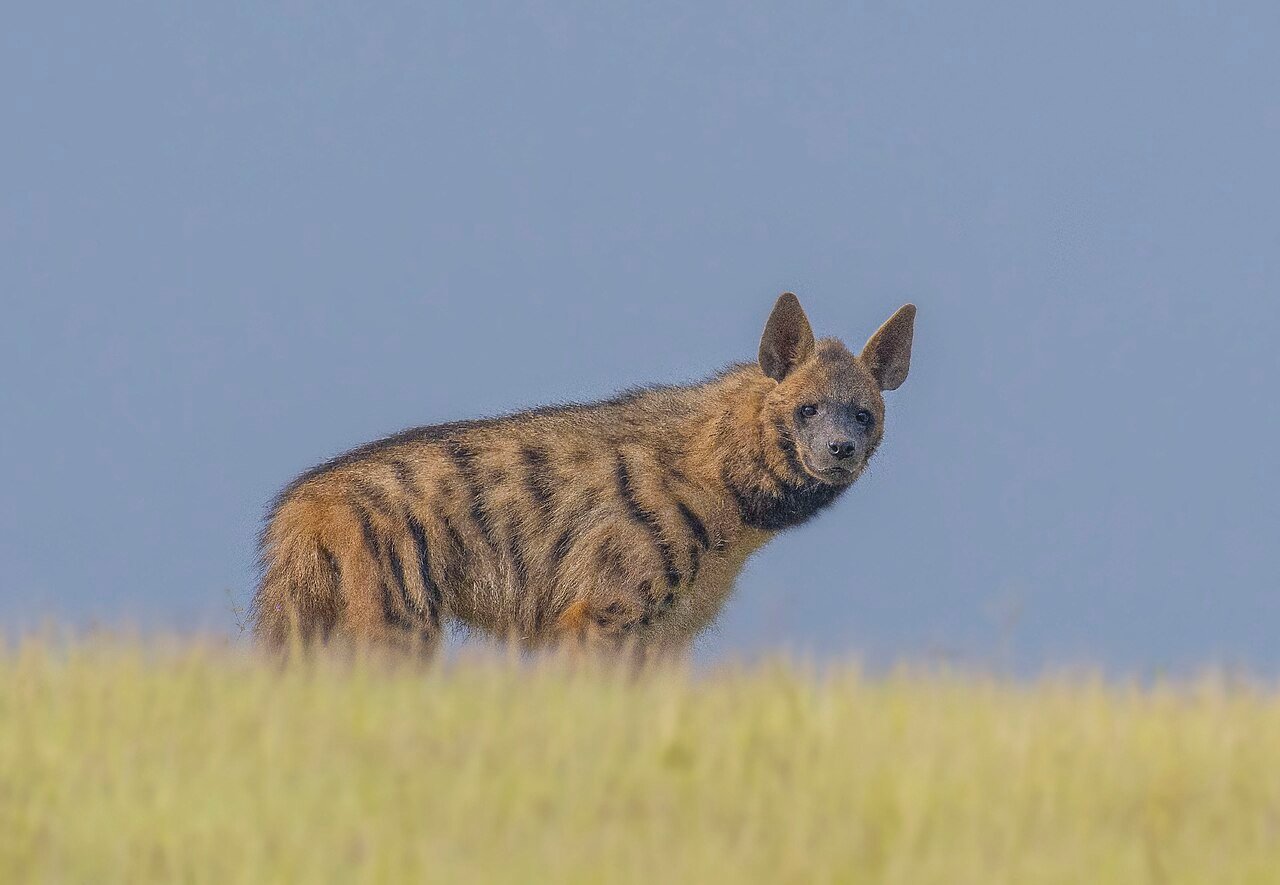
A striped hyena in Kiraksal. Image by Chinmay Sawant.
How would legal protection impact Kiraksal’s humans and wildlife?
Very few grasslands in India have legal protection, said Arnav Gandhe. “Grasslands were misclassified as wastelands, but recent scientific studies have shown that this is a unique ecosystem. Changing the policy on them and ensuring they are legally protected is urgently required, and a step in this direction is the Maharashtra Government Resolution passed on May 7, 2026, which mandates that grasslands be treated as such, and no plantation drives be allowed there,” he shared.
Y.V. Jhala cautioned that any conservation reserve plans must go ahead only with the support of the local community. “For long term conservation of wolves in the area, the prey base needs to be built up there, for which government support is essential. I would suggest a community reserve [as opposed to a conservation reserve] because such legal protection would permit legitimate changes in land use patterns,” he shared.
Amol Satpute, DCF Satara, shared that efforts are ongoing to declare this area a conservation reserve. “There are very few landscapes dedicated to hyenas and wolves, so there is a need to conserve this area. We will only go ahead with this with the support of the local people. There will be a jan sunavni (public hearing) for this; the public should not feel like this decision was imposed on them,” he shared.
This story was originally published in Mongabay India.
Inspired to Take Action?
Tl;dr: A summary for the busy, the curious, and the done-for-today
Kiraksal, a hilly village in the drought-prone region in Maharashtra, has documented 606 species, including the Indian wolf and striped hyena.
The project used camera trap experiments to document wildlife and conducted GIS mapping of five-year data to ascertain land use patterns.
Through the support of the gram panchayat and the forest department, this village has implemented a three-point ban on tree felling, forest fires and hunting to conserve the biodiversity found in the grasslands, scrublands, and open habitats here.