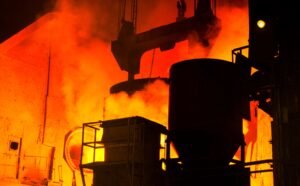
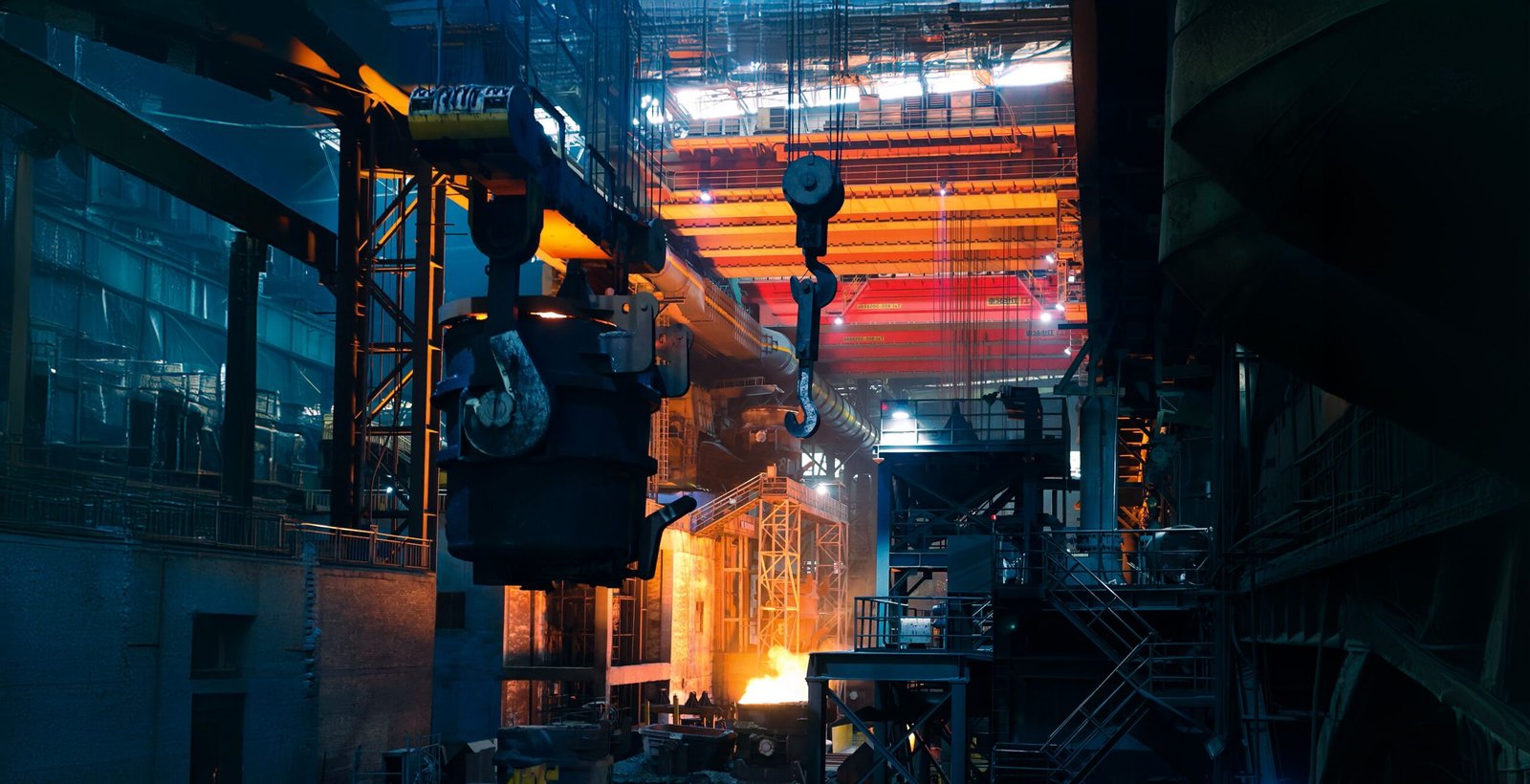
Inside a foundry in Kolhapur, Maharashtra, work never stops. Workers come in shifts, put on yellow helmets and safety goggles, and toil for at least eight hours indoors where temperatures reach up to 50°C. With precision, they toss blocks of pig iron — derived from iron ore — and scrap (recycled steel) into a furnace operating at around 1,600°C. Once the metal melts, it is quickly poured into a mould, taking the shape of a pump, an automobile part, or another industrial component. Once cooled and solidified, these castings are shipped to customers in India and overseas.
This is a regular day at Caspro Metal Industries Private Limited, a company that manufactures 30,000 tonnes of metal castings annually from its base in Kolhapur. Of this, 15-20% is shipped to the European Union (EU).
The company has enjoyed a two-decade-long trading partnership with the EU, but that relationship now appears to be on shaky ground. In 2024, its importers in Germany flagged a new EU climate regulation. “This is going to be a huge add-on cost for us,” said Vijay Patil, Manager at Caspro, at his office in Kolhapur.
The regulation in question is the Carbon Border Adjustment Mechanism (CBAM). First proposed by the EU in 2021, CBAM imposes a tax on the greenhouse gas content of imported goods, covering sectors including iron and steel, cement, aluminium, and fertilisers. In October 2023, it entered a transition phase requiring exporters to submit emissions data. In January 2026, its definitive phase began, effectively taxing carbon-intensive goods entering the EU.
Though EU importers pay the tax, many Indian exporters may have to cut prices by 15-22% to stay competitive, according to Global Trade Research Initiative (GTRI), a research services institute.
EU-based companies already pay domestic carbon prices. By taxing carbon-intensive imports, CBAM reportedly aims to ensure the competitiveness of domestic industries and create a level playing field. Developing countries like India, on the other hand, have argued that CBAM is a unilateral trade barrier that clashes with the principles of Common But Differentiated Responsibilities and Respective Capabilities (CBDR & RC), enshrined in the United Nations Framework Convention on Climate Change (UNFCCC) which acknowledges that industrialised countries bear greater historical responsibility for climate change due to their earlier industrialisation. CBAM has been criticised for going against this principle as it shifts this burden onto developing countries that have contributed little to the crisis, according to a 2024 report by New Delhi-based think tank, Centre for Science and Environment.
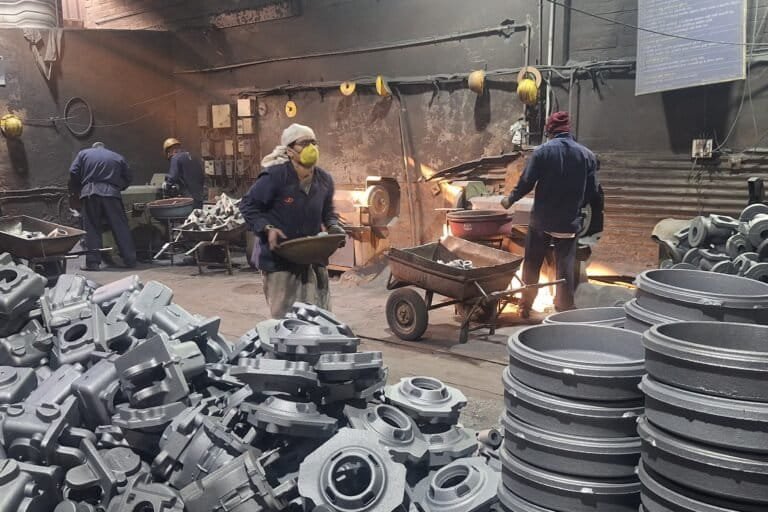
Workers arrange metal castings. Photo by Rohini Krishnamurthy.
The burden on enterprises
India has said, at multiple forums, that EU’s carbon tax on imports is particularly concerning for its micro, small and medium enterprises (MSMEs), which together account for over 48% of exports and 31% of Gross Domestic Product (GDP). This sector in India also employs over 328 million people, the second-largest employer after agriculture, according to the 2025-26 Economic Survey.
India’s iron and steel exports face the greatest exposure to carbon border taxes because manufacturing these materials is emission-intensive and is exported in large quantities, according to a paper by EY, a professional services company.
At various meetings of the Council for Trade in Goods, a subsidiary body of the World Trade Organization (WTO), from 2023 through 2025, India expressed concern that MSMEs will not be able to meet the demands of the CBAM and over time, these micro, small and medium enterprises may be replaced by big firms in the EU’s trading profile.
India classifies MSMEs based on investment in plant and machinery or equipment and annual turnover. Enterprises with turnover of up to ?100 million are classified as micro, up to ?1 billion as small, and up to ?5 billion as medium. Micro units make up 99% of all MSMEs.
“Some 3,000-4,000 iron and steel and aluminium firms export directly and another 25,000-30,000 ship indirectly to the EU through other exporters or traders,” Nilesh Bhattad, the founder and CEO of CleanCarbon.ai, a Pune-based environmental services company that supports Indian exporters with CBAM compliance. Even though CBAM temporarily exempts small exporters with annual exports under 50 tonnes, MSMEs are particularly exposed due to their presence in the supply chains of large exporters.
Mongabay-India’s analysis of government trade data suggests that after the EU introduced its carbon tax, the growth in exports of iron and steel products by the majority of Indian MSMEs declined in 20 of the EU’s 27 member countries in 2024–25, compared to the previous year. Overall, these exports to EU were found to be 11% lower in 2024–25 than in 2022–23, indicating that Indian MSMEs may already be facing challenges in trade with EU.
Further, Ajay Srivastava, founder of research services GTRI, told Mongabay-India that Indian exports of steel and aluminium to the EU fell by 24% in the financial year 2025 compared to the previous year. “I suspect that this decrease could be due to declining exports from MSMEs,” he said.
Compliance burden
Sudipta Das, Managing Partner at Futurestation, a firm specialising in sustainability advisory and assurance services, explained that the EU carbon tax, CBAM, requires Indian exporters to track emissions across the entire production process, from sourcing raw material to manufacturing and transportation. This means exporters will have to make a range of decisions to stay competitive in the EU, such as choosing the right design, raw materials and sourcing.
“MSMEs that adapt early can integrate deeper into the global value chains, while those that don’t, risk gradual exclusion from export markets,” Vinod Kumar, President, India SME Forum, a non-profit organisation for Small & Medium Enterprises, warned.
However, complying with CBAM requires companies to measure, report and verify their emissions, a process that can be costly and technically demanding for smaller firms. CBAM tax applies to Scope 1 (direct emissions from factory operations) in both iron and steel production as well as raw material production,” said Bhattad.
The iron and steel exporters still have to submit emissions data from Scope 2 (electricity use) and Scope 3 (value chain), even though it is not currently taxed, he added.
The financial implications to do this can be significant.
Further, CBAM penalises companies that do not measure their own emissions or are unable to source data from their upstream suppliers, further raising the carbon levy. Data collection is also tricky in some cases where the supply chain includes multiple intermediaries and manufacturers. “Getting data from each of them can be challenging,” Bhattad explained.
Soon, CBAM is expected to tax Scope 2 emissions for additional sectors, including iron and steel, according to a draft report the European Parliament’s Committee on the Environment, Climate and Food Safety released April 10, 2026. The report asks the European Commission to phase in indirect emissions across sectors in its proposal by 2027. The inclusion of indirect emissions will deal a heavy blow to companies that rely on coal-based electricity, according to GTRI.
According to Kumar, many MSMEs are unprepared. “They feel there is a lack of clarity on the methodology for calculating embedded emissions. Verification and the certification systems are not affordable at all,” he added.
Estimates suggest that the measurement, reporting and verification costs for a company can reach ?2.5 million annually.
Ground reality
Kolhapur is home to 300 foundry units, with an annual production of approximately 600,000 tonnes, nearly 30% of which is exported, according to a 2025 report by Asar Social Impact Advisors, an environmental Services startup.
Caspro’s exports are not yet covered under CBAM. “But our EU customers are (already) asking us to collect data on our carbon emissions,” Patil of the iron and metal manufacturer, said.
While Caspro and Ceraflux India Private Limited are yet to collect emissions data from their upstream suppliers (suppliers of raw materials such as crude steel), they are monitoring energy consumption at their factories. “EU importers will send me an assessment form, and we will fill in data based on our energy consumption and production process,” Abhinav Pednekar, Environmental Health & Safety Officer at Ceraflux India Pvt, explained.
Raipur, another major MSME iron and steel cluster, has more than 300 MSME steel units. Only 5-10% of MSMEs in the state of Chhattisgarh export directly to the EU, and around 30-40% of firms ship indirectly through merchant exporters, Sanjay Tripathi, President of the Chhattisgarh Steel Re-rollers Association, said.
Jainam Ferro Alloys in Raipur is one such MSME that indirectly exports ferrous-manganese or silico-manganese to the EU through merchant exporters. “Our merchant exporters have not asked us for data yet. We will get more clarity soon,” Archit Parakh, Chairman and Managing Director of Jainam Ferro Alloys, said.
The government has largely remained silent on CBAM’s impact on Indian exports. In a written response to a Lok Sabha inquiry on whether the government has addressed the concerns regarding the EU’s CBAM and its potential impact on Indian metal and engineering exports, the ministry noted that India has secured an annex on CBAM for a technical dialogue on implementation under the recently signed Free Trade Agreement with the EU, but skipped responding to CBAM’s potential impact on Indian metal and engineering exports.
For India, decarbonising is urgent, especially if the country wants to stay competitive. Soutrik Goswami, Research Associate, Climate Policy at the New Delhi-based independent research organisation Sustainable Futures Collaborative, warned that India will have to watch out for countries with similar exports to the EU, such as Turkey and South Korea. “If we are not able to decarbonise as much as them, we might lose out, and MSMEs will face impacts through their presence in the supply chain,” he explained.
This story first appeared in Mongabay India. It was produced with support from Internews’ Earth Journalism Network.