Nearly a decade after independence, one of India’s first public sector steel plants was established in Bhilai, Durg district, Chhattisgarh — a region rich in iron ore, coal and other natural resources. In the ensuing decades, several scattered steel units, dominated by micro, small, and medium-enterprises (MSMEs), began to mushroom some 40 km away in Raipur, helping Chhattisgarh become the third-largest producer of crude steel in the country.
Meanwhile, about 1,100 km away, a slightly different story unfolded in Maharashtra’s Kolhapur during the 1960s — one where the region’s industrial journey was shaped by its agricultural roots. The demand for agricultural machinery paved the way for a local foundry industry. Foundries use metals like iron to produce castings that are used widely, from irrigation pumps to automobiles. Now, Kolhapur is one of the country’s largest foundry clusters, dominated by MSMEs, contributing 7-8% of India’s casting production.
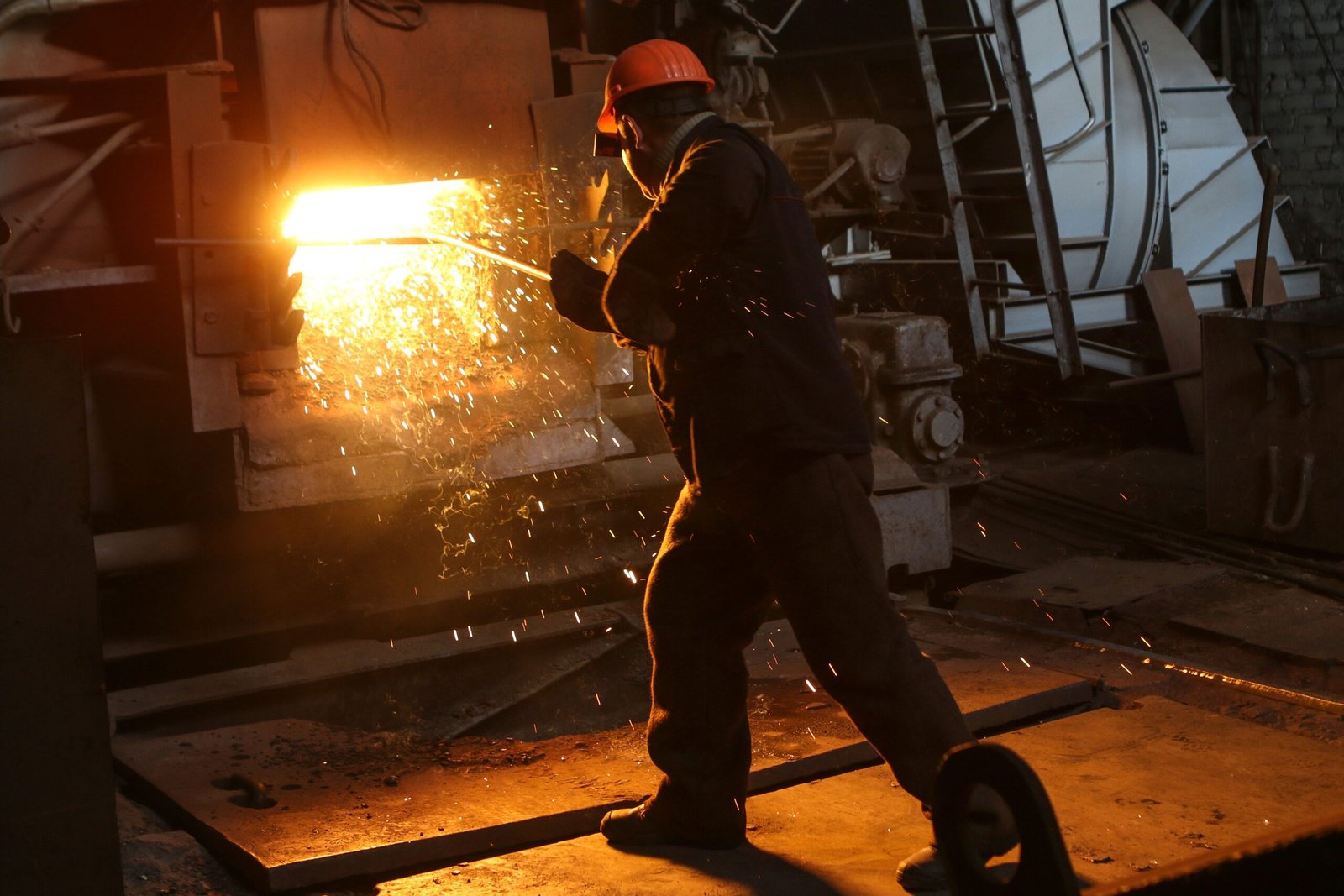
Together, Raipur and Kolhapur, along with other MSME clusters across India, drive India’s secondary steel production — where steel is made by melting scrap metal and other processed forms of iron in electric furnaces, rather than producing iron from iron ore first. The secondary steel sector, which contributes 30-35% of the country’s crude steel capacity, is dominated by MSMEs and relies on coal and inefficient technologies. In contrast, the primary production route is also energy-intensive but dominated by large players with higher capital investment.
Notably, the secondary route of steel production accounts for more than 50 million tonnes (MT) of greenhouse gas emissions annually, according to a 2023 report by The Energy and Resources Institute, a not-for-profit based in New Delhi. For context, Norway’s total emissions in 2023 were 46.7 MT of emissions, without considering the land use, land-use change, and forestry sector.
These emissions highlight why decarbonising MSMEs in the iron and steel sector is central to India’s goal of achieving net-zero emissions by 2070. In 2022, MSMEs alone emitted 135 million tonnes of carbon dioxide equivalent, of which 32 million tonnes (23.7%) came from only three sectors (forging, foundry and steel rerolling) that are part of the MSME iron and steel supply chain, according to a January 2026 report by Niti Aayog.
Despite these long-term climate goals, there is a more immediate challenge from the west: The Carbon Border Adjustment Mechanism (CBAM), a new European Union (EU) regulation that became fully operational in January 2026. CBAM puts a price on carbon-intensive goods such as steel, aluminium, hydrogen, cement, fertilisers and electricity entering EU countries. Of these sectors, India’s iron and steel sector is the most exposed due to high emissions in the production process and a high volume of exports, according to a paper by Ernst & Young.
“If you [India] really have to access the global market, you need to empower the MSMEs,” Sangeeta Godbole, a former trade negotiator and Indian Revenue Service officer, said.
Annup Kashyap, an independent expert who has been working in steel sector decarbonisation, stresses that the government provides financial and technological support to smaller businesses. “Skill management is needed, given that many are still following the old pattern of making steel,” he explained.
From protests to the fine print
After the EU first proposed CBAM in 2021, India raised concerns at the World Trade Organization (WTO) about its potential impacts on MSMEs. India requested that the EU provide relief to MSMEs during the Free Trade Agreement (FTA) negotiations. However, the final trade deal, reached on January 27, failed to provide any exemptions.
Moments after signing the FTA, the EU issued a statement committing €500 million in support over the next two years, “subject to the EU’s budgetary and financial rules and procedures”, to help India cut its emissions and accelerate its industrial transformation.
The text of the EU-India FTA contains an annex on CBAM that establishes a technical dialogue and pledges support for emissions reduction for MSMEs, but provides no further details.
Going forward, it is unclear whether India will continue to take up the CBAM issue at the WTO. R.V. Anuradha, a partner at Clarus Law Associates, has argued that the inclusion of the CBAM annex appears to show that India has acknowledged CBAM as a legitimate measure. Theoretically, though, India can initiate a dispute at the WTO that it violates norms of equal treatment for all WTO members, she added. “But the fact that India agreed in its FTA to technical dialogue on implementation of CBAM exposes it to a possible counter-argument by the EU that the parties have in good faith agreed to implement such measures without contestation,” she argued.
Green schemes, marginal impact
While further details on the EU’s €500 million commitment are still awaited, India in the meantime has launched financing schemes and energy efficiency programmes for MSMEs. However, their impact on MSME decarbonisation has been limited, reads a 2025 report by the Institute of Energy Economics and Financial Analysis (IEEFA), a global think tank.
One of the most recent schemes supporting this effort is the World Bank-assisted Raising and Accelerating MSME Performance (RAMP) programme, designed to help small and micro enterprises reduce their emissions emissions. Under RAMP, the Ministry of MSME launched two sub-schemes in 2023 for a four-year duration.
The first is the MSE Scheme for Promotion and Investment in Circular Economy (MSE-SPICE), introduced to promote the adoption of circular economy practices among micro and small units. It offers a 25% credit-linked capital subsidy (capped at ?12.5 lakh for projects costing up to ?20 million).
However, uptake has been low: only seven, far short of the expected 3,400 units have been benefited. As a result, just ?7.553 million of the ?4.5 billion (0.16%) subsidy outlay has been disbursed, as per the latest government data.
“One of the reasons is that MSMEs are not rigorously looking at circular economy solutions,” Vinamra Mishra, Joint Secretary of the Ministry of MSME, said while talking to Mongabay India. The government now plans to expand the scope by supporting greenfield projects (new projects). “We are looking at improving the quantum of financial assistance,” he added. Vinod Kumar, President, India SME Forum, a not-for-profit organisation for Small & Medium Enterprises, believes that holding proper consultations with MSMEs can help in the better design of schemes.
The second scheme under the RAMP programme is the MSE Green Investment and Financing for Transformation Scheme (MSE-GIFT Scheme). With a total outlay of ?4.78 billion, the scheme allocates ?3.5 billion for interest subvention (a subsidy on the payable interest) to help small and micro enterprises adopt identified green technologies.
This scheme, too, has underperformed. The GIFT scheme aims to provide an interest subvention of 2% per annum for five years on loans of up to ?20 million. Yet of the ?3.5 billion for interest subvention, only ?287.3 million (8.2%) has been disbursed, according to government data.
Although the schemes have been designed to target small and micro units, awareness remains limited. For example, Ravi Enterprises, a small foundry unit in Kolhapur, was not aware of their existence. According to government data shared in the Lok Sabha on March 12, 2026, 578 small and micro units in Maharashtra have benefited from the GIFT scheme as of 2025-26, while only 16 have signed up in Chhattisgarh.
Sanjay Tripathi, President of the Chhattisgarh Steel Re-rollers Association, believes one reason for the poor uptake is the government’s cap on subsidies. “The cost in setting up a small steel re-rolling mill and 1 MW solar capacity comes to around ?9-10 lakh, without battery storage,” he explained. “The cap (such as 2% annual subsidy subvention for up to five years for a ?20 million loan limit) does not offer much help,” he said.
The other issue is that MSMEs, especially smaller companies, lack the capacity to access funds. This is because they are required to conduct a detailed energy audit to understand their energy consumption, following which they need to prepare a detailed project report on the investments needed, the expected cost savings, and emissions reductions, according to Shantanu Srivastava, Research Lead, Sustainable Finance & Climate Risk, at IEEFA. This whole exercise, he added, can be cumbersome for MSMEs, given that these are typically single-person companies. “The second major issue is that smaller businesses do not have proper accounting practices, making it difficult to secure a bank loan,” he explained.
Further, smaller companies typically don’t want to take additional capital for renewable energy or energy efficiency measures on their balance sheets, Srivastava said. In such cases, the government can help by bringing MSMEs and energy service companies (ESCOs) that develop, design, build, and fund energy projects together to save energy, reduce energy costs, and better access existing financial mechanisms through project preparation, transaction advisory, and matchmaking, he added. Energy service companies identify energy-saving opportunities and implement energy efficiency projects. They also take up upfront capital costs on their balance sheets. MSMEs, in turn, can pay them through the savings they realise by implementing energy efficiency projects.
The government is also looking at renewable energy adoption. “We are working to create demand by providing financial support and creating an enabling environment with help from renewable energy supply companies and industry associations. We will look at the supply side, too, by focusing on technology supply and financing,” Mishra said. He also told Mongabay-India that the ministry has so far held stakeholder consultations in energy-intensive clusters in Kolhapur, Kolkata, Ludhiana and Coimbatore this year. They conducted surveys among MSMEs to capture their views on aggregating demand for solar projects, battery storage and land availability for solar projects.
Interactions with MSMEs on the ground and experts show a few MSMEs in Kolhapur and Raipur are already embracing renewables by signing power purchase agreements with renewable energy developers or setting up captive plants. For example, Caspro Metal Industries Private Limited in Kolhapur has installed a 1.9-megawatt solar plant and is in the process of setting up another 5 MW. Yet, deep-seated concerns remain. Vijay Patil, Manager at Caspro said, “Even if we increase adoption of renewables and energy-efficiency measures, our products do not fetch higher prices compared to conventional ones.”
This story was produced with support from Internews’ Earth Journalism Network. It was first published on Mongabay India.