Every smartphone, washing machine, inverter, LED bulb and industrial controller hides a component few consumers ever notice. The printed circuit board, or PCB, is the platform that holds electronic components together and allows them to communicate. Almost every electronic device depends on one. Yet the material at the heart of most PCBs has changed remarkably little over the past several decades.
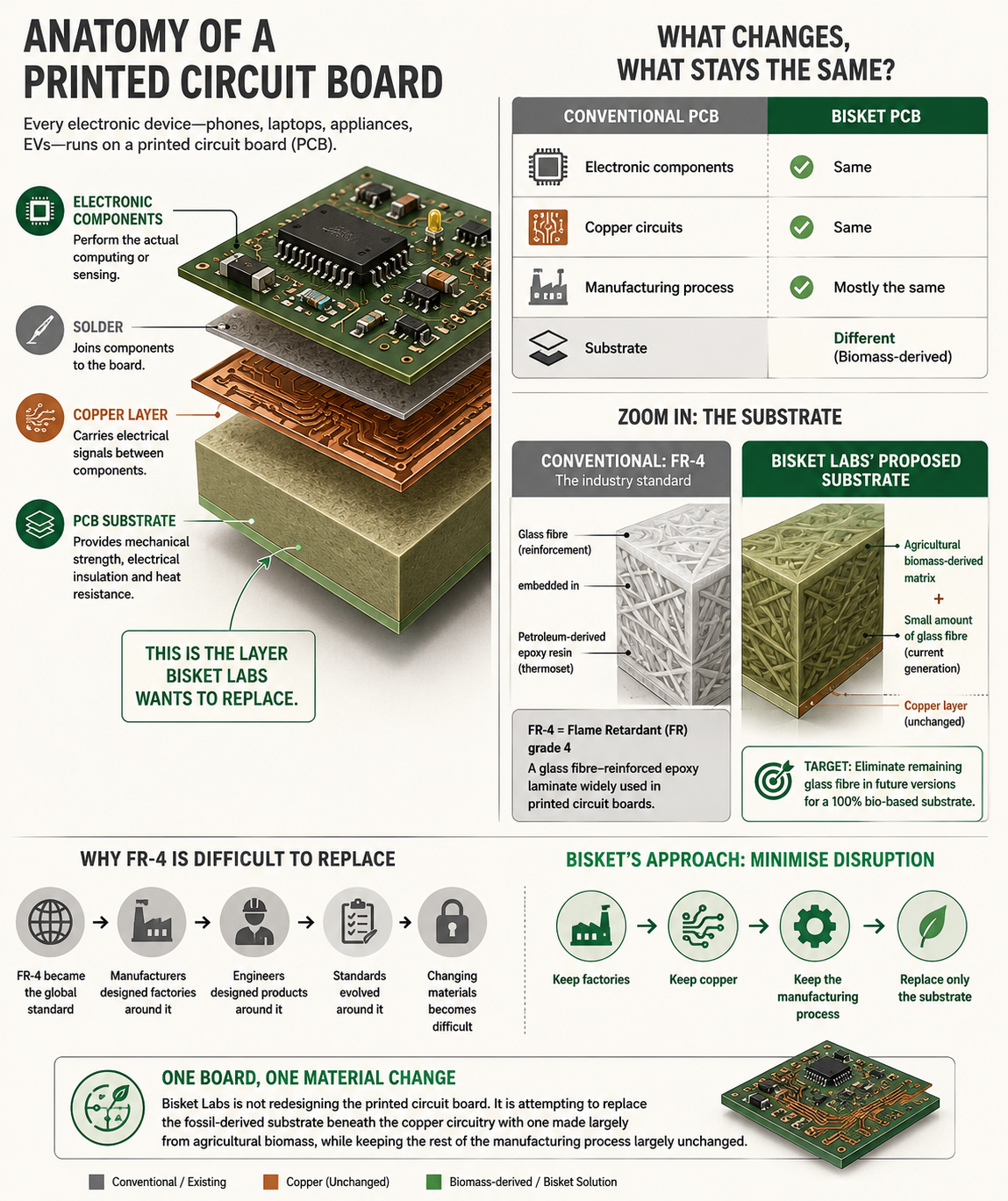
Most PCB ‘substrate’, the non-conductive base material that physically supports and insulates the copper circuitry and electronic components in a PCB, are built on FR-4, a composite made from epoxy resin and glass fibre. It is cheap, reliable and deeply embedded in global manufacturing. It is also derived from petrochemicals, difficult to recycle and manufactured through supply chains concentrated largely in China and East Asia.
An IIT Madras spinout, Bisket Labs, believes the substrate can be built from agricultural waste instead.
Its founders are developing a PCB substrate made largely from biomass that can work in existing manufacturing lines while replacing petroleum-derived resin with material derived from crop residues.
The idea is ambitious because it is trying to solve three problems at once: reducing agricultural waste, making electronics less dependent on fossil-derived materials, and helping countries build more resilient domestic electronics supply chains.
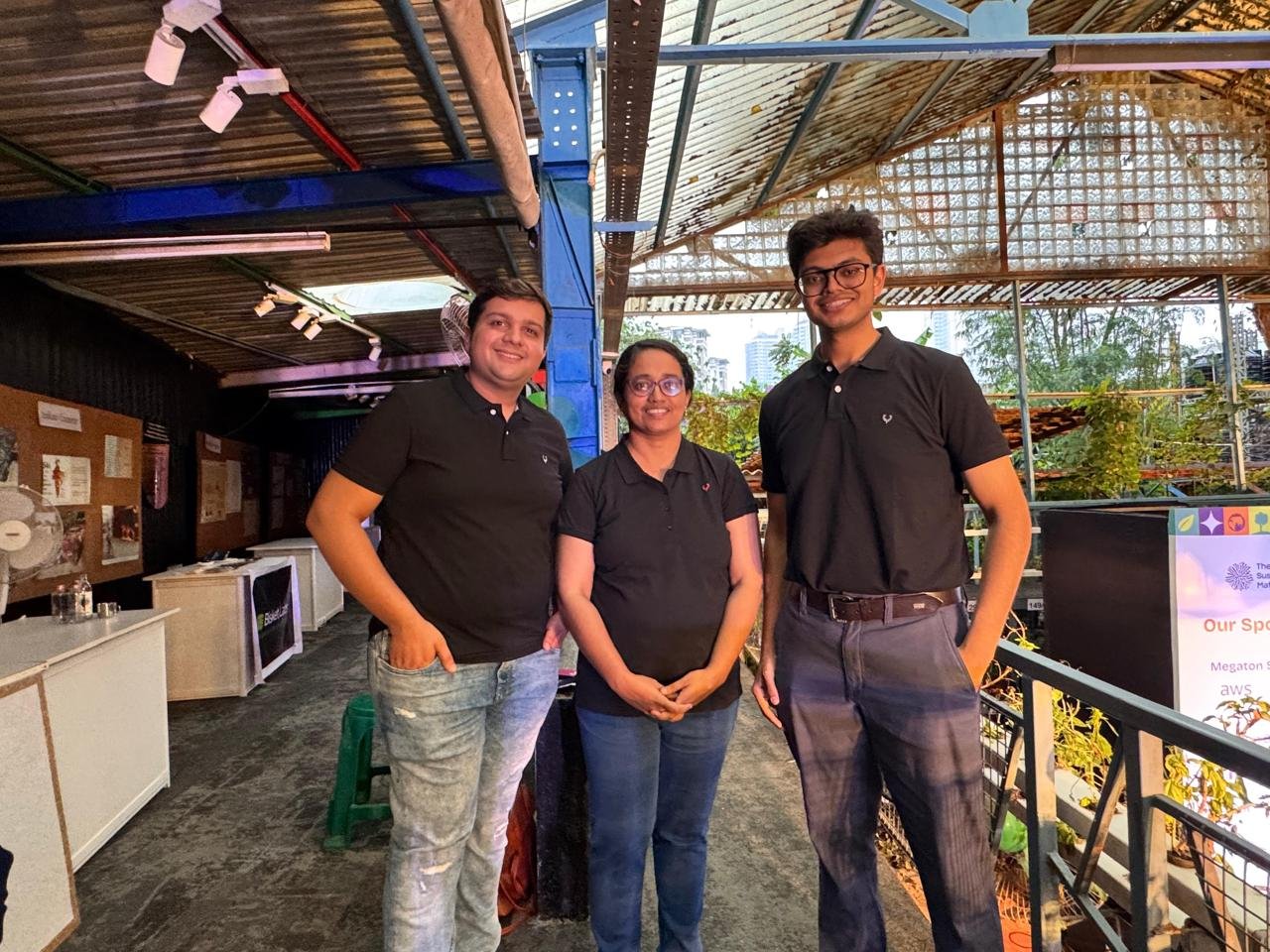
It has already attracted attention within India’s climate innovation ecosystem. Last year, Bisket Labs won the Big Pi Award at SusCrunch, the annual climate innovation showcase organised by The Sustainability Mafia, recognition that helped put the young startup on the radar of investors and industry observers. Several such awards have recognised the promise of its approach. The harder challenge now is demonstrating that the technology can perform reliably at commercial scale.
This translation will depend on something less exciting than breakthrough chemistry: convincing the world’s PCB manufacturing industries that a new material deserves a place inside billions of electronic devices.
Infographics promp-engineered by Madhur Singh using ChatGPT
The journey to PCBs
The company’s journey did not begin with electronics. During his final-year research at IIT Madras, co-founder Aryamaan Singh was working with biotechnology researcher Shereena P. Joy on improving second-generation ethanol production (second-generation ethanol is produced from farm waste). Their process generated a viscous liquid by-product with no obvious commercial use.
Instead of treating it as waste, they experimented with additives and curing processes until it hardened into a rigid material. Only after extensive testing of its mechanical, thermal and electrical properties did they begin searching for applications.
Construction materials seemed the obvious choice. So did furniture, insulation panels, battery separators and biodegradable products. But commercialising all of them proved impossible for a small startup.
PCB substrates eventually emerged as the most attractive target.
Unlike construction materials, PCB laminates are compact, high-value products that can be prototyped without building factories or demonstrating performance across entire buildings. Success would also place the company inside an electronics industry willing to pay for performance rather than volume alone.
“We allowed the material properties to guide us towards an application, rather than starting with an application first,” Singh says.
Why change something that already works?
This question became the founders’ biggest challenge.
FR-4, which stands for Flame Retardant grade 4, the industry standard for PCB substrates, dominates rigid PCB manufacturing because it performs reliably, manufacturers understand it thoroughly and production lines around the world are optimised for it.
The world generated an estimated 62 million tonnes of electronic waste in 2022, and printed circuit boards account for roughly 3 to 7 percent of that total by weight. FR-4 boards are difficult to recycle because the glass fibre is permanently bonded to a thermoset epoxy resin. While metals such as copper and gold can be recovered economically, the remaining non-metallic fraction is typically landfilled, incinerated or downcycled into low-value applications.
Those non-metallic fractions make up nearly three-quarters of a waste PCB by weight, creating a persistent disposal problem because the resin-glass composite neither biodegrades nor lends itself to high-value recycling.
As Bisket Labs moves towards commercialising its biomass-derived PCB substrate, it joins a small but growing group of innovators attempting to reinvent the PCB substrate. Companies such as UK-based Jiva Materials and India-based Karotimum are also developing sustainable PCB substrates using natural fibres and bio-based polymers.
The founders believe their real differentiator lies not just in replacing fossil-derived materials, but in doing so with locally available agricultural waste, a circular end-of-life pathway and a manufacturing model that countries can replicate using regional biomass. Singh says with Bisket Labs’ product, after copper and electronic components are recovered, the biomass-derived substrate composts in soil in roughly eight months. The company says it has demonstrated this through internal testing, while a formal life-cycle assessment is pending.
But replacing FR-4 substrate means far more than inventing a greener material. It means producing something that behaves almost identically inside factories. Manufacturers are less likely to adopt a new material if they’ll need new equipment or retraining.
Recognising this early, Bisket chose not to redesign PCB manufacturing. Instead, it tried to redesign the material. Its substrate is intended to be a drop-in replacement for FR-4 that can move through existing production lines without requiring manufacturers to change machinery or workflows.
Instead of depending on a single crop, the process is designed to accept multiple agricultural residues, provided they contain sufficient cellulose and lignin. The company says it has successfully tested rice straw, sugarcane bagasse, wheat straw, bamboo powder, chilli residues and lake weeds.
That flexibility, Singh argues, is essential because different countries generate different agricultural waste streams. Rather than exporting one material globally, the company envisions countries manufacturing PCB substrates with the biomass most readily available.
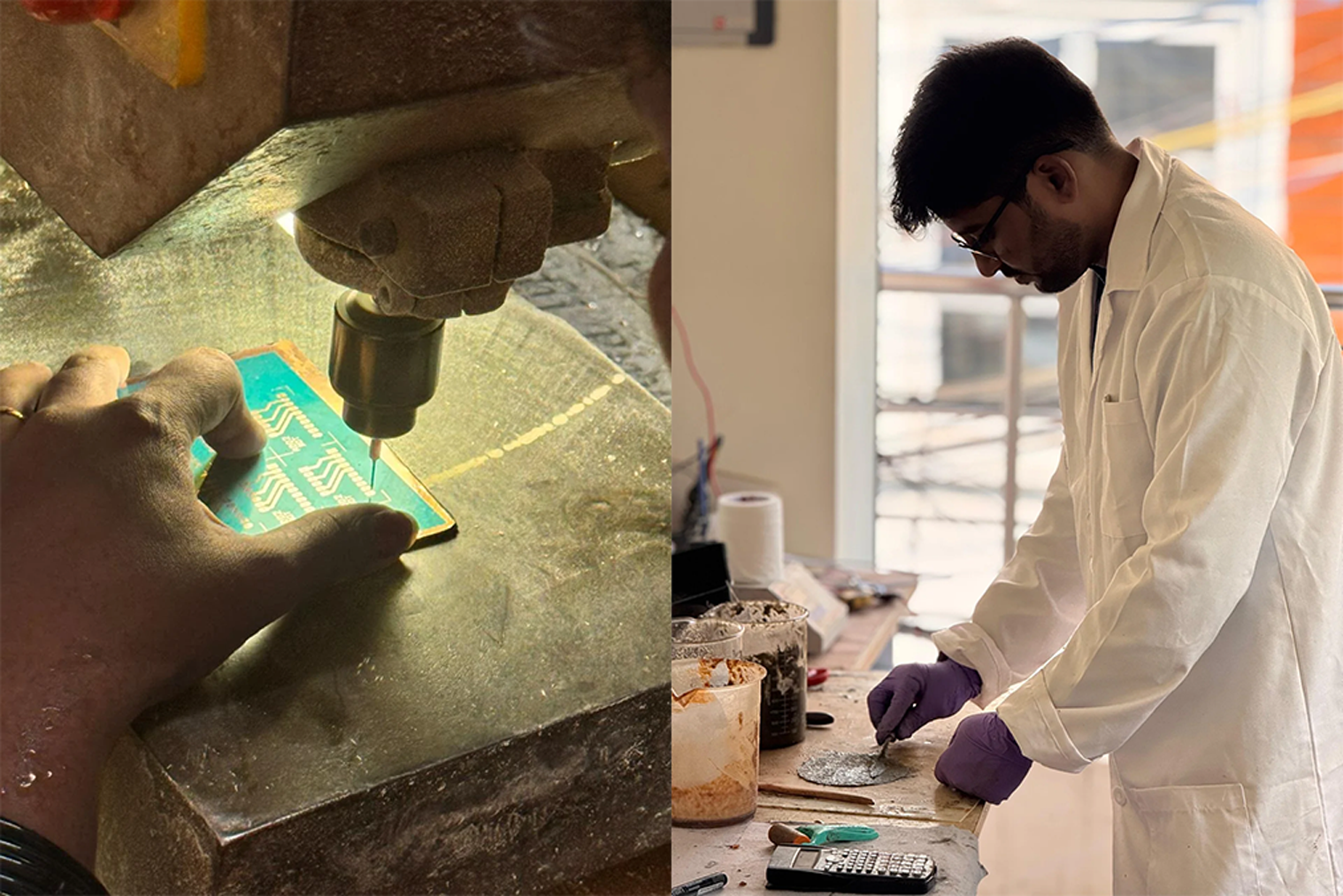
Photo by Bisket Labs
Learning from the factory floor
Independent laboratory testing has measured the material’s tensile, flexural, electrical insulation, dielectric and thermal properties, while accelerated weathering tests on an earlier version of the material indicate it retains its performance after prolonged UV exposure.
Laboratory success meant little until the material survived commercial production. That validation came through PCB manufacturers willing to experiment.
One of them is Chennai-based manufacturer Madhavan, whose company is called Green Circuits. He has spent more than 25 years producing printed circuit boards. “When they first approached me saying they wanted to replace the resin used in PCBs, I was intrigued,” he recalls.
The first prototypes revealed problems. Copper failed to bond properly because the biomass particles were too coarse. The founders refined the material.
The next version produced uneven surfaces because boards were being pressed manually. That led them to an automated hot-press operator in Chennai’s Ambattur industrial area, where pressure and temperature could be controlled more precisely.
Later iterations uncovered another challenge. During electroplating, microscopic air gaps inside the substrate prevented reliable copper deposition through drilled holes, creating the possibility of circuit breaking in double-layer boards.
That remains one of the principal engineering challenges today. Madhavan’s company has spent more than a year helping refine successive prototypes for commercial PCB production. Together, the evidence suggests the technology is moving beyond proof of concept, although longer-term commercial deployments and a formal life-cycle assessment remain to be completed.
Each failure has taught the founders something about a manufacturing process that even experienced PCB manufacturers often understand only through decades of practice rather than formal documentation.
The process has required well over a hundred material iterations, according to Singh. Today, the product meets FR-4 performance in single-layer PCBs, which are used in LED lighting, home appliances, power supplies and industrial electronics, Singh says. Further research and development is underway for making the product suitable for double or multi layer PCBs.
Building a board that behaves differently
The material itself differs fundamentally from FR-4 – Bisket has developed an entirely different composite.
Agricultural biomass is processed into a slurry that forms the structural matrix of the board. Today, around 80 percent of the substrate by volume is bio-based, according to the company.
Copper remains essential because it carries electrical signals. A small amount of glass fibre is still used to reinforce the board, though the company says this is roughly 90 percent lower than conventional FR-4 and hopes to eliminate it entirely in future versions.
Unlike conventional substrates that rely on added flame retardants, Singh says the biomass-derived chemistry contains naturally occurring phenolic groups that promote char formation during combustion. He says the material has achieved a UL94 V-0 flammability rating in third-party testing conducted by CIPET, while earlier testing measured a glass transition temperature of around 250°C.
The first commercial target
Rather than trying to replace every PCB immediately, the company is starting with simpler applications.
Its current technology supports single-layer boards used in products such as LED lighting, household appliances, industrial controls and power supplies.
Double-layer boards remain under development. Once that hurdle is crossed, the company believes multilayer boards can follow more quickly because existing lamination techniques can be applied.
This staged approach reflects both technical caution and commercial reality.
Replacing FR-4 across high-speed computing, telecommunications or aerospace electronics would require years of additional qualification.
Starting with simpler products lowers technical risk while giving manufacturers an opportunity to validate the material under real operating conditions.
The opportunity extends beyond sustainability
Although Bisket positions itself as a climate technology company, co-founder Rohith Sharma frames the business as one of industrial resilience. “Countries know they must develop sustainable supply chains, and better still, indigenous production technologies and capacities,” he says.
For Madhavan, the appeal extends beyond sustainability. India’s PCB manufacturers remain heavily dependent on imported substrate materials. “We’re dependent on China for PCB materials,” he says. “Recently we’ve seen around a 40 percent increase in epoxy prices because of the Strait of Hormuz crisis.”
For Sharma, that makes the technology as much about industrial resilience as environmental performance. “Our objective is broader than simply creating a greener PCB substrate,” he says. “We want countries to be able to manufacture one of the most fundamental components of modern electronics from locally available agricultural biomass.”
Madhur Singh is a Bengaluru-based journalist and Editor of Climate Action Live.
Inspired to Take Action?
Tl;dr: A summary for the busy, the curious, and the done-for-today
An IIT Madras spinout is developing a PCB substrate made largely from agricultural waste to replace the fossil-derived material used in conventional FR-4 circuit boards.
By designing the substrate as a drop-in replacement, Bisket Labs aims to fit existing PCB manufacturing lines without requiring new equipment.
More than 100 design iterations and collaboration with an experienced PCB manufacturer have helped the company overcome challenges in copper bonding, surface finish and manufacturability.
Independent laboratory tests support several key electrical, thermal and mechanical properties, while work continues on validating double-layer boards and scaling production.
If successful, the technology could reduce the environmental footprint of electronics while strengthening domestic supply chains by using locally available biomass instead of imported petrochemical materials.