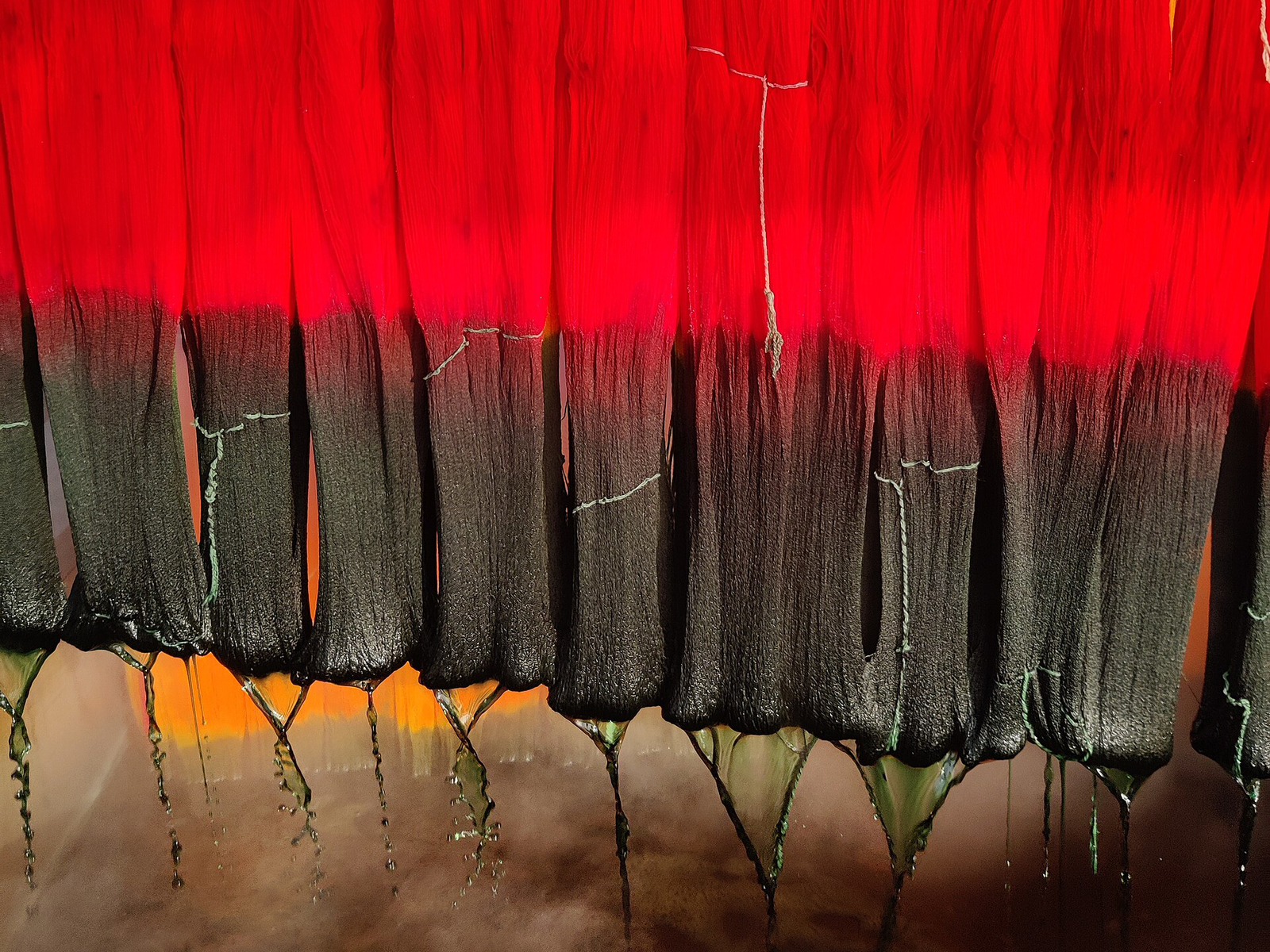
Whenever filmmakers want to portray the raw, uncomplicated beauty of India, two shots often make it to the screen. A crowded city bazaar, with two-wheelers and colourful autorickshaws jostling for space, women wearing vibrant sarees in blue, green, yellow and orange, and children smiling toothily into the camera while waving paper fans. The second shot is deeper and more evocative, of a fisherman standing on the hull of his boat at dawn, tossing his net in slow motion as the sun’s orange rays break through the sky.
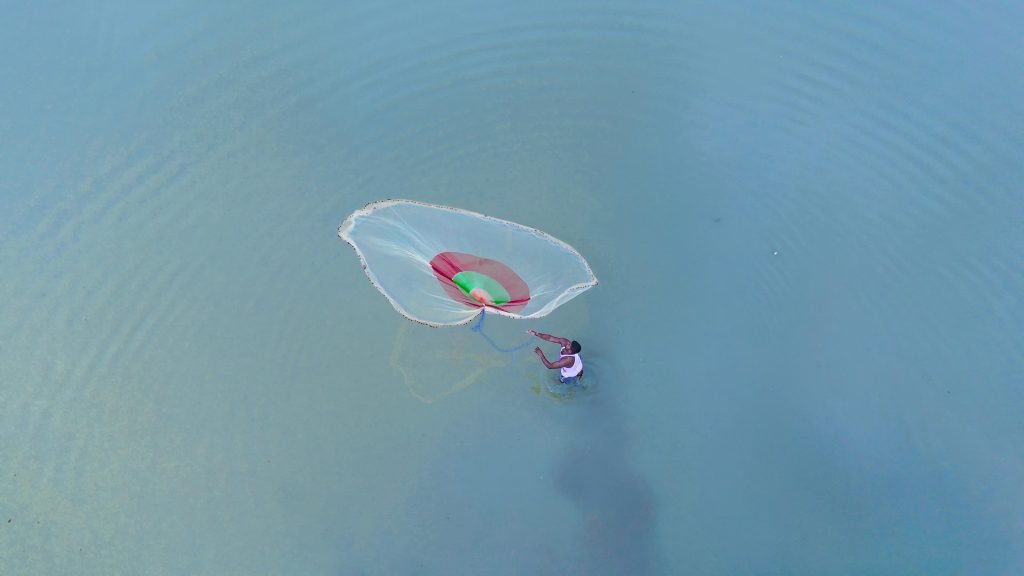
A fisher casts his net. Photo by Debharga Bhattacharya on Pexels
These images feel like poetry in motion, timeless snapshots of a nation that pulses with life and colour. However, there is a thread that connects these two familiar scenes, and it’s a dangerous one. The same vivid colours that brighten bazaars are flowing into rivers and soils, leaving behind chemicals that harm both ecosystems and people.
Toxics Link, a New Delhi-based not-for-profit that conducts field research and advocacy on toxic chemicals, has found nonylphenols (NP) in rivers near textile hubs. This chemical can mimic hormones, disrupt reproduction, and damage the development of humans and wildlife. Tests have revealed nonylphenol in surface waters of five major rivers – the Cooum and Adyar in Chennai, Buddha Nullah in Punjab, the Bandi in Rajasthan, and the Sabarmati in Ahmedabad. Toxics Link has also undertaken an assessment of 40 textile products from across 10 cities and found nonylphenol ethoxylates in many. The most extreme cases were women’s hosiery and innerwear, and baby and children’s clothing; sixty per cent of the latter tested positive for NPs.
In simpler words, the colours that seem to celebrate life are quietly poisoning the rivers, the soil and the people who depend on them.
What the numbers reveal
- Nonylphenols are persistent, bioaccumulative endocrine disruptors linked to reproductive and developmental harm, yet India lacks comprehensive regulation compared to the EU, the US and other jurisdictions.
- 15 of 40 clothing items tested (?35%) contained nonylphenol ethoxylates (NPEs, which degrade into NPs), with most being innerwear; the highest reading was 957 mg/kg in a female hosiery item.
- 60% of baby and children’s products (9 of 15) showed NPE presence (8.7-764 mg/kg).
- Rivers near textile hubs were contaminated: Cooum (Chennai) had 70 µg/L1, Adyar 60 µg/L, Bandi 40 µg/L and Sabarmati 7.9 µg/L.
- Sediments are also highly polluted: Buddha Nullah had 460 µg/kg NP and 1,190 µg/kg mixed isomers, which are different forms of the same chemical. Sabarmati’s sediments contained 360 µg/kg NP and 810 µg/kg mixed isomers.
- Effluent samples from textile units recorded NPE levels at 10.1 µg/L, detected only downstream, indicating the textile industry as the likely source.
1 µg/L = micrograms per litre, a standard unit of chemical concentration in water (1 µg/L is roughly 1 part per billion)
Source: Toxics Link, 2025
Where it started
Before the mid-1800s, Indian textiles were coloured with natural dyes made from indigo, madder root, turmeric, marigold, henna and other plant extracts. Indigo villages thrived in Bengal, Bihar and Tamil Nadu, where each dye plant was part of rural economies.
The industrial revolution changed that. Synthetic dyes from oil were cheaper to produce in bulk and offered an unlimited palette on demand. Plants needed farmland and were tied to seasons, while petrochemical dyes could be made year-round, in any colour, with industrial consistency.
This shift meant India largely forgot its botanical dyes.
Reviving nature’s palette
Natural dyes are increasingly being seen as a safer alternative. Dr Padma Vankar, who has spent three decades studying natural dyeing, told The Sustainability Times: “Petrochemical-based synthetic dyes cause a huge environmental impact due to their slow degradability compared to natural dyes. Plant-based dyes are biodegradable and their remnants can be used for composting after the extraction of the colourant.”
In Jaipur, Sodhani Biotech takes this idea to scale. The company extracts pigments from plants and waste such as onion skins, marigold petals and walnut husks, creating a circular supply chain that reduces pressure on farmland and supports farmers and suppliers. Its goal is to prove natural dyes can be consistent, scalable and commercially viable for global fashion. Clients include major distributors and brands, among them the US retailer Target, which used Sodhani dyes in a 1.5-million-garment collection.
Dyeing with synthetics leaves rivers choked with oxygen-hungry chemicals. Scientists measure this as Chemical Oxygen Demand (COD) and BOD (Biochemical Oxygen Demand), which show how much oxygen is needed to chemically break down all organic and inorganic pollutants in water. In Sodhani’s tests, natural-dye effluent demanded four to five times less oxygen than synthetic-dye effluent.
If microbes consume large amounts of oxygen, they leave less oxygen for fish and aquatic life. For rivers, this is not just a statistic; it determines whether water can sustain life.
Natural-dye revival is also a story of rural livelihoods. Sodhani Biotech has partnered with NGOs such as Pradhan to cultivate indigo as an intercrop, giving farmers steady income without displacing food crops. Indigo also acts as a cover crop, improving soil fertility and preventing erosion.
| Key Indian Players in Natural and Organic Dyes (Suppliers and innovators working at the textile and fibre level) | ||
|---|---|---|
| Company Name | Location | Description of Services/Products |
| Sodhani Biotech | Jaipur | Plant- and bio-based dye extracts from crops and agri-waste. Works with global fashion brands. |
| A&A Eco Products | New Delhi | Certified organic fabrics, certified by leading organizations including GOTS, GRS, OCS, FSC and Oeko-Tex. |
| Bio Dye | Sindhudurg | Focuses on scaling natural dyeing technology for cotton yarn led by molecular biology. |
| KG Fabriks | Coimbatore | Eco-conscious denim mill using organic cotton and zero-liquid-discharge (ZLD) dyeing processes. |
| Suvetah | Kangra | Offers naturally dyed, handwoven textiles using plant-based colours. Focuses on eco-friendly fabrics and artisanal processes for conscious fashion. |
| Livbio | Coimbatore | Develops bio-based natural dyes and extracts with an emphasis on sustainable colour solutions for the textile industry. |
| AMA Herbal | Lucknow | Pioneer in herbal and plant-based dye extracts for fabrics. Supplies eco-certified dyes and promotes large-scale adoption of chemical-free dyeing. |
Yet, organic, plant- and bio-based dyes remain niche items in both India and globally. The global organic dyes market is valued at around US$680 million in 2024, expected to grow at a 5.6% CAGR to over US$1 billion by 2032. In India, the textile dyes market is worth a few hundred million dollars, with organic variants being only a small fraction. Most usage is limited to premium lines, fashion pilots and conscious kidswear.
India’s textiles and apparel industry is among the world’s largest today, valued at about US$179 billion and contributing more than two per cent to India’s GDP while employing over 45 million people. Exports are close to US$37.7 billion, nearly nine per cent of India’s total merchandise exports. The country produces a wide range of textiles, including readymade garments, home furnishings, technical textiles, jute, silk and cotton yarn. These numbers show the scale at which natural-dye alternatives would need to find their place.
| Table 2: Brands Using Natural Dyes You Can Buy From | |
|---|---|
| Label Name | Website |
| Adiv Pure Nature | adivpurenature.com |
| Sui | sui.com |
| Oshadi | oshadi.in |
| 11.11 | 11-11.in |
| Ilamra | ilamra.com |
| Heena Agrima | heenaagrima.com |
| Avani Naturals | avaninaturals.in |
| Tula Organic Clothing | tula.org.in |
| Akane Studio | akane-studio.com |
| Kokun | kokun.in |
| Studio Itihaas | studioitiha.com |
| Bageeya | bageeya.in |
| Try Natural Dyeing At Home. You can order kits from: |
|---|
| Suvetah |
| Adiv Pure Nature |
| Avani |
| Color Ashram |
The business case
India’s textile and apparel industry is one of the world’s largest, accounting for over 12% of exports and directly employing some 45 million people. Export volumes reached about US$34 billion in 2023-24, following a peak near US$44 billion earlier in the decade.
Some of the momentum for organic dyes is already coming from niche buyers, much as organic cotton and handloom found early patrons overseas. Indian suppliers are working directly with international fashion houses. Oshadi, for instance, has collaborated with Stella McCartney and Mara Hoffman on naturally dyed collections, while Adiv Pure Nature has supplied to Eileen Fisher, Anthropologie (including Free People) and ABC Home. These are only a few of their global collaborators, as both labels have partners across Europe, North America and Japan.
The global organic baby clothing market alone is projected to grow past US$2.5 billion by 2030, making it a natural fit for organically dyed fabrics where chemical safety is paramount. While still a sliver of India’s US$37 billion textile exports, this demand could expand into a meaningful growth stream if backed by trusted certifications such as GOTS and OEKO-TEX and by reliable supply at scale. Indian exporters that pair their sustainable label with reliable dyeing processes, wastewater transparency and confirmed supply chain integrity can tap this emerging, high-respect niche.
Misconceptions, and other challenges
There are challenges and myths surrounding natural dyes. While science and entrepreneurship are beginning to reimagine how textiles can be dyed naturally at scale, it’s a work in progress. One of the biggest hurdles is that natural dyes do not bind easily to fabric. They need mordants, which are substances that fix the colour to the fibre. Traditionally these mordants are metal salts, some of which are toxic to humans and harmful to the environment. This shows that ‘natural’ dyeing is not automatically eco-friendly and needs innovation to live up to its promise.
Researchers are tackling this problem from different angles. Dr Padma Vankar’s team has worked on replacing toxic mordants with safer options such as enzymes, biomordants and rare earth salts. She explained, “We were even able to improve the fastness properties by using safe finishing agents; even fugitive dyes like turmeric showed far better fastness for light and wash.”
Fastness refers to how well a fabric keeps its colour without fading, bleeding or washing out. Different tests check colour fastness to washing, rubbing, sweat and light. Rare earth salts, Dr Vankar added, also improved the rub fastness of indigo.
Meanwhile, dye labs like Sodhani Biotech are exploring microbial colours, which already outperform plants in colour fastness and can make costly shades such as blue or green cheaper and more reliable.
Yet barriers remain. Sidhant Sodhani, MD, Sodhani Biotech, said asking brands to move from synthetic dyes is like asking them “to move from a smartphone back to a keypad.” Synthetic dyes still outperform in range, durability and supply. For instance, collecting adequate quantities of onion peel for colour extraction can take weeks.
Yes, there’s greenwashing too
Not all products marketed as ‘natural’ are genuine. Loopholes allow synthetics to slip into the market. An industry insider shares that some dyes are passed off as natural dyes but actually contain, say, 10 percent synthetic material. Adding even 10 per cent synthetic defeats the purpose, as the colour majorly comes from the synthetic part. Without stronger standards, cheap blends could flood the market, riding on the pro-nature trend – undercutting innovators and misleading brands and consumers.
The policy gap
Both scientists and entrepreneurs agree on the solution, which is stronger policy. Despite regulations, enforcement remains weak. Satish Sinha of Toxics Link emphasised, “The norms are well defined but the gap is in its implementation. Most rivers and surface water, when analysed, are found to contain dye residues.”
The reality on the ground confirms this gap. In Panipat, Haryana, dozens of bleaching and dyeing textile units were caught operating illegally without effluent treatment plants or pollution control consents, prompting closure notices from regulators. In Ludhiana, Punjab, hosiery and dyeing units continue discharging untreated wastewater into the Buddha Nullah despite repeated orders from the National Green Tribunal. Even state-run Common Effluent Treatment Plants (CETPs) in Haryana’s industrial hubs have been fined crores for failing to meet discharge norms, affecting clusters that include textiles.
Independent research paints the bigger picture, which is that fewer than 35% of textile effluent treatment plants (ETPs) and under 10% of CETPs consistently meet standards, showing how enforcement lags behind policy promises.
Stricter discharge limits, third-party audits and incentives for compliance could tip the balance. Take for instance the enforcement of Zero Liquid Discharge (ZLD), a wastewater treatment system to treat and reuse all wastewater so that nothing is discharged into rivers. Currently, ZLD is not a single nationwide rule for every textile unit in India and it is mandated case-by-case by CPCB/SPCBs (or via court or National Green Tribunal orders) for polluted or sensitive areas and certain large units. Sodhani said a key policy change that could help natural dyes scale would be stricter wastewater rules that move the industry towards Zero Liquid Discharge (ZLD)
For natural dyes to truly scale, three pillars must align: science, industry and policy. And you, dear reader, can vote with your wallet.
Sonam Raina is a contributing writer at Climate Action Live, covering verified climate solutions across built environment and interiors, fashion and textiles, waste management, and circular design. She focuses on evidence-led reporting that separates credible solutions from false and ineffective climate claims.
Inspired to Take Action?
Tl;dr: A summary for the busy, the curious, and the done-for-today
Scientists and entrepreneurs are reviving plant- and bio-based dyes as biodegradable, safer alternatives. Startups such as Sodhani Biotech are scaling natural dyes from crops and agri-waste, working with global brands to prove viability.
Natural dyes also support rural livelihoods by creating income streams for farmers and reducing pressure on land.
Key challenges remain: colour fastness, reliance on mordants, limited supply chains and the dominance of synthetics.
Enforcement gaps weaken existing pollution controls; stricter policies (e.g., mandatory Zero Liquid Discharge) are needed to curb synthetic dye pollution.
For natural dyes to grow beyond a niche, science, industry and policy must align, and consumers must make conscious choices.