

Every tourist season brings an outcry to ban plastic. First, TV and phone screens fill with scenery that makes city-dwellers sigh – a meadow in Himachal, riotous with wildflowers, or a lake so still it mirrors the sky. Then the camera pans, and there they are – chip packets gleaming in the sun, juice cartons flattened underfoot, and plastic chai cups scattered across the grass.
India has responded by banning single-use plastic time and again. The country rolled out a nationwide ban on certain single-use plastics effective from 2022, yet enforcement remains patchy. Himachal Pradesh has been banning carry bags and disposable items since the 1990s, adding restrictions on small PET bottles more recently, yet plastic keeps turning up. Maharashtra announced one of India’s strictest bans in 2018, targeting bags, plates, cutlery, bottles and more. Eight years on, single-use bags are still everywhere across the state.
So the question for a serious reader is no longer should we ban plastic?
It is why do these bans keep failing and what actually works instead?
Why bans are so appealing
Plastic bans feel powerful because they seem simple. What could be more straightforward than giving up plastic straws and drinking cold coffee straight from the glass? The ban feels like a clean, decisive blow, as if the problem has been cut off at the root. However, this straightforwardness is deceptive.
“Plastic bans often signal political intent,” explains Swathi Seshadri, an energy specialist at the Institute for Energy Economics and Financial Analysis, “but their effectiveness depends on upstream controls, transition support and system-wide policy design.”
Our reliance on cheap, easily available plastics has been shaped over decades. Bans target consumers, but the real causes of plastic use sit further upstream – namely, production, pricing decisions and supply chains. Seshadri says, “As long as the plastic manufacturing tap is open, consumption in one way or another will continue. Production capacity often outpaces downstream policy controls. If one set of plastic goods is banned, other kinds of plastic goods will be manufactured to ensure that manufacturing and consumption do not stop.”
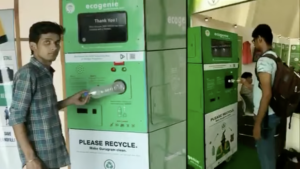
A reverse bottle vending machine. Courtesy: Gujarat Information Department
Bans address the symptoms, not the cause
When a city bans single-use plastic, problematic substitutes enter. An example of a widely promoted replacement is cloth-like bags – non-woven bags made of polypropylene or multilayer plastic. These bags look like fabric, but they contain more plastic by weight, need multiple reuses to break even on environmental impact, and cannot be recycled by most dry-waste centres. The same applies to garbage bin liners made of biodegradable or compostable plastic.
The focus of object bans is on the visibility of plastic litter. What bans leave largely untouched is the less visible layer of the problem, which is the decades’ worth of growth in plastic resin production that the petrochemical and packaging industry have planned for. As long as virgin plastic remains cheap and production targets continue to rise, disposable packaging will keep flooding markets. Object-level bans may remove a few items from view, but they do little to slow the volume of plastic entering the system in the first place.
To show the enforcement and performance of the ban, the authorities undertake headline-making crackdowns – inspections, raids, seizures, and sometimes even arrests. However, sustained enforcement is difficult as municipal bodies are responsible for policing commercial spaces, but manufacturers fall under state pollution control boards and other departments, says Garima Kaushik, head of the IPCA Centre for Waste Management and Research. “Enforcement officers themselves are often confused about what exactly is banned and what isn’t,” she says.
It doesn’t help that the relevant municipal authorities, which are responsible for managing bans in commercial places, have limited resources, are short of storage space for seized material, and have no clear plan for what to do with the seized goods.
Kicking the can down the road
This lack of urgency is written into the law itself, says Girija Bharat, a renowned researcher on plastic waste governance. While the 2021 rules banned 20 specific single-use plastic items from July 2022, they added a concerning amendment that any future notification to ban additional plastic products such as carry bags, plastic sheets and multilayer packaging would take up to 10 years to come into force from the date of announcement. This means that if the government announces today that it wants to ban plastic bottles, that ban will not take effect until 2036.
While the deadline is purportedly meant to give industry time to adapt, Bharat warns that a decade-long delay risks locking in continued plastic use and weakening the regulatory signal altogether. This amendment allows business as usual for far too long.
The most troubling aspect of the ban on single-use plastic is that it ignores the fact that current waste systems are not made for materials like coated paper and polypropylene packaging, as described earlier, and can create problems by jamming sorting lines, contaminating recyclable streams or fragmenting microplastics.
How is household waste managed in India
In Indian cities, household waste is broadly divided into three categories. Wet waste includes food scraps and other biodegradable material that can be composted. Dry waste refers to non-biodegradable items such as plastics, paper, metal, glass and multilayer packaging materials that must be sorted and sent to different recyclers. Reject waste consists of items that cannot be recycled or composted at all and usually end up in landfills, open dumpsites or incinerators. The effectiveness of any plastic policy depends heavily on how well dry waste is segregated and processed, because this is where most single-use plastics eventually end up.
At a dry-waste collection centre in Bengaluru run by Indumathi, a former waste picker-turned-entrepreneur, teams of waste pickers sort incoming waste. Milk pouches go into one pile, thin polythene bags into another, aluminium foil into a third, and thermocol into yet another because each material has to be sent to a different recycler that can handle only that specific type of waste.
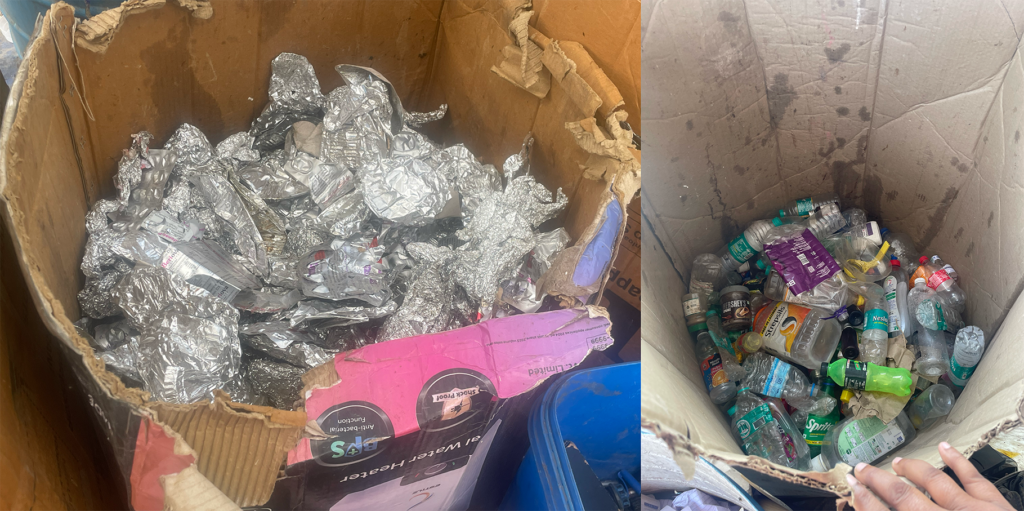
Aluminium foil and PET bottles segregated at Indumathi’s dry waste collection centre, Bengaluru. Each material stream is routed to a recycler equipped to handle it. Photos by Sonam Raina.
Indumathi recalls that Bengaluru’s plastic ban, introduced in 2014, did reduce volumes of single-use plastics, but the materials used to replace them made things worse. Multilayer plastic now dominates the reject stream. These materials are not recyclable and for the past year have been sent to a new waste-to-energy incinerator in Bidadi. (Watch our video that explains why waste-to-energy plants are a poor waste management and energy solution.)
Incineration is frequently celebrated as a solution, but research shows that it has environmental and health costs. Burning mixed plastic waste releases fine particulate matter linked to respiratory and cardiovascular disease, heavy metals such as lead and mercury, and toxic by-products like dioxins. Studies have associated proximity to waste incinerators with increased risks of cancer, adverse birth outcomes and long-term health effects. Incineration resolves the immediate problem of storage, and prevents waste from bloating landfills, but does not eliminate the broader impacts of unrecyclable plastic.
The limits of substitution
There are businesses that comply early and in good faith. Kala Ghoda Café in South Mumbai stopped using plastic straws years ago and continues to rely on compostable packaging. Paper straws are provided only on request. Straws, the café’s management says, are viewed as non-essential. But the switch has not been frictionless, they say, citing hot liquids as the biggest challenge. Compostable cups and containers struggle with hot coffee and soups, leading to frequent complaints about leakage. The café is now considering a heat-sealing machine that would seal compostable tubs with a thin plastic film but will reintroduce plastic into the system.
Paper straws are in use despite going soggy, largely because customers still expect them and staff often give in to customer demands, Farhad Bomanjee from Kala Ghoda says. This example is not a story of hypocrisy or backsliding. It is a reminder that asking individual businesses to solve a systems problem through object-level substitutions pushes them into compromises.
What actually works: Redesigning systems
Real solutions work upstream, cutting off the flow of plastic before it becomes waste. This means getting rid of unnecessary packaging formats and single-use packaging as much as possible, treating refill and return systems as basic infrastructure rather than lifestyle choices, standardising and labelling packaging so it can actually be collected and recycled effectively, and making sure extended producer responsibility isn’t just paperwork.
Seshadri proposes the application of the “Essentiality Principle” (also known as the Essential-Use Concept). Successfully modelled by the Montreal Protocol to phase out ozone-depleting substances, under this principle, a plastic product would only be considered for use if it is necessary for human health and safety or critical for societal functioning. Furthermore, its use is only justified if there are no technically and economically feasible alternatives that are acceptable environmentally and health-wise. Through identifying and progressively disincentivising these non-essential uses, regulators can systematically eliminate primary plastic polymers and chemicals of concern at source.
Norway, whose deposit-return systems for beverage containers are considered among the world’s most effective, did not ban plastic bottles. Through a system implemented over decades, anyone buying a drink in a bottle or can pays a small extra amount at the counter. This deposit would be refunded in full when the empty container is returned for recycling.
This method differs from “fixed kerbside” recycling, which is the standard system used in many cities, in which households place empty bottles and cans in a bin outside their homes, and municipal trucks collect them on a fixed schedule. While this system captures some recyclables, it relies heavily on users participating regularly and on waste handlers sorting items correctly. Contamination is a problem when plastic items are mixed with other waste.
Norway’s deposit-return system adds a direct incentive to bring containers back. Empty bottles and cans are returned to shops, where reverse-vending machines accept them and issue instant refunds. These machines automatically sort and store the containers, which are later sent to recycling facilities. For those who prefer not to use machines, many stores also accept returns manually.
Rather than relying on household bins alone, the system creates a nationwide network of return points that people encounter during everyday shopping trips. Returning bottles becomes routine, not an extra chore.
The results have been impressive. More than 90% of beverage containers in Norway are returned through the deposit-return system. Convenience plays a major role, as does the small but tangible financial reward. Over time, the combination of easy access, clear incentives, and consistent rules has shaped everyday habits.
The success of the model elsewhere shows that high recycling rates can be achieved without bans when systems are designed to align convenience, economics and behaviour. In India, early pilots have been initiated, but entire supply chains need to be engineered.
But, there is precedent. Indians of a certain age will remember that when you bought a “cold drink” in the pre-2000 era and took it home, the shopkeeper would collect a small deposit for the bottle. You would drink it, return the empty bottle, and get a refund. The bottles would go back to the bottling plants to be washed, sterilised and refilled. This system worked not because of environmental virtue but because of straightforward design in which the bottle had a clear monetary value, returning it was the easiest way to reclaim it, and reuse infrastructure was already in place.
Once PET bottles and Tetrapak-type packaging became ubiquitous – and cheaper for manufacturers to use and transport – it displaced glass over the 1980s and 90s. This shift from circularity towards corporate convenience passed the true cost of disposability onto municipalities, consumers – and the environment.
| Solutions Comparison (What Works vs What Fails) | |||
|---|---|---|---|
| Approach | Type | Effectiveness | Reason |
| Plastic bans | Reactive | Low | Targets symptoms |
| Substitutions | Reactive | Low-Medium | Often worse materials |
| Incineration | Disposal | Medium (short-term) | High health cost |
| Deposit-return systems | Systemic | Medium-to-Low | Low incentive + missing infrastructure + displacement of waste pickers |
| Refill/reuse systems | Systemic | High | Reduces production |
| Essentiality principle | Preventive | Very High | Eliminates unnecessary plastics |
Solutions that work don’t just ban one thing at a time, swap one throwaway for another, slap on eco labels without proof, or burn waste to get it out of sight. They put the onus on producers, and build infrastructure that makes doing the right thing the path of least resistance. In addition, waste-picker consultations would ensure that waste management concerns with alternatives are weighed, and that the informal sector is a part of the transition away from single-use plastic – this bottom-up approach would strengthen any policy targeted at plastic pollution.
If this article does its job, you will still wince when you see a PET bottle on a mountainside or on a gorgeous beach, but you will also know that the bottle is not just a personal failure but a design, policy and production decision. That’s where real solutions must begin.
Sonam Raina is a writer and reporter based in Bengaluru. She covers verified climate solutions across the built environment and interiors, fashion and textiles, waste management, and circular design. Sonam focuses on evidence-led reporting that separates credible solutions from false and ineffective climate claims.
Reporting for this story was supported by Break Free From Plastic.
Anil Kumar helped produce this story.
Inspired to Take Action?
Tl;dr: A summary for the busy, the curious, and the done-for-today
Despite repeated restrictions (since the 1990s in states and a 2022 national ban), single-use plastics remain widespread due to weak enforcement, unclear rules and limited capacity of local authorities to enforce.
Bans target visible items and consumers, but plastic production, cheap virgin materials, and supply chains continue to drive consumption—often leading to worse substitutes like non-recyclable multilayer plastics.
Alternatives like compostable packaging or paper straws create new issues, while India’s waste systems struggle to handle complex materials, leading to landfill, incineration and health risks.
Fragmented governance, long policy delays (up to 10 years for new bans), lack of recycling infrastructure and behavioural challenges limit the effectiveness of current approaches.
Effective solutions focus on reducing production, enabling reuse/refill systems, and incentivising returns – such as deposit-refund models (used in Norway and planned in Goa) – that align convenience, economics and accountability.