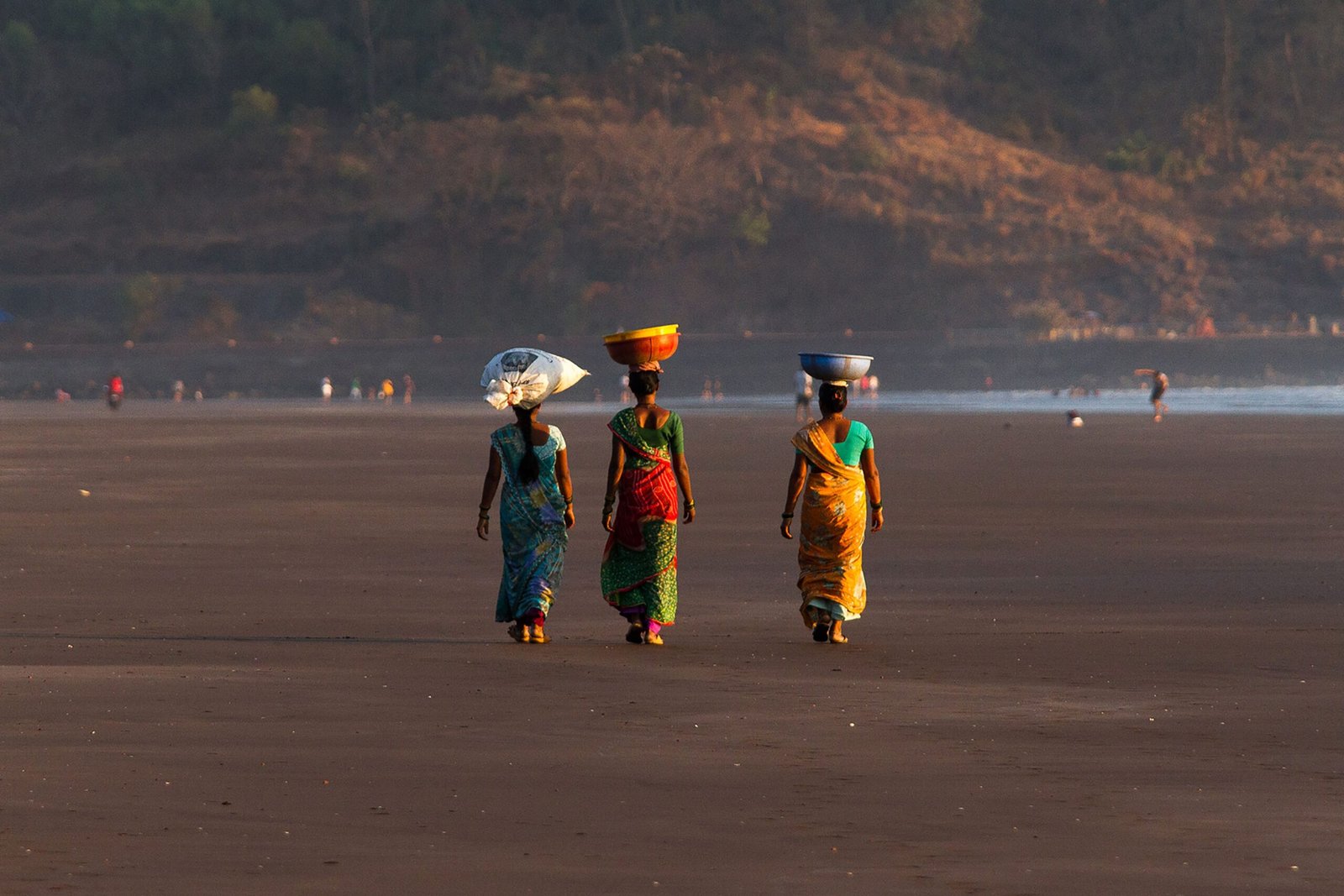
As dawn breaks over Bheemili beach, the fishing boats return lighter than they once did. The day’s catch is smaller, many fish species have become scarce and an increasing number of men are leaving home to find work in Goa, Kerala, Karnataka and Mumbai. In village after village, the responsibility for keeping fishing communities alive has quietly shifted to the women.
They are doing far more than filling the gap. In villages such as Postapatraika and across Vizianagaram district, fisherwomen are building local fish markets where none existed, organising themselves into federations that provide affordable credit, and leading campaigns against industries they say are poisoning the groundwater and threatening their livelihoods.
As climate change and coastal erosion compound shrink fish stocks already strained by overfishing and industrial aquaculture, these women are creating the social and economic institutions that make it possible for their communities to endure.
Their story challenges a common assumption about climate resilience. It is often imagined as new technologies, bigger infrastructure or government programmes. Along Andhra’s coast, resilience is instead being built from the ground up by women who are strengthening local markets, expanding access to finance and fighting for the natural resources on which India’s fisheries depend. In doing so, they offer a model for coastal communities facing similar pressures across the country.
Where have all the young men gone?
“Earlier, we used to fish for one or two hours,” says Daniya, 41, a traditional fishworker from Bheemunipatnam whose family has lived by the rhythms of the sea for generations. Looking out over looking out over the serene Bheemili area, where the Gosthani River meets the Bay of Bengal. “Now we leave around 2.00 in the morning and come back around 10.00. And still the fish are fewer.”
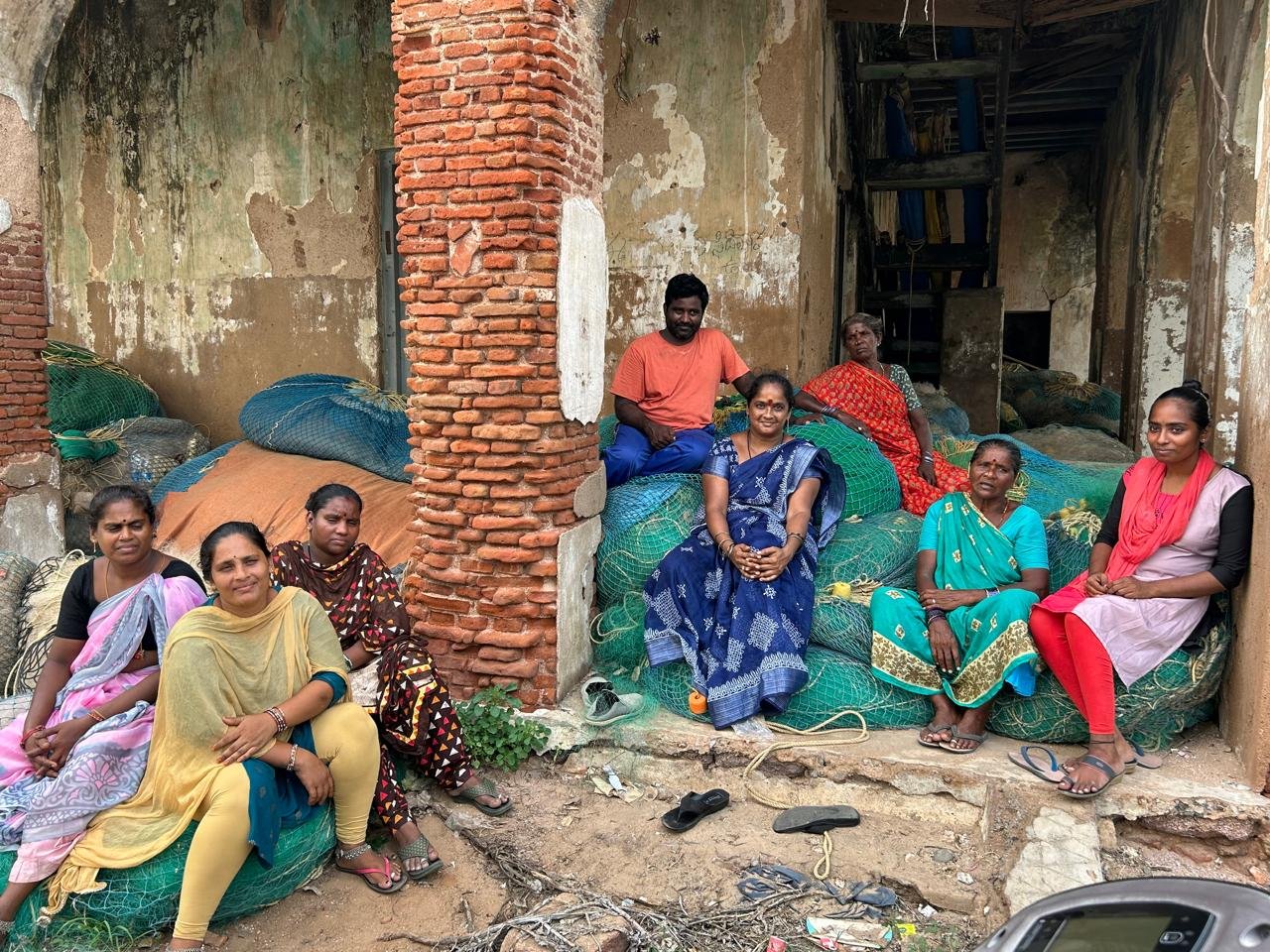
Fisherwomen meet during a fishing ban to discuss challenges to coastal livelihoods and community-led initiatives. Photo by Aishwarya Bajpai
The statistics tell the same tale. Andhra Pradesh’s marine fish landings weighed 1.75 lakh tonnes in 2024 – 8% lower than in 2023, and 19% lower than in 2022, according to the Central Marine Fisheries Research Institute (CMFRI). The state peaked at 3.42 lakh tonnes in 2014. In a decade, landings have halved.
“We lost five or six species,” Daniya says. “Earlier people used to ask for them. Now people know they have vanished.”
“Sawfish have become very rare and many are not available anymore,” says R. Ramasubramanian, Senior Fellow at the M.S. Swaminathan Research Foundation (MSSRF), confirming the species loss. “Silver pomfret, which once fetched good prices, is now found in much smaller numbers.”
For many fishing families, shrinking catches have meant shrinking incomes. Younger men are increasingly migrating to Goa, Karnataka, Kerala, Chennai and Mumbai in search of work, leaving women to hold together both households and the local fisheries economy. This gradual shift is transforming Andhra’s coastal villages.
Polycrisis
What is happening in Bheemili reflects two distinct problems that are often conflated but demand different responses. The first is overfishing – a governance failure.
“Climate change also contributes, but the major cause is overfishing,” Ramasubramanian says plainly. Regulations exist on mesh sizes, bycatch and gear, but enforcement is weak. He cites the example of bycatch: “A lot of juvenile fish are caught as bycatch and brought to the shore. Most of it is discarded because it has very little market value.”
The second pressure is industrial aquaculture contaminating the environment that the communities depend on.
Kovvada Varalakshmi, formidable at 53, has knocked on doors in fishing villages, persuading women to organize and stand up for their rights. Speaking curtly and walking briskly, she is often the only woman in the room. To the fisherwomen who follow her, she is simply Lakshmi akka.
As president of the Traditional Fishworkers Union (TFWU), Andhra Pradesh, she says aquaculture farms are drawing in seawater, increasing salinity in the surrounding groundwater. “Because of that, the borewell water has become salty. Even the piped water is salty,” she says. “There is no water to drink. We are struggling.”
Aquaculture requires large volumes of seawater to be pumped inland, Ramasubramanian explains. Over time, that has made the groundwater increasingly saline.
A peer-reviewed study found a remarkable decline in fish diversity along the AP coast, with anthropogenic disturbances named as a key driver alongside climate change. Environmentalists and former government officials have warned that unregulated aquaculture is creating a drinking water crisis across coastal districts.
The third strand to this polycrisis is coastal erosion – land along the shoreline is gradually wearing away and disappearing into the sea. A National Centre for Coastal Research (NCCR) assessment, which mapped Andhra Pradesh’s 1,027-km shoreline using satellite data from 1990 to 2022, found large stretches facing erosion. The government’s own Shoreline Management Plan has flagged the Bheemunipatnam coast, where Bheemili sits, as one of the zones requiring resilience planning. Fishing villages, ports and ecologically sensitive areas have been identified among the locations most vulnerable to erosion, placing communities like Bheemili’s directly in that path.
The economy that policy forgot
Government relief is built entirely around registered male fishermen. It recognises only the boat/catch side of the economy, not the vending/post-harvest side. During the annual fishing ban, each male fisher receives Rs 20,000 directly. Women, whose vending and post-harvest work sustains the same economy, have no equivalent registration or entitlement; even active self-help groups get no direct benefit.
Historically, women’s work has undergirded the fisheries economy – buying fish at landing centres, transporting them to nearby villages, selling them in local markets, and managing family incomes. A 2025 FAO study found that 4.8 million women engage in India’s small-scale fisheries; 1 in 5 people in the sector are women, with 55% of them working in post-harvest handling, processing and trade. In Andhra Pradesh, 27,000 fisherwomen are working in fish marketing. Fish vending is, structurally, women’s work.
Yet as catches have declined and men have migrated, that economy has begun to unravel. Varalakshmi describes what that displacement looks like from inside a fishing village. “Our women are facing a lot of problems. Their husbands are going for labour work. Women are going for domestic work, hotel work,” she says, adding that they make Rs 300-500 per day from such work. A fishing household usually earns Rs 1,000-2,000 per day, depending on the catch.
“Our villages are increasingly being run by women,” Varalakshmi says.
Building markets the state never built
The Traditional Fishworkers Union was formed in 1999 and affiliated to the National Fishworkers’ Forum (NFF). It works in four districts – Srikakulam, Vijaynagar (Vijayanagaram), Vishakapatnam and East Godavari – and has supported the formation of about 32 marine action committees (MACs) for women. Each MAC has 50-400 members. Members contribute Rs 50 each month to a common pool, from which they can take loans. They have resisted the formation of SHGs, as the requirement of 20 members per SHG could prove divisive for the union and the societies.
As this realisation of women’s expanding roles seeped in, Varalakshmi and her team at the union examined what women fishers needed. The answer was simple: a place to sell. Visakhapatnam has one fish market. Women in the surrounding villages had none.
So, the union helped build fish markets in villages like Postapatraika in Vizianagaram district. “[In these villages], the fisherwomen – they are not going to work in households. They are working in our work, the fisheries,” says Varalakshmi, with a tinge of pride in her voice.
Ramasubramanian, who has observed these markets, confirms they are a meaningful shift. “Many fisherwomen organised themselves into federations years ago. Today, those Self-Help Groups are doing well, with women leading activities ranging from fish vending to dry fish processing and playing a major role in local fish markets.”
While enabling women fishers to persist in their occupation, markets reduce dependence on middlemen. They keep incomes circulating locally rather than letting them disappear into distant supply chains. But, they cannot solve the scarcity problem: when catches are too low, women travel to other villages to buy fish for resale, absorbing transport costs against already narrow margins.
From moneylenders to federations
Credit has been as critical as infrastructure. Twenty years ago, fisherwomen in AP had one option when they needed capital: moneylenders at high interest, no documentation, no recourse. Now, Ramasubramanian says, the federations are working well. “[Women] are taking loans and repaying them,” he says.
Government-supported federations now receive subsidised credit and matching funds. “If a federation has [raised] two lakh rupees, the government will provide another two lakhs,” Ramasubramanian explains. Structures like Godavari Mahila Samakhya and Mandal Mahila Samakhya now operate across blocks in AP, giving women’s groups formal credit pathways that didn’t exist a generation ago.
Explaining why credit is important, Varalakshmi says in villages where credit and markets both exist, women are staying in fisheries. In villages where one is missing, they are leaving.
From building markets to fighting for their coast
In Vizianagaram district, the fisherwomen’s work extends well beyond markets and lending. They are also leading the fight against industries they say are destroying the resources their communities depend on.
“Aquaculture companies are producing prawns for export to countries like France, while the native fish that our communities have traditionally caught are becoming scarce,” says Varalakshmi. How seawater pumped inland for aquaculture has contaminated groundwater, leaving many villages without safe drinking water, has been documented in Vizianagaram district.
The union has petitioned government officials, met the Joint Director and worked through village leaders to demand a government-funded water treatment plant, estimated to cost Rs 1 crore. “We need a water plant,” Varalakshmi says. “We do not need aquaculture. We need good water.”
Ramasubramanian says district administrations have the legal powers to monitor compliance and respond to complaints from fishing communities. The challenge, he says, is implementation rather than regulation.
Union advocacy has delivered one victory.
When a pharmaceutical company proposed a factory on land used by fishing communities in Vizianagaram district, many residents were persuaded by promises of jobs and other incentives. “They offered money, alcohol and jobs in the pharmaceutical company,” Varalakshmi recalls.
Fearing the long-term impact on fishing and the environment, Varalakshmi and other fishworkers organised protests, filed petitions and campaigned against the project. She was arrested during the demonstrations and spent two days in jail.
The campaign ultimately succeeded in preventing the land from being permanently converted to industrial use. For Varalakshmi, the episode reinforced the power of collective action to defend both livelihoods and the ecosystems on which they depend, even as Andhra Pradesh and Telangana continue to host more than 250 bulk drug and API manufacturing units.
Government support
The state is not entirely absent. AP’s Y.S.R. Matsyakara Bharosa scheme increased annual fishing ban compensation to Rs 10,000, and the current government has raised it further. “Government now gives Rs 20,000 during the fish ban,” Daniya says. “Earlier they didn’t give. Now the government is giving loans for buying boats, also around ₹3 lakh per boat,” he adds.
But the Pradhan Mantri Matsya Sampada Yojana (PMMSY), the government’s Rs 20,312 crore flagship fisheries scheme, is oriented toward exports, technology and industrial aquaculture expansion. And the Rs 20,000 ban compensation goes only to registered male fishers. RTI data confirms that women vendors receive nothing. “Only men,” Daniya confirms. “Active fishermen.”
Ramasubramanian has some practical and modest suggestions: enforce the fishing ban properly, provide ice boxes for the fishers to refrigerate the catch and get better prices, and accelerate solar-powered boats to reduce fuel costs. “Solar-powered boats are one good solution that is coming,” he says.
None of these requires a new programme. But all require political will to direct existing resources towards people at the bottom of the value chain.
Why the rest of India should care
Andhra Pradesh accounts for nearly 28% of India’s seafood export by value. It is one of the engines of the country’s Blue Economy ambitions, where aquaculture, exports and coastal infrastructure are expected to drive economic growth.
But this story also exposes the uneven distribution of those gains.
Communities living alongside shrimp farms say groundwater has become saline, fishing grounds have shrunk and traditional livelihoods have become more precarious. Women, who undertake more than half of India’s post-harvest fisheries work, remain largely absent from compensation and support schemes despite carrying much of the burden of sustaining household incomes.
Back in Daniya’s village, change is afoot in many ways.
“There used to be conflicts,” he says of the two fishing castes that once competed with each other. “Now they are marrying.”
As fishing has become more difficult, old divisions have given way to cooperation. Women have built markets where none existed, organised federations that provide affordable credit, and fought to protect the coast on which their livelihoods depend. Families have adapted, even as many younger men have left in search of work.
Daniya’s own son stopped fishing four years ago. Daniya did not. “There is nothing wrong with this work,” he says. “We want to continue doing it.”
Whether the next generation can make the same choice may depend on whether India’s Blue Economy invests not only in expanding production, but also in the communities that have sustained the country’s fisheries for generations.
“Our women are working in the fisheries,” says Kovvada Varalakshmi. “They should be recognised too.”
Aishwarya Bajpai is a Haryana-based freelance journalist and researcher focusing on climate and environmental reporting.
Tl;dr: A summary for the busy, the curious, and the done-for-today
Andhra Pradesh’s fishing communities are facing a polycrisis of declining fish stocks, overfishing, industrial aquaculture and coastal erosion, compounded by climate change.
As catches shrink and young men migrate for work, fisherwomen are increasingly holding together both household incomes and the local fisheries economy.
In villages such as Postapatraika, women have built fish markets, organised federations and created affordable credit systems that help families stay in fishing.
They are also fighting industrial projects and aquaculture practices they say are damaging groundwater and the coastal ecosystems their livelihoods depend on.
Their experience offers a different model of climate resilience: not just technology and infrastructure, but women-led institutions that strengthen local economies, protect natural resources and keep communities together.