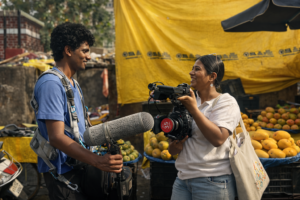
In November 2022, at the American University in Cairo’s pavilion at COP27, a film I co-directed had its premiere. Emissions Market India: Surat Leading the Way told the story of the world’s first emissions trading scheme for particulate matter in seven minutes, through the lens of the researchers and regulators who built it. The story showed the journey of a city of textile mills that had cut particulate emissions by about a quarter while lowering compliance costs and increasing profits – something that has never ever been seen in developing economies.
I was not in the room – communications people rarely are. We build the story, send it out, and follow its journey from a distance. This one travelled well – a year later the film featured in a video presentation at the Pollution Pods in COP28 as well. It isn’t every day that the visual story of a research experiment finds a COP audience two years running. But something was missing, and it took me a while to notice. I will come back to that.
For the better part of two decades, my work has been moving climate evidence from the researchers who produce it to the people it concerns. Some of that work has aged well. But the lessons have come from the rest, which hasn’t.
When I look back, I find that every miss had the same habit underneath – I started with the climate problem and got to the audience later. That habit taught me five uncomfortable truths and here they are:
1. Nobody is waiting for our message
The newsroom taught me this early. A story that did not touch the reader’s health, money or family moved down the priority, however important you thought it was.
Institutions run the other way round, and the topics you’ll pick to tell stories about will be mandated. For me, that meant emissions markets, sulphur dioxide, particulate matter. Over time, those words became my default language. I wrote press notes on trading schemes for readers who were thinking about the smog outside their window and a child’s cough that wouldn’t go away.
A Yale and CVoter survey asked 10,751 Indians about climate between December 2024 and February 2025. Seventy-one percent had lived through a severe heat wave that year. More than 25% had never heard the term “global warming.” Both numbers describe the same country, often the same person. My audience was living the story, and I was writing it in a language they had no reason to know.
It began to get better when I started writing from their side of the window.
2. We write for each other
After every major outreach, I would check the engagement. The reposts came from partner organisations. Webinar seats often filled with peers working in the same domain, advancing similar goals. When a report reached out well, the congratulations came from people who write the same kind of reports. For years, all of that counted as reach.
The World Bank once checked who actually reads its policy reports. Nearly a third had never been downloaded, even once. Almost 87% had never been cited. So, do we always manage to reach our audiences? No. Our messages do travel, but mostly to rooms full of people like us, not always to the public outside them.
3. Better wording won’t rescue the wrong frame.
I have refined press releases for days, convinced the next draft would work better. The ones announcing a research outcome, or an institutional milestone, have rarely drawn massive coverage, however polished.
Yet some of our media briefs took off, picked up and amplified far beyond our own push. The difference was never the editing.
A megastudy published in Nature Climate Change this January explained this to me. Researchers tested the 10 most-cited climate messaging strategies on more than 13,000 Americans. Six of the 10 shifted attitudes, by 1 to 4 percentage points. Not one message persuaded people to donate to the cause.
Reading it, I felt like diagnosing a long-standing challenge. I realised that a release starts working when its first line carries the reader’s stakes – what the smog costs them, what the scheme saves them. The institution’s name can wait for the second paragraph.
4. People move for their health
This lesson came from something that worked. For the past eight years I have worked to make the Air Quality Life Index part of how South Asia argues about its air. The index turns pollution levels into years of life lost. Micrograms per cubic metre never entered a parliamentary question but ‘years of life’ did.
Members of Parliament cited it, public interest litigation before the Supreme Court cited it. The data was quoted extensively in media reports, films, books and coursework over the years. Identical data but different units, and the impact was huge. For years I treated that as a lucky break, particular to air pollution.
Then a study landed in late 2025. The Climate Opinion Research Exchange and the Wellcome Trust ran a randomised controlled trial across Brazil, India, Japan and South Africa, with more than 30,000 respondents. Health-framed climate messages shifted attitudes twice as often as anything else tested.
In India, the strongest of all 16 messages was air pollution, and that message alone pushed demand for urgent government action up by 8 percentage points. Brazil moved on mental health, Japan moved on extreme heat and South Africa moved on children’s health. The trial confirmed what the years-of-life unit had shown me: climate evidence moves people when it lands on their family’s health.
5. The messenger outweighs the message
Which brings me back to the film. The mill owners, the people whose trading decisions made the scheme work, weren’t in it. We told their story through the economists and officials who designed the system. The bet on video was right but the casting was incomplete. We recorded the mill owners much later. Nothing we had scripted came close to how they told it themselves.
And such a gap costs more now than it did in 2022. The audiences we chase scroll the same feeds as the rest of us and possibly on a phone, in under a minute. Through a face and a voice. The officials who sign policies scroll them too. A trader’s own words explaining why compliance became cheaper than evasion will travel further as a 60-second video than the report we publish around him. Short, first-person, visual storytelling now does more of the persuading than the documents it once merely promoted.
So here is the takeaway
For the next content you create around climate, try a small audit. Dig out the last press release or post you sent or received and stop at the hundredth word. Has anything your audience actually worries about shown up yet? Mine hadn’t, for several years, before I thought to check and tried to fix.
What those years produced is a short routine. In every draft now, I try to answer three questions: What does this audience stand to lose? What do they want for their families? Whom do they already trust?
The answers pick the unit, the story, the spokesperson, and increasingly the format. Get them right, and the evidence starts to count. Skip them, and it stays in the rooms where it was written.
Ashirbad Raha leads communications for the University of Chicago’s Energy Policy Institute in South Asia.