If you live in an Indian city today, chances are there’s construction happening nearby. A new metro line, a flyover, a housing tower, a mall, or endless road repairs. Enormous quantities of concrete are being poured every day.
Now consider this: if concrete were a country, it would be one of the world’s largest emitters of greenhouse gases.
That sounds strange. Concrete doesn’t burn fuel or have an exhaust pipe. It is mostly made from materials that seem fairly benign: stone, sand, gravel and water. Yet concrete production is responsible for an estimated 5–8% of global greenhouse gas emissions.
The paradox is hard to ignore: The world needs more infrastructure, and India alone is expected to build vast amounts of housing, transport systems, renewable energy infrastructure and industrial capacity over the coming decades.
So how do you keep building a country without significantly increasing emissions?
The answer may lie in an unlikely place: rethinking the recipe of concrete itself.
Rather than abandoning concrete altogether, scientists, engineers and manufacturers are trying to redesign the world’s favourite construction material so that it delivers the same strength and durability with a much smaller climate footprint.
Welcome to the world of low-carbon concrete.
But before we explore how that works, we need to understand what concrete actually is, and where its emissions come from.
Why is concrete so carbon-intensive?
Concrete is the world’s most widely used construction material. We produce around 30 billion tonnes of it every year, far more than steel, plastic or aluminium.
As cities expand and countries build new roads, railways, airports, housing and renewable energy infrastructure, demand for concrete continues to grow. Global concrete production roughly quadrupled between 1990 and 2020.
Most concrete-related emissions come from one of its key elements: cement.
Concrete is essentially a mixture of cement, water and “aggregates” such as sand and gravel. Cement acts as the glue that binds everything together. Although it makes up only a small proportion of the final mix, it is responsible for most of the carbon footprint of concrete.
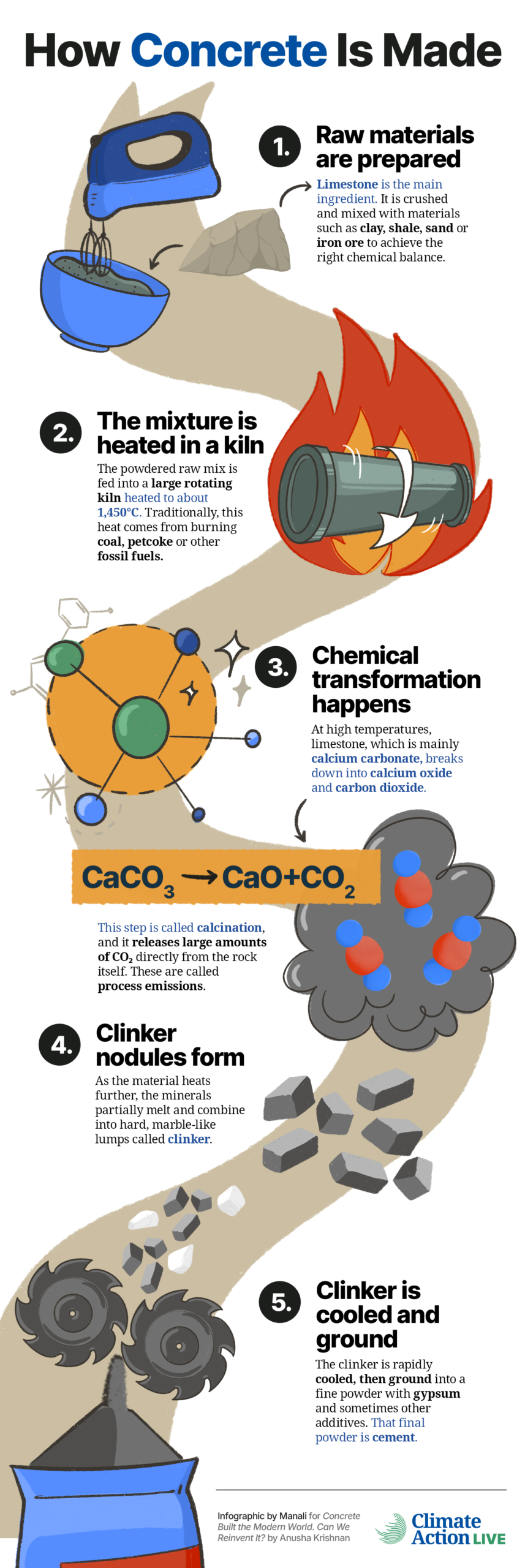
The culprit is a key ingredient called clinker. Clinker is produced by heating limestone and other materials in giant kilns at temperatures of up to 1,450°C.
This process generates emissions in two ways. First, enormous amounts of fuel are burned to reach such high temperatures. Second, the limestone itself releases carbon dioxide as it is transformed into lime, a key ingredient in cement.
Together, these two processes make cement one of the world’s most carbon-intensive industrial products. Producing a tonne of cement releases roughly 580–900 kg of carbon dioxide – or what the burning of 300 or so litres of petrol would produce.
That might not sound extraordinary until you consider the scale. Cement is found in almost every road, bridge, apartment block, office tower and drainage system around us. While some materials such as aluminium have higher emissions per tonne, few are used in such vast quantities. It is present in nearly every road, bridge, drain, office tower and housing complex.
| Table 1. Concrete use versus steel, aluminium and plastic | ||
|---|---|---|
| Material | Approximate annual global use/production | Notable features |
| Concrete | ~30 billion metric tonnes | Most-used human-made material on Earth |
| Steel | ~2 billion metric tonnes | Roughly 55% used in construction |
| Plastic | ~400-450 million metric tonnes | Includes packaging, consumer goods, industry |
| Aluminium | ~70-75 million metric tonnes | Used in transport, electricity, construction |
To put this in perspective, the aluminium industry emitted about 1,116 million tonnes of CO₂ globally in 2020, while cement production crossed 3,000 million tonnes.
Which raises an obvious question: if cement is the problem, can we make concrete with less of it?
Infographic by Manali for Climate Action Live
So how do you make concrete low-carbon?
Once you understand where concrete’s emissions come from – mostly cement; roughly 60% from the chemical reactions, the other 40% come from the heating processes involved – the solution becomes straightforward.
- Use less cement.
- Make cement differently.
Most low-carbon concrete technologies follow one of these approaches.
Some replace a portion of cement with lower-carbon materials. Others use industrial by-products that would otherwise go to waste. Still others focus on making cement production more efficient, using cleaner fuels, capturing carbon emissions, or recycling construction materials.
Together, these approaches can reduce emissions by 15-40%, while sometimes improving durability and lowering lifecycle costs.
The most immediate opportunity, however, is also the simplest: reducing the amount of ‘ordinary Portland cement’ (OPC) used in concrete.
OPC is the most common type of cement used around the world. Because OPC relies heavily on clinker, it is also responsible for most of concrete’s emissions.
What can replace OPC?
One answer is already being tested at scale in India.
The upcoming Noida International Airport at Jewar, Uttar Pradesh, has made extensive use of a material called Limestone Calcined Clay Cement, or LC3. By replacing a significant portion of OPC, LC3 can reduce carbon emissions by up to 40% while delivering comparable strength and durability.
LC3 belongs to a broader family of materials known as supplementary cementitious materials, or SCMs. These materials partially replace clinker, the most carbon-intensive ingredient in cement. Many come from industrial by-products or naturally occurring minerals – including fly ash from coal-fired power plants, rice husk ash from agriculture, silica fumes from industrial processes, and ground granulated blast furnace slag from steel production.
They allow manufacturers to reduce emissions without fundamentally changing how concrete is produced; that is, they can be used to manufacture cement using much of the existing infrastructure. Some of these materials improve the long-term strength and durability of concrete, while others improve workability and reduce the amount of cement required. This makes SCMs easier to scale than many newer alternatives.
But replacing part of the cement is only one approach. What if you could eliminate conventional cement altogether?
Enter: Alternative binders
While SCMs reduce the amount of cement used in concrete, alternative binders aim to replace conventional cement entirely.
Several promising candidates are being developed, including geopolymers, calcium sulfoaluminate cements, and belite-rich cements.
Geopolymers are among the most closely watched. Instead of relying on clinker, they use materials such as fly ash and slag, activated with alkaline solutions to create a strong binding network. Because they avoid limestone calcination, they have the potential to reduce emissions substantially.
Other alternatives take a different approach. Calcium sulfoaluminate cements require lower kiln temperatures and less limestone than conventional cement, while belite-rich cements reduce energy use by altering the chemistry of the cement itself.
The challenge is scale. Unlike SCMs, which can be integrated relatively easily into existing systems, many alternative binders still face hurdles related to cost, standards, supply chains and industry acceptance.
Can low-carbon concrete build India’s future?
For now, materials such as LC3, fly ash and slag-based blends are gaining traction because they can be produced using existing manufacturing systems and construction practices. Fully cement-free alternatives such as geopolymers remain promising, but have yet to achieve widespread adoption.
India is also well-positioned to benefit from this transition. Abundant limestone and clay resources, large infrastructure projects, evolving standards, and a growing ecosystem of researchers and manufacturers are helping push low-carbon concrete from the laboratory into the real world.
The next major shift may come from policy. If governments begin setting limits on the embodied carbon of buildings and infrastructure, demand for lower-carbon materials could accelerate rapidly.
Low-carbon concrete will not solve the climate crisis on its own. But if the world is going to keep building at the scale it does today, it may become one of the most important climate solutions hiding in plain sight.
This article focused on reducing emissions by using less clinker and cement. In Part 2, we’ll explore a different question: even if we cannot eliminate clinker entirely, can we make it without all the emissions that come with it? That takes us into the world of alternative fuels, carbon capture and some of the most ambitious attempts yet to reinvent cement itself.
Anusha Krishnan is a science journalist and editor who writes about climate change, environmental research, biodiversity and conservation to translate complex scientific studies into engaging accessible stories. She holds a Ph.D. in ecology, is a published children’s book author, and aims to bring science to both adult and young audiences.
In the next part of this series, read about cement substitutes, and an interview with Dr Keshav Bharadwaj of the Indian Institute of Science, whose inputs have been vital in reporting and writing this explainer.
Inspired to Take Action?
Tl;dr: A summary for the busy, the curious, and the done-for-today
Concrete accounts for 5–8% of global greenhouse gas emissions, almost entirely due to the clinker in its cement binder.
Clinker production generates CO₂ both from burning fuel to reach 1,450°C (40%) and from the chemical breakdown of limestone itself (60%).
The simplest near-term fix is using supplementary cementitious materials (SCMs) like LC3, fly ash, or slag to replace part of the ordinary Portland cement, cutting emissions by up to 40%.
Fully cement-free alternatives like geopolymers show great potential but face major hurdles in cost, standards, supply chains, and industry adoption.
India is already testing these solutions (e.g., Noida Airport using LC3), but rapid scaling will likely depend on government policies that limit the embodied carbon of buildings and infrastructure.