
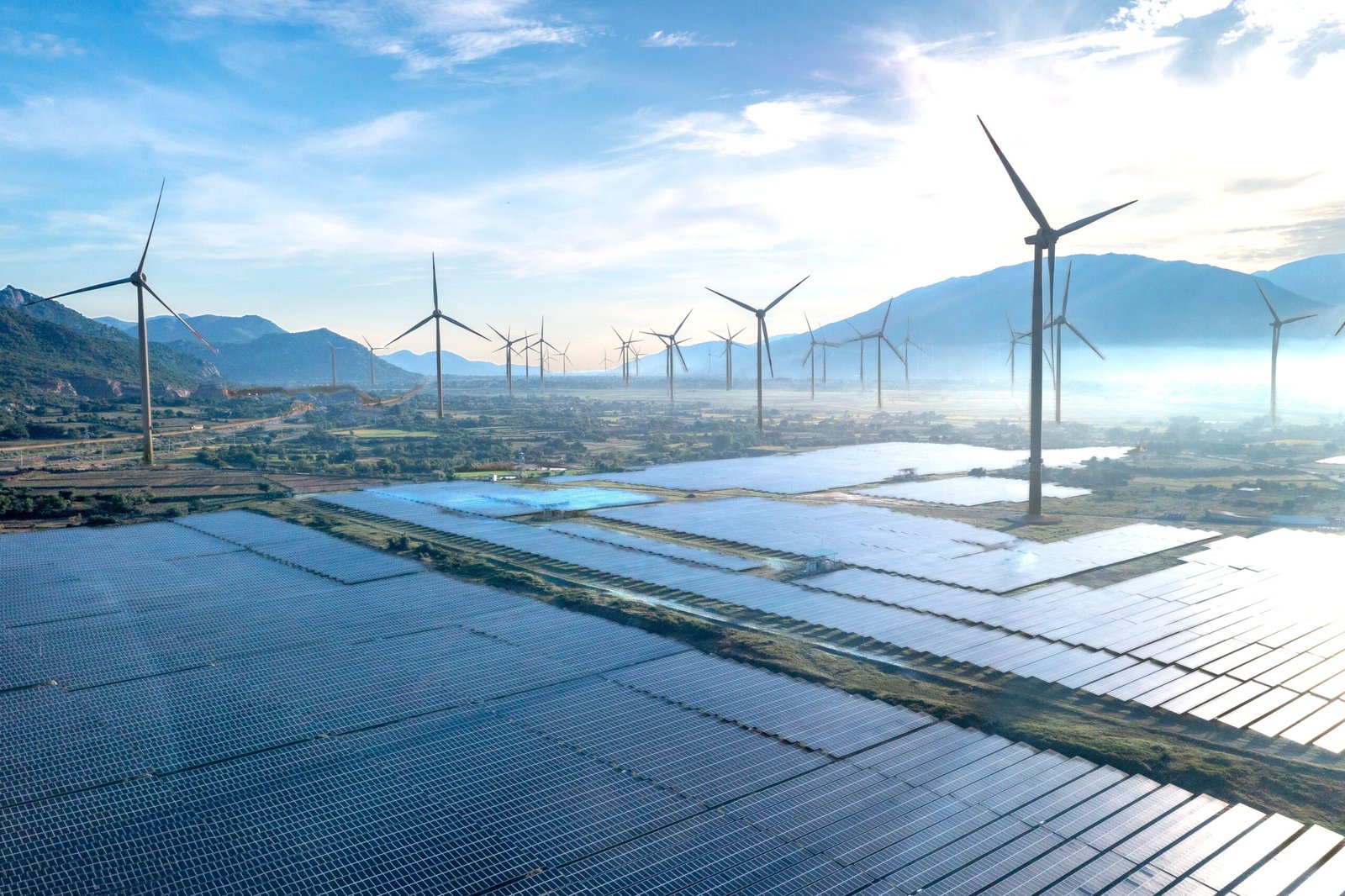
First, the good news: At 12:29 p.m. on July 13, India achieved a record 42.79% solar and wind power generation – the highest ever share of variable renewable energy (VRE) in the grid. Wind and solar together generated electricity at a rate of 103.7 GW, another record.
The think-tank CEEW describes India’s renewables success as a “double leapfrog”: expanding access to affordable power while decarbonising (read less coal) at the same time. Yet, as WRI India estimates, the Indian economy’s electricity demand is set to continue rising 6-7% annually until 2035.
Sun and wind aren’t enough.
Because, there’s intermittency
We all know the sun doesn’t shine at night, and wind doesn’t always blow exactly where and when people switch on their appliances. Solar generation spikes at midday – on a clear day, that is; and wind can be strong in the evenings or monsoon months.
But people’s lives don’t follow those patterns. As IEEFA research suggests, families cook, study and watch TV in the evening, when demand peaks. Demand also peaks in the afternoon in the hot parts of the country, when homes and offices turn on their air-conditioners. Industrial demand also peaks in the evening and at night. Also, summer sees seasonal spikes in demand for cooling, and hence, power.
What happens when all the solar and wind power produced isn’t used up, or when there’s electricity demand but no sun or wind?
Grid studies for India show that the power grid – the giant network of power producers, transmission infrastructure and electricity supply to users – faces tricky balancing acts:
- It suddenly needs a lot of extra power just as solar generation stops.
- Output surges and dips due to clouds, storms and monsoon winds.
- Regional imbalances arise, since the best solar and wind sites are concentrated in a few states (Rajasthan, Gujarat, Tamil Nadu, Karnataka), often far from the most power-hungry places, such as Delhi.
Enter: Storage
Storage is the most intuitive piece of the puzzle. It’s the grid’s power bank: charge when the sun is blazing or the wind is blowing, discharge when households light up and factories fire up.
Once you can hold the sun and wind for later, the dream of a round-the-clock clean-energy India becomes a possibility. Research from organizations such as CSTEP, CEEW and WRI India increasingly converges on a simple formula:
Storage + Smart grids + Demand flexibility = a 24×7 renewable India
What does storage look like in real life? Batteries are one form, of course: giant battery-energy storage systems (BESS). Pumped hydro is another – when energy is aplenty and cheap (off-peak), water is pumped from a lower reservoir to a higher one; when energy is in high demand, the water flows back down through turbines to generate electricity, much like a conventional hydropower plant. Projects to create pumped hydro storage capacity are underway across India – Upper Indravati in Odisha, Sharavathy in Karnataka, Bhivpuri in Maharashtra, etc., with developers including Adani Green and Greenko. Read about pumped hydro’s benefits over batteries here.
EV batteries are another grid-scale storage solution: currently, pilot projects in both vehicle-to-grid technology and second-life batteries are underway in India.
This future storage scenario is arriving fast. A 2025 analysis shows solar-plus-storage power can now be contracted at under ₹6/kWh, costing as low as conventional electricity from coal. But it’s not time to pop the champagne yet because only about 500 MWh of grid-scale BESS is currently operational – enough to power just one small Indian city.
Storage technology is ready. Scaling it in the real world is the challenge.
Smart grids: Teaching India’s power system to “think”
The grid is the electricity system’s operating system. The current grid was built for the coal era: when coal-fired thermal power plants sent one-way flows of electricity to millions of passive users. But in the not-so-distant future, electricity will also come from solar panels on rooftops, EV chargers in parking lots, batteries in homes, and wind farms far away. Power will move both ways.
This would require a new, smart grid, with sensors and smart meters to see what’s happening instantly; real-time data and forecasting to predict demand and supply; flexible transformers and inverters to manage changing power flows; and high-speed infrastructure to move electricity long distances smoothly.
In short, India’s grid must change from a simple highway into a smart, self-driving network.
Demand flexibility: Shaping demand to match natural rhythms
The third ingredient is perhaps most transformative: demand flexibility.
Usually, electricity demand arrives at the “wrong time” – evenings, sultry nights, peak summers. But if demand can be nudged, shaped and shifted slightly, India could do with far less storage and far fewer backup plants. Some cool ways to do this are:
- Electricity could be made cheaper at certain times, just like movie tickets are cheaper for morning shows. Use more power in the daytime when solar is plenty, and you pay less.
- Convince big users like factories to pause or shift heavy electricity use when the grid is under stress. In return, they get paid. It’s like you staying home during a traffic jam and earning free bus passes.
- With smart controls in industry, machines that cool warehouses, run motors or pump water can automatically slow down or speed up. Like an AC that knows when to chill harder and when to relax without anyone touching the remote.
- Smart EV charging would charge when clean power is abundant, such as sunny afternoons or windy nights.
So… could India actually run on sunshine, 24×7?
Technical feasibility
Integrating more than 900 GW of non-fossil capacity by 2035-36 (within the next 10 years) is technically feasible if the transmission network is built in advance, this report from the Central Electricity Authority says. It notes that solar and wind projects can be commissioned much faster than transmission infrastructure, and if transmission capacity isn’t built ahead of time, renewable projects risk being stranded – the power they generate cannot be “evacuated”.
Economics
Solar-plus-storage bids below Rs 6/kWh suggest that clean 24×7 power is no longer a fantasy but a market reality.
The economic cost for the government for enabling renewable integration is estimated at about Rs 7.93 lakh crore, for:
- about 1,37,500 circuit kilometres of new transmission lines
- about 8,27,600 MVA of additional substation capacity
The report treats transmission investment as an enabling investment rather than an avoidable cost.
It explicitly says implementation should be aligned with the pace of renewable deployment, but planning should happen ahead of time to avoid bottlenecks and provide certainty for project developers and other stakeholders.
But…
Coal currently handles most evening peaks, and new coal plants are planned to manage short-term reliability. And while the government is looking to build new storage projects, current deployment and grid upgrades are way behind what the 900-GW vision demands. (And some recent bids for building storage projects have quoted such low prices that experts have questioned whether they are even realistic.)
So the real answer?
Technically: increasingly yes.
Economically: rapidly getting there.
Institutionally: a long way to go.